
A little room to wonder
Bird Beaks & Structures
Bird beaks differ in length, width and shape. These structures can support different tasks, but a shape comparison needs evidence before it becomes a claim about diet, efficiency or the history of a species.
What can a length-to-width ratio tell you about a beak model, and what can it not tell you?
Describe the structure before its job
A beak can be described by measurable features such as length, depth, curvature and tip shape. Birds use beaks in different ways, and form can be related to tasks such as taking seeds or reaching food. A functional explanation needs more than naming a shape.
A University of Bristol-led study found that the relationship between beak shape and feeding is more complex than a simple shape-to-food rule. Our enquiry uses drawn outlines and invented dimensions to test what a limited comparison can establish, with no bird handling, feeding or collection of materials.
Worked example: compare fictional proportions
Two invented beak outlines are drawn at the same scale. A is twelve millimetres long and six wide; B is eighteen millimetres long and three wide. Using the stated length and maximum-width rule, A has a length-to-width ratio of 12/6 = two, while B has 18/3 = six.
B is three times as long relative to its width under this ratio, because six divided by two equals three. It is not three times as efficient, three times as strong or able to eat three times as much. Those are different quantities, not consequences of the ratio alone.
A function claim needs a suitable test
A drawing might suggest that a slender form can reach a narrow opening, but its performance would also depend on dimensions, material, movement and the task. An analogy with a tool is useful for generating a question, not proof that a living beak behaves exactly like that tool.
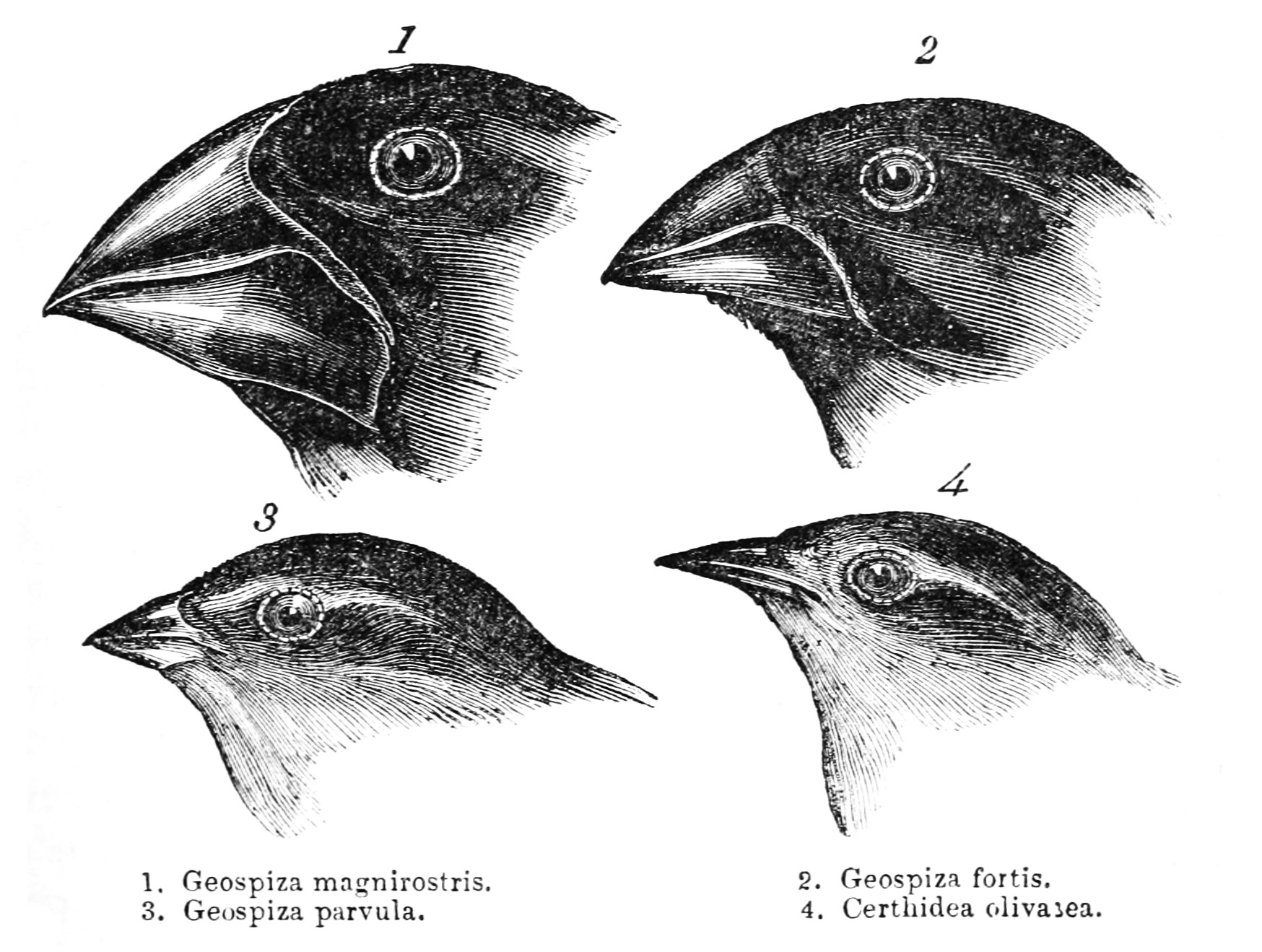
A still image may hide the far side or exaggerate proportions through viewpoint. The historical finch illustration makes shapes visible for comparison, but its species labels and artistic scale should not be treated as current measurement data. Our numerical outlines are independent of it.
Keep several explanations open
Similar beak shapes can be used in more than one way, and similar tasks can be achieved by different structures. An animal’s behaviour and surroundings also matter. Avoid turning a single visible feature into a complete account of its diet or evolutionary history.
A clear paper comparison names the measurement rule, reports a supported difference and proposes an additional observation that could test a function claim. That is more useful than inventing a confident story from the outline alone.
Only if you feel like trying
Compare two paper beaks
- Draw the two fictional outlines at the same scale and label their supplied length and maximum width.
- Calculate both ratios and their ratio-of-ratios. Write why relative slenderness is not a performance measurement.
- Sketch a fictional slot width and explain what further dimensions or evidence would be needed to test a reach claim.
Optional drawing or verbal comparison. Do not handle, feed, attract, trap or test anything on an animal.
Look at the sources.
These references offer further reading on the ideas here. Check who published them, what they support and what you would ask next.
- University of BristolBird beaks did not adapt to food types as previously thought
Research checked 1 November 2026. External pages have their own content and privacy practices.
Where could this connect?
These are editorial links between subjects. You choose which, if any, to follow.
Analogy & Comparison
A beak–tool analogy can suggest a question while leaving important differences unresolved.
Follow this connection
Ratio & Proportion
A ratio compares stated dimensions; it does not automatically measure function.
Follow this connectionZoology
Zoology relates animal structures to their functions; comparing beak shapes invites testable questions without assuming one visible trait explains an entire animal.
Follow this connection