
A little room to wonder
Grouping Animals with Keys
An identification key asks a sequence of feature questions. It works only for the items and observations it was designed to distinguish, so an unknown or unmatched result is sometimes the most accurate answer.
How can a key be logically clear but fail on an animal whose relevant feature is hidden?
A key is a decision tool
A key directs a reader through criteria until an item can be distinguished within its defined set. A paired choice might ask whether a labelled feature is present or absent. The wording must avoid ambiguous terms such as big unless a threshold or comparison is supplied.
Science Learning Hub describes developing and revising classification systems when information or purposes change. An identification key is not automatically a family tree of evolutionary relationships. A convenient visible feature can separate cards without establishing their ancestry.
Worked example: four fictional animal cards
Use four invented model descriptions, not real species: A has wings and antennae; B has wings and no antennae; C has no wings and six legs; D has no wings and eight legs. First ask whether wings are present. In the yes branch, antennae distinguish A from B. In the no branch, the stated leg count distinguishes C from D.
Each card reaches one label after two decisions. But an invented E with no wings and four legs reaches neither C nor D; the key needs an unmatched outcome. An F whose wings are obscured cannot answer the first question. Unknown is not the same as no, and should not be forced down the no-wings branch.
Test the rules against every card
A key can fail through overlapping questions, missing outcomes or a feature that is difficult to observe. Run every supplied card through each decision and record the path. Changing the order might still identify all four original cards, while changing the observations can expose a weakness.
The number of visible legs in one photograph may be smaller than the animal’s actual number because parts are hidden. Reference information and a more complete view may help, but do not invent an observation just to reach a desired endpoint.
Keep purpose and scope attached
Label the key as intended for A to D, with unknown and unmatched outcomes retained. A successful test on four invented cards does not make it a universal animal identifier. Nor does it authorise a reader to handle an animal to expose a hidden feature.
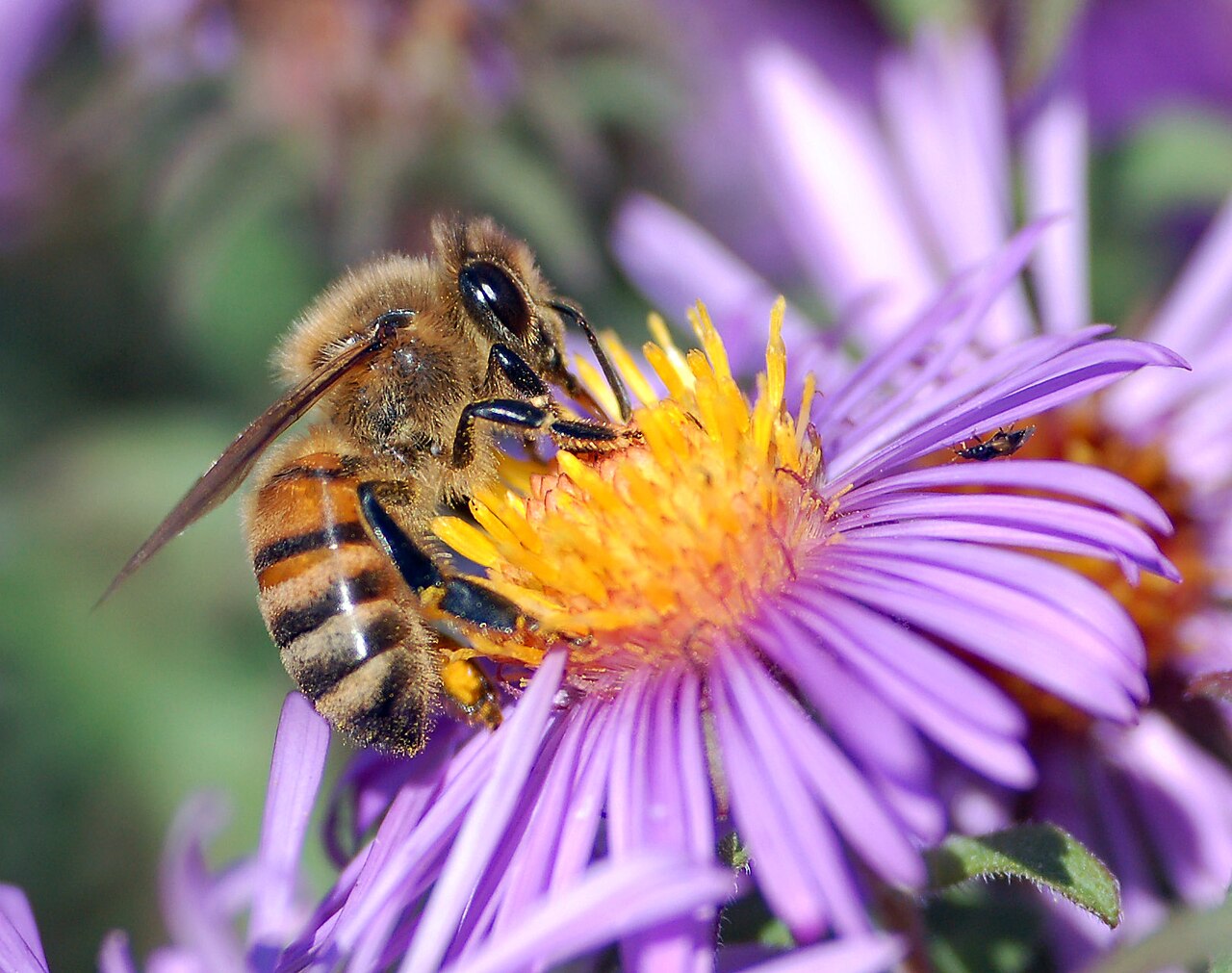
A paper key can be useful, revised and explained without identifying any living organism. The bee photograph offers a real example of obscured body parts; it is not an extra card with all features available. A clear limit is part of a good tool.
Only if you feel like trying
Test a branching paper key
- Make the four fictional cards and draw the two-level key described in the example. Trace every card to its label.
- Add E with no wings and four legs, then F with wings not visible. Create separate unmatched and unknown outcomes.
- Change the first question and test all six descriptions again. State the scope and one observation the key requires.
Optional fictional card exercise. No specimen collection, animal handling, online identification submission or real-species certification.
Look at the sources.
These references offer further reading on the ideas here. Check who published them, what they support and what you would ask next.
- Science Learning Hub, University of WaikatoDevelop a classification system
Research checked 1 November 2026. External pages have their own content and privacy practices.
Where could this connect?
These are editorial links between subjects. You choose which, if any, to follow.
Algorithms & Debugging
Tracing each input through every branch reveals omitted and ambiguous outcomes.
Follow this connection
Categories & Counterexamples
An unmatched example tests the stated scope of a grouping rule.
Follow this connectionZoology
Zoology uses observable criteria to identify and group animals; a key makes a sequence of decisions explicit and should allow uncertainty.
Follow this connection