
A little room to wonder
Concepts & Definitions
A definition makes a term usable within a stated context. Test its criteria against examples instead of relying on a familiar-looking picture.
What must something satisfy before your chosen label applies?
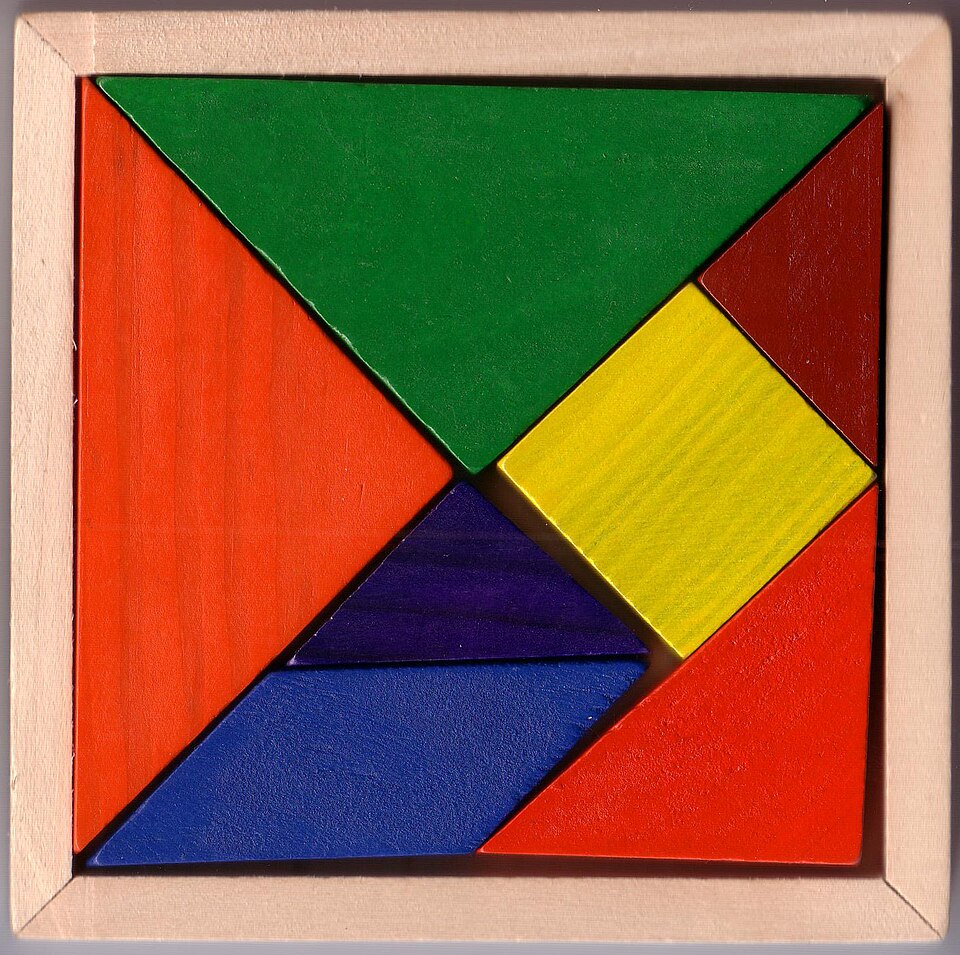
Give the word a job
A label can group things without explaining the grouping rule. A definition supplies criteria for how a term is being used. In a paper game, the author can introduce a new term and state its rule. In another context, an established term may already have a convention that needs to be checked.
A description need not be a definition. Saying that a tile is blue describes one feature; it does not settle whether every blue object is that kind of tile. Ask which features the proposed rule requires and which merely happen to appear in the example.
Worked example: define an invented tile category
An invented game defines a sun tile as a blue, four-sided tile. Card A is a blue triangle, B a blue quadrilateral, C a yellow quadrilateral and D a blue circle. Only B satisfies both stated conditions. A and D meet the colour condition; C meets the side-count condition. One condition alone is insufficient.
Change the definition to a blue tile or a four-sided tile. Now all four qualify. The cards have not changed; the connective has. Record the revised wording rather than claiming that the earlier sorting was mistaken under its original rule.
Check both boundaries
A useful test includes a clear example and a near miss. If an intended example is excluded, the definition may be too narrow for the purpose. If an unintended case qualifies, it may be too broad. Those judgements require a stated purpose, not just a preference for one result.
Mathematical categories can be nested. Under the usual definition of a rectangle by four right angles, a square remains a rectangle. Extra properties can identify a special case without removing it from the broader category. A typical sketch is not the category boundary.
Keep the rule and observation separate
Inventing a label does not establish a fact about nature. The game author may define sun tile, but deciding whether a real drawing has four straight sides still involves examining it. If an edge is hidden, the honest answer can be not enough information.
Use a short rule, test cases and a revision note. This keeps clarification manageable: another reader can identify whether they dispute the definition, a recorded feature or the result of applying the rule. No personal labels are needed.
Only if you feel like trying
Test a definition
- Write the original sun-tile rule and draw or label the four supplied cards.
- Sort them using and, then repeat using or. Keep both rules visible.
- Add one uncertain card with a hidden edge. State which observation would settle its classification.
Optional paper or spoken reasoning with supplied fictional examples. No personal beliefs, experiences, accounts, purchases or public sharing are required.
Look at the sources.
These references offer further reading on the ideas here. Check who published them, what they support and what you would ask next.
- NRICH, University of CambridgeCompleting Quadrilaterals
Research checked 1 November 2026. External pages have their own content and privacy practices.
Where could this connect?
These are editorial links between subjects. You choose which, if any, to follow.
Categories & Counterexamples
A near miss or counterexample tests the boundary created by your definition.
Follow this connection
Philosophy
Philosophy uses clear terms so a disagreement about a rule can be separated from a disagreement about its application.
Follow this connectionRules & Mechanics
A game term needs a usable rule before a player can apply it consistently.
Follow this connection