
A little room to wonder
Leaf Shapes & Veins
Compare leaf outlines and vein arrangements with explicit descriptions, while keeping a drawing separate from a species identification.
Which leaf features are useful to describe, and what can they actually tell us?
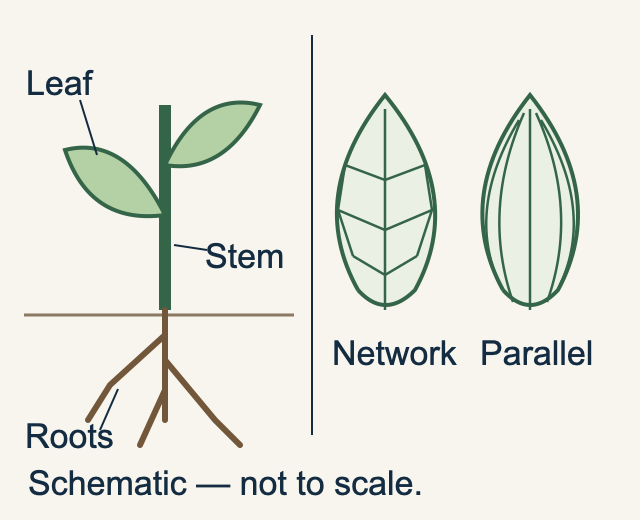 Launch Horizon HQ · Source · Original Horizon diagram
Describe more than a green outline
A leaf blade, or lamina, is the broad part of a typical leaf. Its margin is the edge; a midrib is a main vein; the petiole, when present, connects the blade to the stem. These names separate parts that a quick outline can easily merge.
A description might record a narrow blade, a smooth margin and visible branching veins. It should distinguish what was visible from what was hidden or too small to resolve. A clear description can be useful without assigning a species name.
Read veins as a transport arrangement
Leaf veins contain transport tissues. Some visible vein arrangements are roughly parallel, others form branching networks, and some fork repeatedly. The schematic gives two simplified patterns; real leaves have finer structures and variations that are left out.
A broad pattern can guide a question, but it is not an infallible identification key or a direct reading of habitat. Related plants can differ, and unrelated plants can share features. A pattern is one piece of evidence to compare with other characteristics.
Worked example: compare shape without changing size
Two fictional leaf drawings have blade dimensions A: 72 mm long and 24 mm wide; B: 60 mm long and 30 mm wide. A’s length-to-width ratio is 72/24 = 3, while B’s is 60/30 = 2. A is proportionally narrower under this measurement rule.
If A is enlarged by a factor of two, its drawing becomes 144 mm by 48 mm and still has a ratio of 3. The proportional description survives resizing; its printed dimensions do not. Neither the ratio nor the fictional labels identify an actual plant.
Keep the measurement rule visible
Define whether length includes the petiole, where maximum width is measured and whether a curled outline has been flattened in a drawing. Changing the rule halfway through can create an apparent difference that belongs to the measurement method rather than the leaf.
The optional task uses invented outlines. No collecting or touching plants is required. A labelled drawing can communicate blade shape and venation more honestly than a confident species guess based on one blurry photograph.
Only if you feel like trying
Make a two-leaf description key
- Draw the two supplied fictional blades with their dimensions and add one chosen vein pattern to each.
- Write three visible features for each, keeping the length-to-width ratio separate from absolute size.
- Change one measurement rule and explain which comparison would need to be repeated.
Optional. Use paper or talk through the supplied fictional example. No purchase, personal information, account, public sharing or practical experiment is needed.
Look at the sources.
These references offer further reading on the ideas here. Check who published them, what they support and what you would ask next.
- OpenStax / Rice University30.4 Leaves
Research checked 1 November 2026. External pages have their own content and privacy practices.
Where could this connect?
These are editorial links between subjects. You choose which, if any, to follow.
Biology
Leaf descriptions connect plant structures with evidence about their form and function.
Follow this connection
Drawing & Observation
An observational description separates measured proportions from a familiar object label.
Follow this connectionRatio & Proportion
A length-to-width ratio can preserve a shape comparison while the whole drawing changes size.
Follow this connection