
A little room to wonder
Biology
Biology studies living things, from individual cells to whole organisms. It asks how they function, reproduce, vary and relate to one another.
How can looking at a different scale change a question about a living thing?
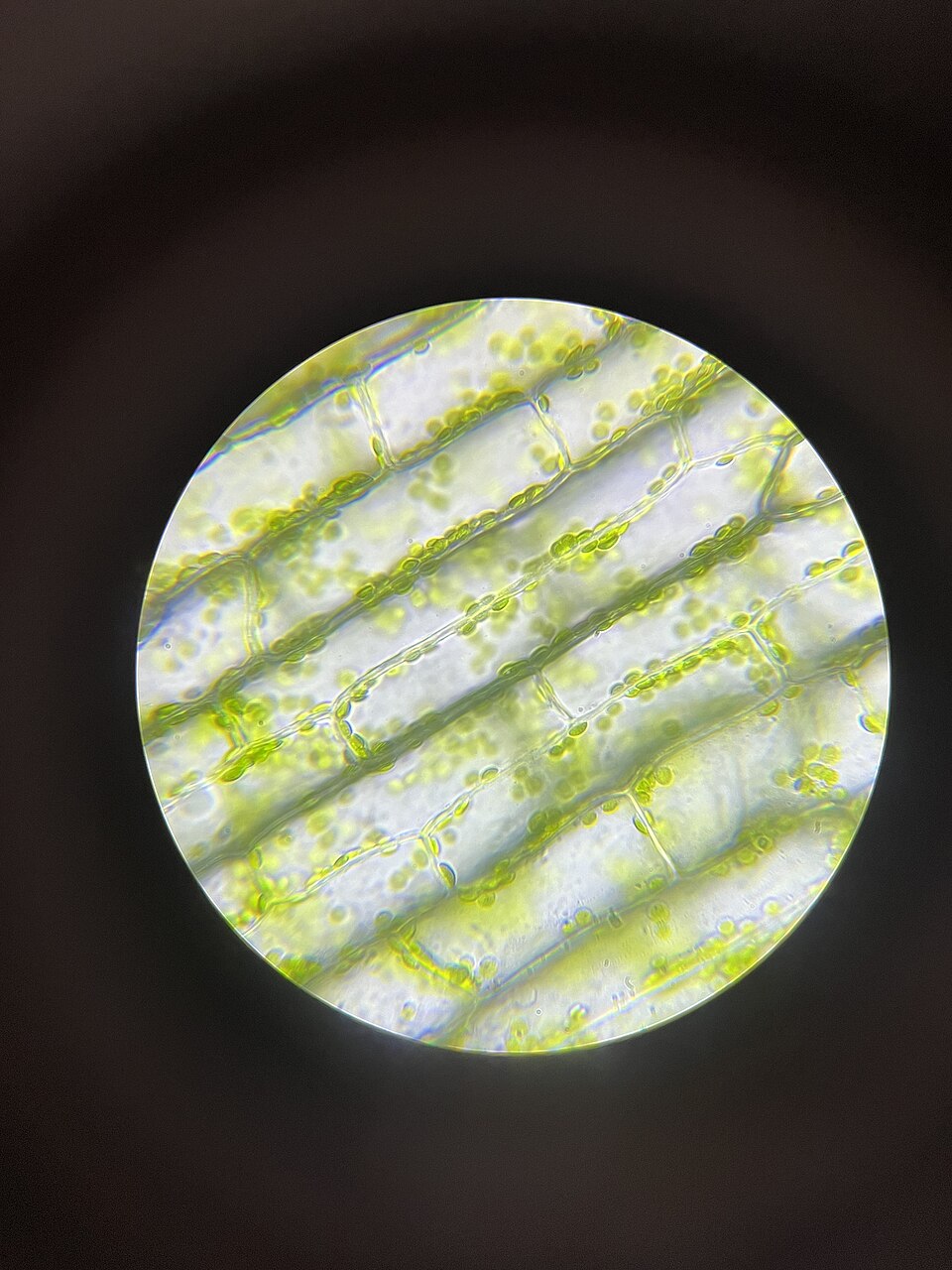
Cells are a starting point
Cells are the basic units of living things. Some organisms consist of one cell; others contain many cells with different roles. Most plant and animal cells have a nucleus and membrane-bound internal structures, while bacteria belong to a different cellular group without a nucleus. One familiar cell drawing cannot represent every kind of life.
Structure and function
A cell’s parts help it perform particular jobs. A microscope reveals features that are invisible to an unaided eye, but the image is still evidence to interpret. In this plant image, repeated boundaries and green structures are visible. A labelled diagram can help explain them, while a photograph shows how untidy a real sample can look.
Grouping helps us ask questions
Classification groups organisms using shared characteristics and relationships. Taxonomy includes describing, naming and classifying life. A first guess based on appearance can be a useful starting question, but identification needs checking: organisms that look similar are not automatically the same species. Record uncertainty rather than inventing a confident name.
Only if you feel like trying
Make an observation before a label
- Look at the microscope photograph and draw three shapes or patterns you can actually see.
- Use one colour for observations and another for questions or possible explanations.
- Choose one question to check against the cell reference in Sources. You do not need to collect a sample.
Optional image-based activity. Do not culture microbes, handle unknown organisms or use sharp preparation tools for this task.
Look at the sources.
These references informed this introduction. You can check who published them, what evidence they use and whether you would ask another question.
- US National Human Genome Research InstituteCell
- Australian MuseumWhat is classification?
- NSW Department of EducationCell structure and function
Research checked 1 November 2026. External pages have their own content and privacy practices.
Where could this connect?
These are editorial links between subjects. You choose which, if any, to follow.
Cells & Microscopy
Cell organisation connects small structures with the functions of living organisms.
Follow this connection
Chemistry
Living cells contain substances whose structures and interactions make biological processes possible.
Follow this connectionDNA, Inheritance & Variation
Inheritance connects cellular information with variation across generations.
Follow this connectionEcology
The same organism can be studied as an individual and as part of a network of living and physical surroundings.
Follow this connectionEvolution & Adaptation
Inherited variation and reproduction connect individual organisms with changes in populations.
Follow this connectionPlants & Photosynthesis
Chloroplasts and cellular processes connect plant structure with the making and use of organic molecules.
Follow this connectionZoology
Zoology focuses biological questions on animals: their bodies, behaviour and relationships.
Follow this connection