
A little room to wonder
Ecology
Ecology studies relationships between living things and their surroundings. It asks what changes when one part of a living system changes.
Which relationships would I miss if I studied only one organism?
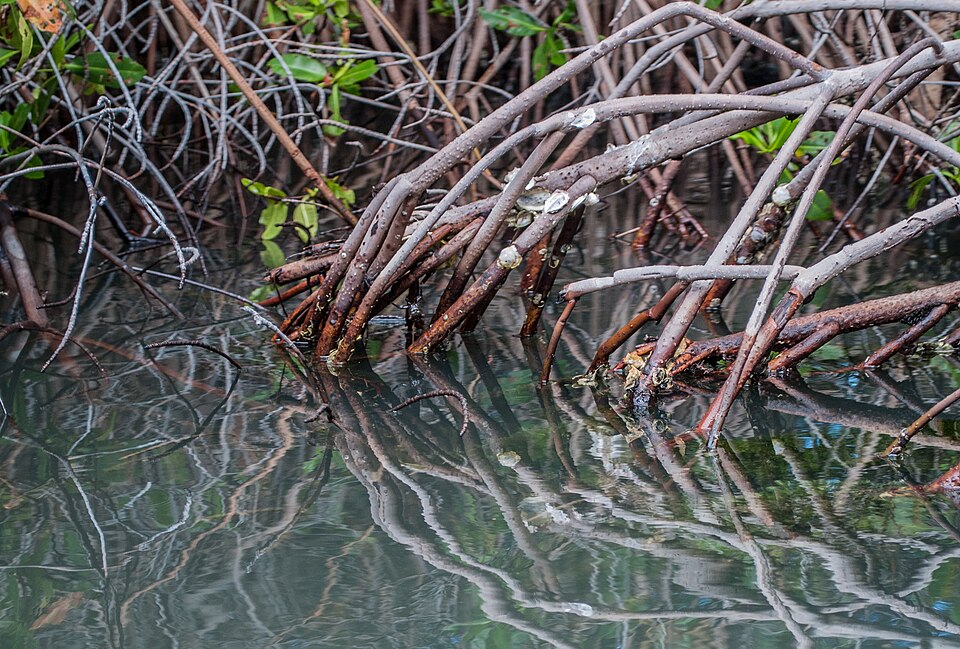
An ecosystem includes the surroundings
An ecosystem brings together a community of organisms and the physical environment they interact with. It can be as large as a forest or as small as a pond. Water, light and temperature belong in the picture alongside living things; a list of species alone does not describe the whole system.
Biodiversity has several scales
Biodiversity includes variation in genes, the variety of species and the variety of ecosystems. Counting species answers one question, but it does not capture all three levels. Two places with similar species counts can still have different habitats and relationships, so be clear about what a comparison measures.
Observe without overstating
The mangrove photograph shows roots and water together. It can prompt questions about shelter and changing water conditions, but a photograph alone cannot establish every species or interaction present. Record what you observed, where and when it was observed, and which explanations still need checking. One visit is a snapshot, not a complete ecological survey.
Only if you feel like trying
Map relationships from a window
- Choose a view you can observe safely without entering a habitat, or use the photograph.
- Draw three living features or visible plant parts and two physical features. Mark uncertain identifications as unknown.
- Add arrows labelled “possible relationship” and choose one that would need evidence.
Optional observation or drawing. Stay on safe access routes; do not disturb wildlife, enter water or collect organisms.
Look at the sources.
These references informed this introduction. You can check who published them, what evidence they use and whether you would ask another question.
- Australian MuseumWhat is biodiversity?
- Australian MuseumBiodiversity
Research checked 1 November 2026. External pages have their own content and privacy practices.
Where could this connect?
These are editorial links between subjects. You choose which, if any, to follow.
Biodiversity & Conservation
Biodiversity describes variation across the organisms and systems whose relationships ecology studies.
Follow this connection
Biology
Cellular and organism-level knowledge helps explain what different living things need and do.
Follow this connectionEcosystem Change & Restoration
Restoration uses ecological relationships to define recovery goals and interpret changes.
Follow this connectionFood Webs & Energy
Food webs organise relationships among organisms while linking them with the non-living environment.
Follow this connectionGeography
Land, water, climate and human decisions shape where habitats occur.
Follow this connectionHabitats & Niches
Habitat and niche distinguish an organism’s setting from the relationships that support its life.
Follow this connectionZoology
Animal behaviour becomes easier to understand when food, shelter and other organisms are considered.
Follow this connection