
A little room to wonder
Habitats & Niches
A habitat describes where an organism lives. Its niche concerns the conditions, resources and interactions through which it lives there.
How can two species share a place without using it in exactly the same way?
Separate the place from the relationships
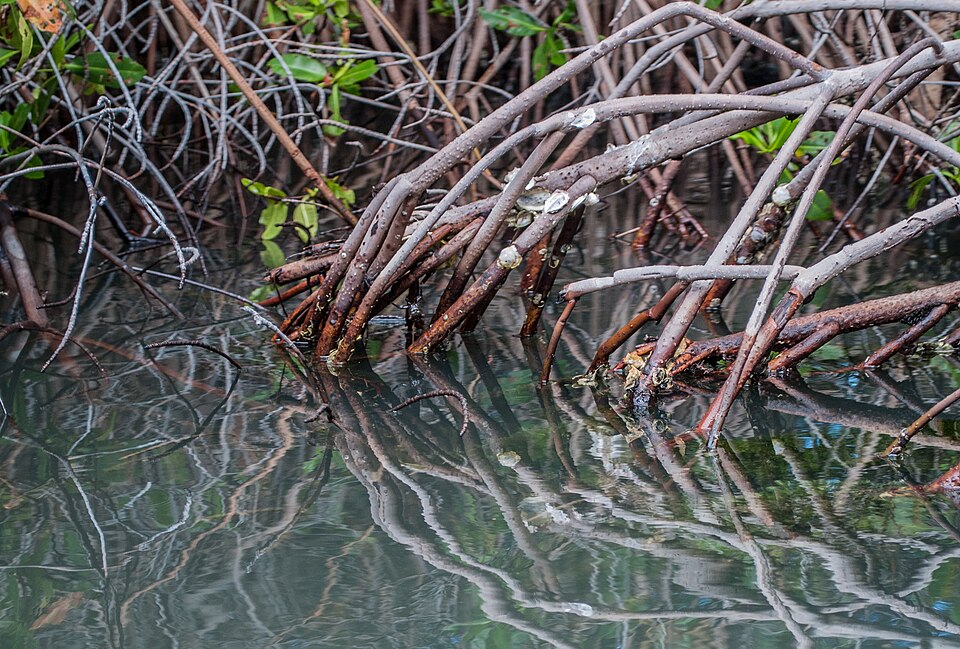
A habitat can be a mangrove area, stream, forest or another setting that provides conditions and resources. It is more than a location name: water, temperature, shelter and other features influence whether an organism can live there.
A niche describes how an organism relates to those conditions and resources, including interactions with other organisms. Calling it a “job” can be a memory aid, but organisms do not have assigned occupations or a duty to keep an ecosystem balanced.
Look at several dimensions
Two species may use the same habitat but feed at different times, take different foods or occupy different parts of it. These differences can reduce overlap in their resource use. Where limited resources overlap, competition may affect survival and reproduction.
A single characteristic rarely describes the whole niche. Seeing two birds in the same tree does not establish that they have identical diets, nesting needs or activity patterns. Describe the observed use and keep unobserved relationships open.
Worked example: a fictional pond comparison
Imagine species A and B living beside the same pond. Over a defined set of fictional observations, A feeds on floating seeds at dawn near the edge; B takes small bottom-dwelling animals during the middle of the day. They share the pond habitat, while the recorded feeding places, times and resources differ.
Now the pond becomes much shallower. It is reasonable to ask whether B’s feeding area changes, but it is not enough to conclude that A must benefit or that B must disappear. Both species might depend on an unrecorded shelter, and the shallow water may affect their food resources. The comparison helps identify questions; it does not supply a complete future population model.
Bound a claim by the observation
An observed pattern needs a time and sampling context. “B fed at midday during these observations” is narrower and better supported than “B only ever feeds at midday”. A more complete study might compare seasons or conditions while avoiding disturbance.
An empty observation is not automatically proof that a species is absent; an organism may be difficult to detect. Use fictional records, published observations or a safe view from an existing location. Do not enter water, move nests, remove logs or handle animals to answer the exercise.
Only if you feel like trying
Add a missing column
- Make a table for the two fictional pond species with place, time and resource columns.
- Add one unmeasured factor that could matter, such as shelter or water depth.
- Write a testable question that does not pretend the existing table already contains the answer.
Optional. Work on paper, point to the example or talk it through. No account, purchase or public sharing is needed.
Look at the sources.
These references informed this introduction. You can check who published them, what evidence they use and whether you would ask another question.
- OpenStax, Rice UniversityBiology 2e: The Scope of Ecology
- OpenStax, Rice UniversityBiology 2e: Community Ecology
Research checked 1 November 2026. External pages have their own content and privacy practices.
Where could this connect?
These are editorial links between subjects. You choose which, if any, to follow.
Ecology
Habitat and niche distinguish an organism’s setting from the relationships that support its life.
Follow this connection
Evolution & Adaptation
Inherited differences can matter differently under particular environmental and resource conditions.
Follow this connectionMaps & Scale
A map can locate habitat features while needing other evidence to describe how organisms use them.
Follow this connection