
A little room to wonder
Chemistry
Chemistry explores what substances are made of, how their particles are arranged and how substances change. A particle model can explain something you cannot see directly.
How does a particle model explain the difference between a mixture and a new substance?
Atoms, molecules and ions
An atom is a unit of a chemical element. A molecule contains two or more bonded atoms and is electrically neutral. An ion has an electrical charge. These terms are not interchangeable: not every substance consists of separate molecules. Choosing precise words helps prevent a model from creating a misconception.
Arrangement matters
Two materials can contain some of the same elements and still behave differently because their particles are arranged or bonded differently. A mixture brings substances together without necessarily making a new substance. In a chemical reaction, atoms are rearranged as substances change; the atoms are not simply used up and lost.
Models need a key
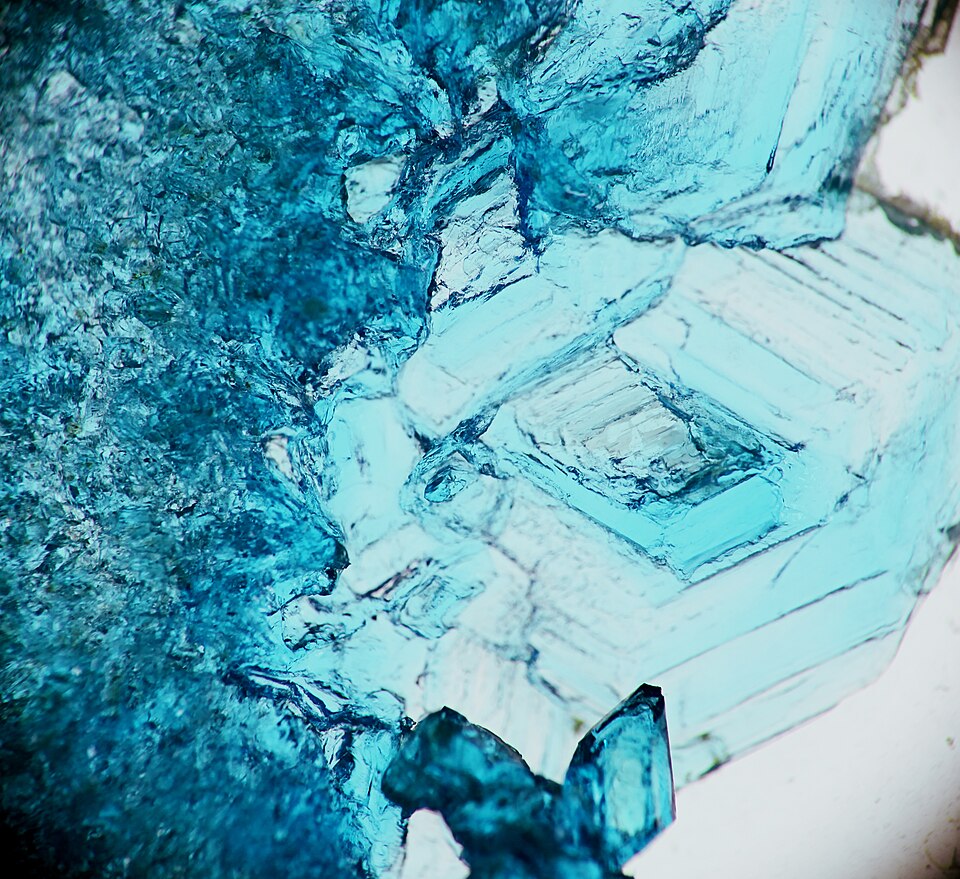
Coloured circles can stand for different atoms, but the colours are a code you choose, not the atoms’ real colours. Lines may represent bonds. Include a key and say what the model leaves out, such as three-dimensional arrangement or particle size. A photograph of crystals shows a material’s appearance, not individual atoms.
Only if you feel like trying
Rearrange atoms on paper
- Draw two pairs labelled H–H and one pair labelled O–O. Explain that H and O are different elements.
- Redraw the same four H labels and two O labels as two H–O–H groups.
- Count before and after. What stayed the same, and what changed in the arrangement?
Optional symbolic model of a reaction, not an experiment. Do not mix, taste or heat chemicals; the crystal photograph is not an invitation to handle copper sulfate.
Look at the sources.
These references informed this introduction. You can check who published them, what evidence they use and whether you would ask another question.
- Royal Society of ChemistryAtoms, molecules and ions
- Royal Society of ChemistryInterpreting chemical equations: teacher guidance
Research checked 1 November 2026. External pages have their own content and privacy practices.
Where could this connect?
These are editorial links between subjects. You choose which, if any, to follow.
Atoms & the Periodic Table
Elements and atoms provide the identities used to describe chemical substances and transformations.
Follow this connection
Biology
Cells depend on chemical substances and reactions, so particle models can help explain living processes.
Follow this connectionEngineering
Choosing a material means considering its properties and how it may change in use.
Follow this connectionMolecules & Bonding
Bonding connects atomic identities with the structures and properties of substances.
Follow this connectionPhysics
Electrical charge and energy help explain interactions between particles.
Follow this connectionReactions & Conservation
Reaction models explain how substances change while conserving their constituent atoms.
Follow this connectionStates & Changes of Matter
States describe how a substance is organised without necessarily changing its chemical identity.
Follow this connection