
A little room to wonder
Atoms & the Periodic Table
An element’s identity depends on its proton count. The periodic table organises those identities and reveals recurring patterns without making every atom identical.
Which change makes a different element, and which change makes an isotope or ion?
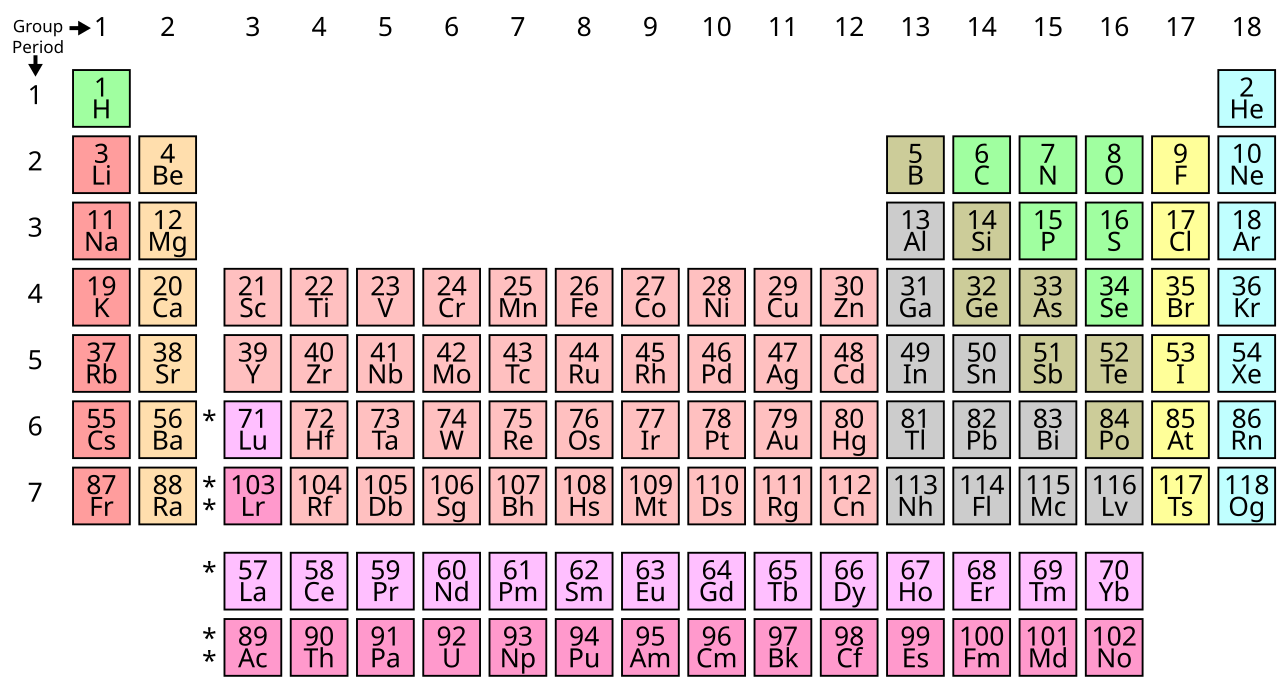 Offnfopt · Source · Public domain
Count the particles with different jobs
An atom contains a small nucleus with protons and usually neutrons, surrounded by electrons. Protons have positive charge; electrons have negative charge; neutrons have no electrical charge. A neutral atom has equal numbers of protons and electrons.
Atomic number is the number of protons. Every carbon atom has 6 protons, for example. Changing an atom’s proton count changes its element identity. Changing the neutron count gives a different isotope of the same element; changing the electron count can give a charged ion.
Read the table’s organisation
The periodic table orders elements by increasing atomic number. Horizontal rows are periods and vertical columns are groups. Elements within a group often show related chemical behaviour, which makes the arrangement useful for forming and checking predictions.
An element’s symbol is a compact identifier, with the first letter capitalised and any second letter lower-case. The number shown as atomic mass on many tables is often an average reflecting isotopes. It should not be confused with the integer proton count or the mass number of one particular isotope.
Worked example: three lithium records
Consider a fictional set of records using actual particle definitions. Record A has 3 protons, 4 neutrons and 3 electrons. Its atomic number is 3, so it is lithium. Its mass number, counting protons plus neutrons, is 7. Its net charge is zero because +3 and −3 balance.
Record B has 3 protons, 3 neutrons and 3 electrons. It is still lithium but has mass number 6: a different isotope. Record C has 3 protons, 4 neutrons and 2 electrons. Its nucleus is like A’s, but the charges sum to +1, so it is a lithium ion. None of these electron or neutron changes turns lithium into another element.
Pictures simplify a much smaller structure
Ball-and-orbit drawings help organise counts, but electrons are not tiny planets following painted rings. A model’s colours are conventions rather than the natural visible colours of individual atoms. The spacing and scale in classroom diagrams are also greatly simplified.
The periodic table offers patterns, not a licence to handle substances based on their column or colour. An element and a compound containing that element can have very different properties. Work with symbols and records here; no chemical samples are needed.
Only if you feel like trying
Track all the particle-count changes
- Make a paper record for an atom with 6 protons, 6 neutrons and 6 electrons.
- Create three new records: change only a neutron count, only an electron count, then only the proton count.
- Compare element identity, mass number and net charge in every record. Changing protons while keeping electrons fixed changes both element and charge; the labels can overlap. Identify the pair that are isotopes of the same element.
Optional. Work on paper, point to the example or talk it through. No account, purchase or public sharing is needed.
Look at the sources.
These references informed this introduction. You can check who published them, what evidence they use and whether you would ask another question.
- OpenStax, Rice UniversityChemistry 2e: Atomic Structure and Symbolism
- OpenStax, Rice UniversityChemistry 2e: The Periodic Table
Research checked 1 November 2026. External pages have their own content and privacy practices.
Where could this connect?
These are editorial links between subjects. You choose which, if any, to follow.
Chemistry
Elements and atoms provide the identities used to describe chemical substances and transformations.
Follow this connection
Patterns & Algebra
A periodic pattern helps organise related behaviour while keeping the underlying number rule explicit.
Follow this connectionStars & Starlight
The elements found in stars connect atomic structure with evidence carried by their light.
Follow this connection