
A little room to wonder
Stars & Starlight
A star’s light carries clues about its properties. Apparent brightness, surface temperature and total energy output answer different questions.
Does a brighter-looking star have to be hotter or more powerful?
A star is a physical object with a history
Stars form from collapsing regions of gas and dust. During the main-sequence stage, fusion of hydrogen into helium releases energy in the interior. Our Sun is a star in this stage. A star is not a lump of ordinary material burning in oxygen like a campfire.
Mass strongly influences a star’s development. Very massive stars use their available fuel rapidly, while less massive stars can remain on the main sequence much longer. There is no single lifetime that applies to every star, and a star changes as it ages.
Distinguish temperature from brightness
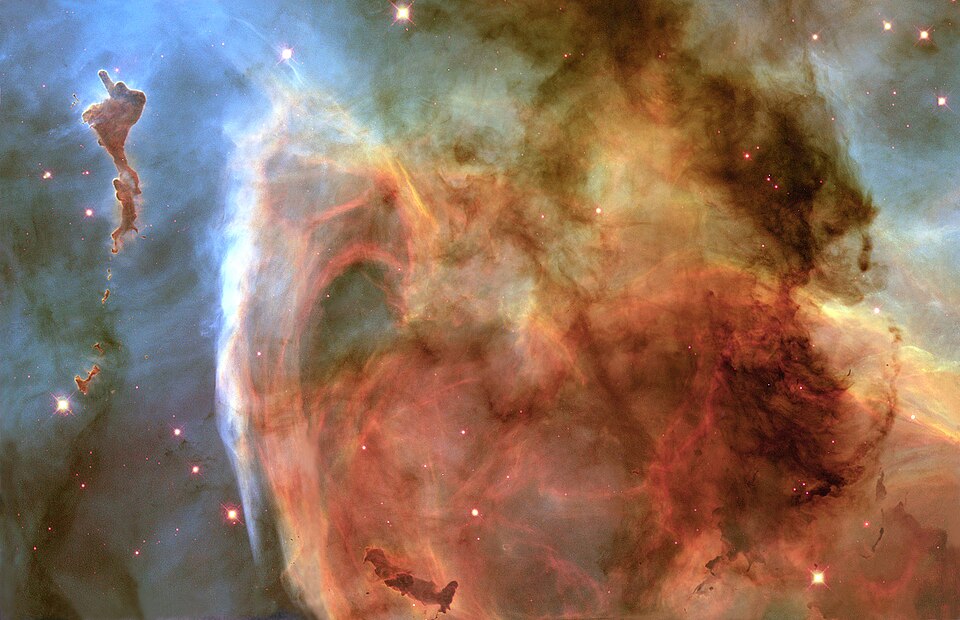
A star’s surface temperature affects the distribution of the light it emits. Among stars, blue-white generally indicates a hotter surface than red. This differs from everyday diagrams that use red as a symbol for heat. The colour in a processed astronomical picture may also represent selected wavelength bands, so read its explanation.
Luminosity means the total energy emitted per unit time. Apparent brightness is what reaches an observer from a particular direction and distance. Distance and intervening material affect that received light, so apparent brightness alone cannot settle luminosity or temperature.
Worked example: read three fictional records
An invented observing sheet lists A: reddish, 4,000 kelvin, detector count 80; B: blue-white, 10,000 kelvin, count 20; C: reddish, 4,000 kelvin, count 10. Assume the counts were measured with the same instrument, exposure and filter. B has the hottest listed surface even though A has the largest received count.
A and C share the listed temperature but produce different counts. Possible explanations include different distances or sizes; these records do not distinguish them. Ranking the counts gives A, B, C. Ranking the temperatures puts B first and ties A with C. Keeping those rankings separate prevents “brightest here” becoming “hottest” without evidence.
Check the observation before the explanation
Instrument settings matter. A longer exposure can collect more signal without the star changing. Comparing pictures made with different settings is not the same as measuring a change in a star. A useful record states the filter, exposure and conditions alongside the result.
You can investigate starlight using supplied images and fictional data. No night outing or equipment is required. Never look at the Sun through binoculars, a telescope or an improvised filter; ordinary sunglasses do not make direct solar viewing safe.
Only if you feel like trying
Make two rankings
- Copy the three fictional records, or read them aloud. Rank their detector counts and temperatures separately.
- Choose one pair and write exactly what the data establishes.
- Name one missing measurement that would help investigate the differing counts.
Optional. Work on paper, point to the example or talk it through. No account, purchase or public sharing is needed.
Look at the sources.
These references informed this introduction. You can check who published them, what evidence they use and whether you would ask another question.
- NASA ScienceStars
- NASA ScienceTypes of Stars
- NASA ScienceHubble Design
Research checked 1 November 2026. External pages have their own content and privacy practices.
Where could this connect?
These are editorial links between subjects. You choose which, if any, to follow.
Astronomy
Starlight is evidence used to investigate objects beyond direct physical reach.
Follow this connection
Light & Optics
Temperature, wavelength and the way an instrument collects light affect an observation.
Follow this connectionStatistics & Data
Comparisons require consistent measurement conditions and clearly defined quantities.
Follow this connection