
A little room to wonder
Astronomy
Astronomy investigates objects and processes beyond Earth. It connects observations with models that help explain how worlds and larger systems behave.
What can a model of space show clearly, and what might it hide?
Systems within systems
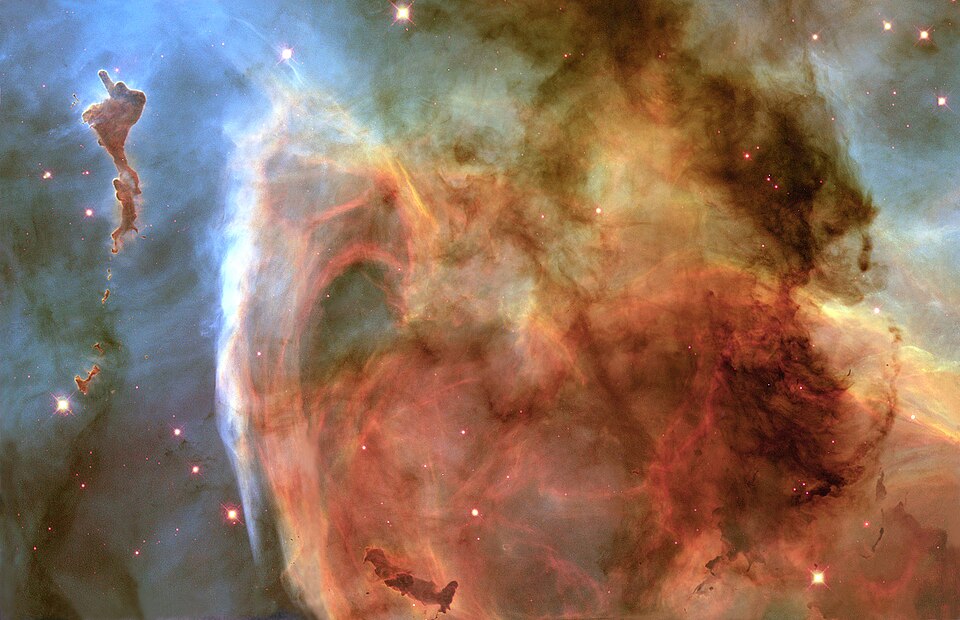
The Solar System includes the Sun, eight planets, their moons and many smaller bodies. The Sun is a star; Earth is a planet orbiting it. Our Solar System belongs to the Milky Way galaxy. A nebula, such as the one pictured here, is a cloud of gas and dust, not another name for a planet. Outward from the Sun, the planets are Mercury, Venus, Earth, Mars, Jupiter, Saturn, Uranus and Neptune.
Names depend on definitions
Astronomers classify objects using shared definitions. The Solar System’s eight planets meet criteria that include orbiting the Sun and gravitationally dominating their orbital neighbourhoods. Pluto is classified as a dwarf planet. A category tells you which definition an object meets, rather than how interesting or valuable it is.
Scale is part of the explanation
A neat row of equally spaced planets is convenient to read but does not represent their real distances. Models often simplify size, spacing or motion. Ask what a diagram is designed to explain and which features are not to scale. A useful model states its limits instead of hiding them.
Only if you feel like trying
Make the missing scale visible
- Sketch the Sun and the eight planets in the order named above; use labels rather than trying to show their real sizes.
- Add “sizes and distances not to scale” to the drawing.
- Choose one distance or size comparison you would need to check before making a scale model.
Optional paper activity. Never look directly at the Sun or point binoculars or a telescope at it.
Look at the sources.
These references informed this introduction. You can check who published them, what evidence they use and whether you would ask another question.
- NASA ScienceSolar System Facts
- NASA Jet Propulsion LaboratoryPlanets
Research checked 1 November 2026. External pages have their own content and privacy practices.
Where could this connect?
These are editorial links between subjects. You choose which, if any, to follow.
Galaxies & Cosmic Scale
Galaxies place individual stars and planetary systems within a larger cosmic structure.
Follow this connection
Geography
Views of Earth from space can reveal patterns that are difficult to see from the ground.
Follow this connectionMathematics
Ratios and units let you compare very different sizes, distances and times.
Follow this connectionOrbits & the Solar System
Orbits explain how objects within a planetary system move and relate to one another.
Follow this connectionPhysics
Gravity and motion help explain why objects follow orbits and how spacecraft travel.
Follow this connectionStars & Starlight
Starlight is evidence used to investigate objects beyond direct physical reach.
Follow this connectionTelescopes & Observation
Telescopes turn arriving radiation into evidence about distant objects.
Follow this connection