
A little room to wonder
Telescopes & Observation
A telescope collects and directs light to an eye or detector. Its collecting area, wavelength range and resolving ability influence the questions it can answer.
What can a larger telescope reveal that simply enlarging a picture cannot?
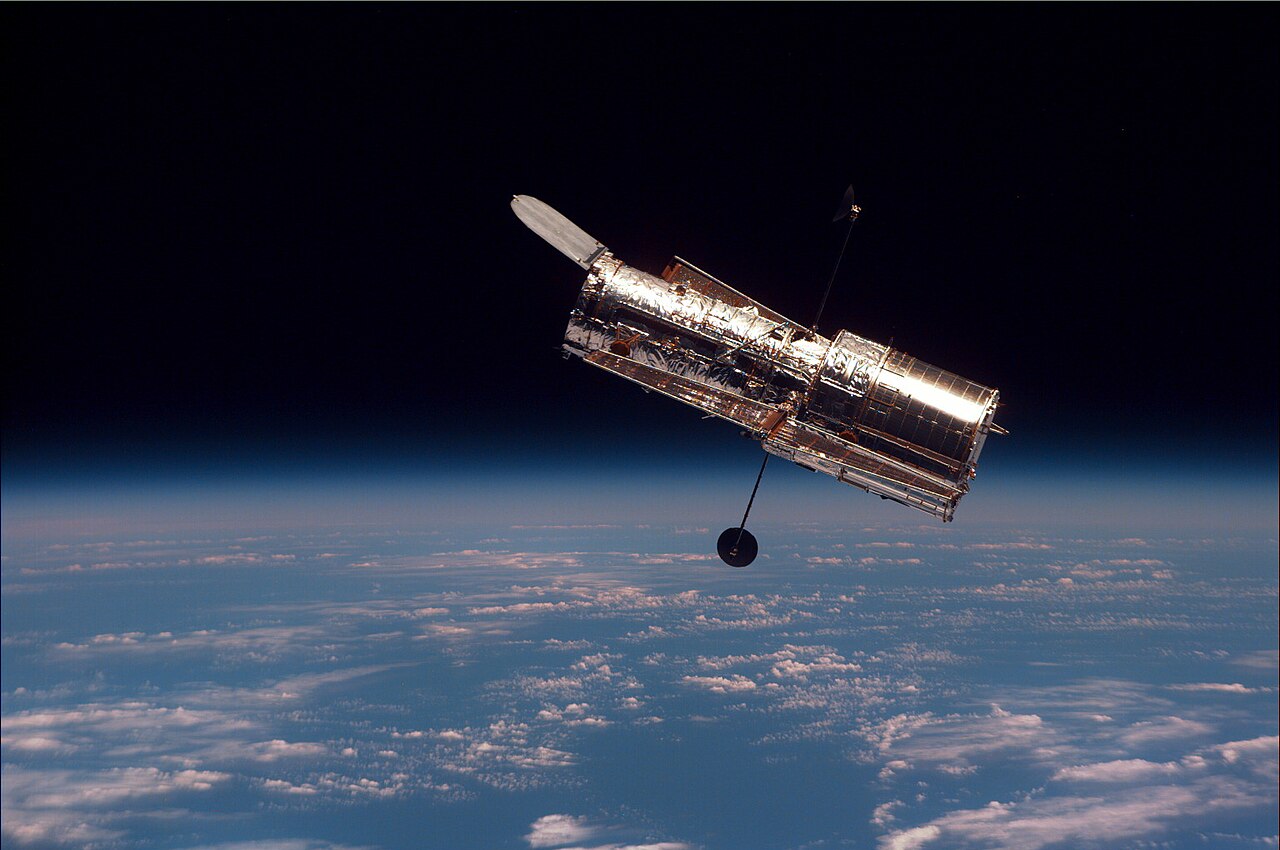
Collect first, enlarge second
A telescope gathers light over an opening called its aperture and directs it to form an image or feed an instrument. Reflecting telescopes use mirrors; refracting telescopes use lenses. A camera detector records incoming light so that observations can be examined and compared.
Magnification enlarges an apparent view. Resolution concerns the ability to distinguish nearby details. Enlarging a blurred image makes the blur bigger; it does not recreate detail the observation never resolved. Collecting faint light and separating fine detail are related design goals, but they are not identical.
Choose wavelengths as well as a location
Visible light is only part of the electromagnetic spectrum. Different instruments observe different wavelength ranges. A space telescope can work above the atmosphere that blurs or blocks some incoming radiation, while ground observatories have other practical advantages and technologies.
Hubble uses a primary mirror and a secondary mirror to direct light to instruments. Its observing location and optical design help explain its results. Calling a telescope “powerful” without saying whether you mean collecting area, resolution or wavelength coverage leaves the comparison unclear.
Worked example: compare model apertures
Consider two ideal circular mirrors with diameters of 10 and 20 units, otherwise used under the same conditions. A circle’s area is proportional to the square of its diameter. The diameter ratio is 20 ÷ 10 = 2; the area ratio is 2 × 2 = 4. The larger mirror can collect roughly four times as much incoming light in this simplified comparison.
That does not mean every resulting image is four times sharper. Atmosphere, wavelength, optical quality, detector and exposure also matter. If the task is to detect a faint object, more collected signal may help. If the task is to separate two nearby points, you must also investigate resolution.
Images are measurements with settings
A useful observing record includes the instrument, date, filter or wavelength range and exposure. Colour may combine several filtered observations. Explain the colour assignment before treating it as what an unaided eye would see.
A photograph of a telescope is evidence about its visible structure, not a diagram of every internal light path. Use labelled technical information for those paths. This enquiry needs no purchase or live observing: work with published observations and paper comparisons. Never point optical equipment towards the Sun.
Only if you feel like trying
Separate the two questions
- Sketch circles with diameters of 2 and 4 centimetres or compare the numbers without drawing.
- Work out the collecting-area ratio. Label the assumptions.
- Write one question about faintness and one about detail, and say why they need different evidence.
Optional. Work on paper, point to the example or talk it through. No account, purchase or public sharing is needed.
Look at the sources.
These references informed this introduction. You can check who published them, what evidence they use and whether you would ask another question.
- NASA ScienceTelescopes 101
- NASA ScienceHubble Design
Research checked 1 November 2026. External pages have their own content and privacy practices.
Where could this connect?
These are editorial links between subjects. You choose which, if any, to follow.
Astronomy
Telescopes turn arriving radiation into evidence about distant objects.
Follow this connection
Light & Optics
Mirrors, lenses, wavelengths and resolution determine how light becomes a usable observation.
Follow this connectionProducts & Prototypes
An instrument is designed around a question and must be tested against specific requirements.
Follow this connection