
A little room to wonder
Light & Optics
Optics studies light and how it interacts with materials. A ray model can explain a mirror’s reflection, provided the angles and limits of the model are clearly stated.
From which line should an angle of reflection be measured?
A ray is a model of a direction
A light ray is a line used to represent a direction of light travel in geometrical optics. It is not a thin object you have to see floating in space. At a smooth mirror, a ray diagram can predict a reflected direction. The normal is an imaginary line perpendicular to the surface at the point where the ray meets it.
The angle of incidence and angle of reflection are measured from that normal. For ideal specular reflection, they are equal. A rough surface has differently oriented small regions, so reflected light can spread in many directions. That is different from claiming that reflection stops obeying physical laws.
Worked example: avoid the wrong reference line
Draw a horizontal mirror line and a vertical normal. An incoming ray makes 30 degrees with the normal. Its reflected ray must leave on the other side of the normal at 30 degrees. Each ray therefore makes 60 degrees with the mirror surface, because the surface and normal are at right angles.
A fictional learner labels the outgoing angle 60 degrees and says it differs from the 30-degree incoming angle. The ray drawing may be correct while the labels use different reference lines. Re-labelling both from the normal resolves the apparent disagreement. Before announcing that a model failed, check whether the quantities being compared mean the same thing.
An image is not necessarily an object behind the mirror
For a plane mirror, reflected rays reaching an eye can be traced backwards to an apparent source behind the surface. That apparent position is a virtual image; the light need not actually travel through the mirror and originate there. A ray diagram separates the path of light from where an image appears.
Refraction is a different interaction, involving a change in light’s direction under appropriate conditions as it enters a medium with a different refractive index. A mirror and a lens are not interchangeable devices. The simple reflection example does not explain every colour, wave or material effect, and it does not establish how an unfamiliar optical device should be used.
Connect the model to an actual artefact
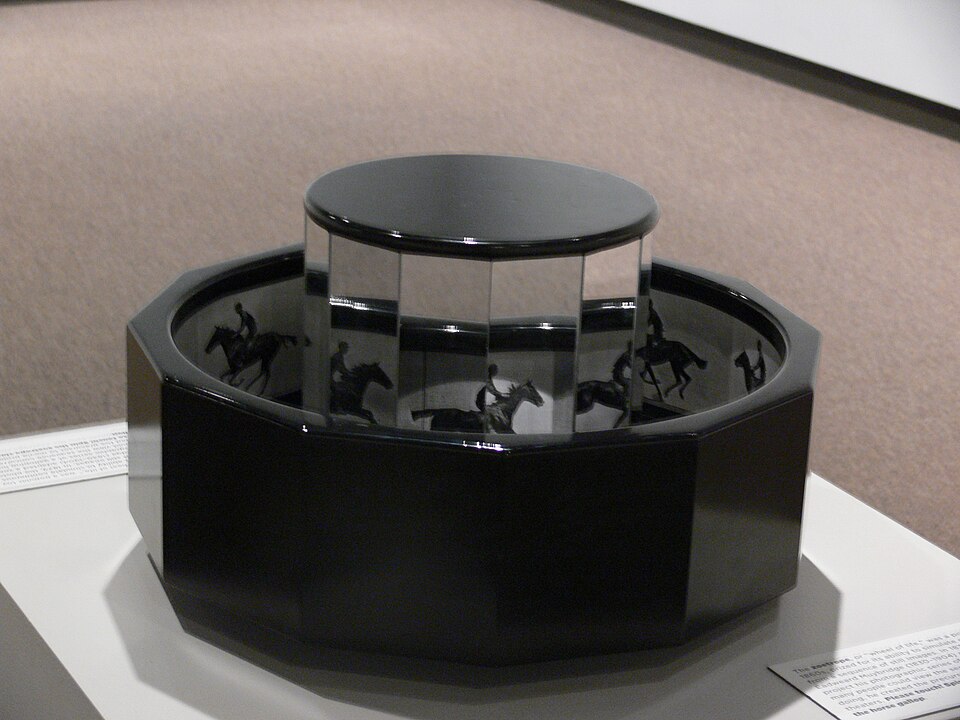
The animation display in the photograph includes a ring of mirrors reflecting successive horse images. You can locate visible reflecting surfaces and ask which way a viewer would look to see them. A single photograph cannot show the full moving effect. Use the reflection rule as one part of an explanation rather than claiming that a static ray diagram establishes the entire animation mechanism.
Only if you feel like trying
Repair an angle explanation
- Draw the mirror, normal and 30-degree incident ray described in the example. Add the reflected ray.
- Label angles from the normal and from the surface, using different annotations. Explain why 30 and 60 can describe the same ray.
- Write one claim your diagram supports and one question about the museum display that needs more evidence.
Optional drawing only. Never look at the Sun through any optical device. Do not use lasers, concentrated sunlight, bright lights or dismantled mirrors for this task.
Look at the sources.
These references informed this introduction. You can check who published them, what evidence they use and whether you would ask another question.
- OpenStax, Rice UniversityReflection
- OpenStax, Rice UniversityRefraction
Research checked 1 November 2026. External pages have their own content and privacy practices.
Where could this connect?
These are editorial links between subjects. You choose which, if any, to follow.
Photography & Framing
A camera records light arriving through an optical system; framing and image formation are related but different choices.
Follow this connection
Physics
Physics describes models and observations; optics applies them to light, images and the paths used in a ray diagram.
Follow this connectionTelescopes & Observation
Telescopes collect light with lenses or mirrors, so their images need optical and observational interpretation.
Follow this connection