
A little room to wonder
Physics
Use observations, models and measurements to explain matter, motion and energy.
What would change if the same push acted on a different object?
Motion is a change you can describe
Speed tells you how quickly position changes. Velocity includes direction as well. Acceleration means a change in velocity, so an object can accelerate by speeding up, slowing down or changing direction.
Describe motion relative to something: a tabletop, the ground or another object. A passenger can be still relative to a moving train while moving relative to the station. Naming the reference point keeps an explanation clear.
Add the forces
For ordinary situations described by Newton’s laws, the net external force on a constant-mass object equals its mass multiplied by its acceleration: Fnet = ma. “Net” matters because several forces can act at once and partly or completely balance.
In an idealised example, a net force of 2 newtons on a 1-kilogram object gives an acceleration of 2 metres per second squared. The same net force on 2 kilograms gives half that acceleration. This is a model calculation, not an instruction to test heavy objects.
Follow the energy
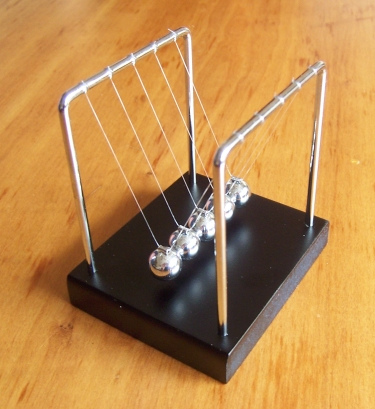
Energy can be transferred and transformed. A raised pendulum has gravitational potential energy; as it swings down, more of that becomes kinetic energy associated with motion. In a real device, some energy also spreads to the surroundings as sound and heating.
A model often leaves out small effects so a relationship is easier to examine. State those simplifications. If a prediction and an observation disagree, check the measurements and the assumptions rather than pretending the difference does not exist.
Only if you feel like trying
Draw a force story
- Sketch an imaginary trolley at rest on a level floor.
- Add labelled arrows for gravity, the floor’s support and a horizontal push. State which forces you are assuming balance.
- Draw a second trolley with twice the mass and the same net horizontal force. Predict how their accelerations compare.
Optional diagram activity. No moving equipment, electricity, launching, dropping or heavy lifting is needed.
Look at the sources.
These references informed this introduction. You can check who published them, what evidence they use and whether you would ask another question.
- OpenStax, Rice UniversityNewton’s Second Law of Motion
- OpenStax, Rice UniversityMechanical Energy and Conservation of Energy
Research checked 1 November 2026. External pages have their own content and privacy practices.
Where could this connect?
These are editorial links between subjects. You choose which, if any, to follow.
Energy & Power
Physics follows energy through systems; energy and power separate the amount transferred from the rate of transfer.
Follow this connection
Engineering
Engineers use physical models and measurements when comparing possible designs.
Follow this connectionForces & Motion
Physics introduces motion and models; force analysis connects a specified set of interactions with a change in velocity.
Follow this connectionLight & Optics
Physics describes models and observations; optics applies them to light, images and the paths used in a ray diagram.
Follow this connectionMusic
Vibrations and waves explain important features of musical sound.
Follow this connectionSport & Movement
Motion, forces and changing direction can be explored in descriptions of games.
Follow this connectionWaves & Sound
Physics introduces vibration and energy; wave descriptions connect repeated changes in time with patterns across distance.
Follow this connection