
A little room to wonder
Forces & Motion
Motion changes when the forces on a chosen object do not balance. A force diagram helps show which interactions affect that object and which assumptions a calculation needs.
Why does “a force is acting” not tell us whether an object speeds up?
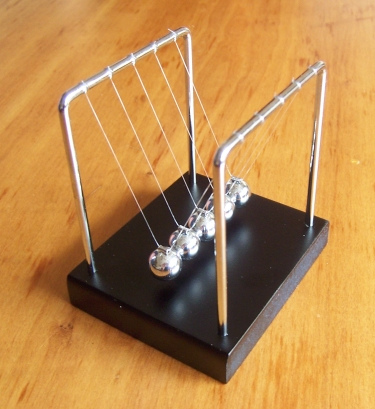
Choose the object before adding arrows
A force describes an interaction, such as a surface pushing on a box or Earth pulling on it. A free-body diagram shows forces acting on one chosen object. Draw that object separately and label each arrow with the interaction it represents. Do not mix a force on the box with a force the box exerts on something else.
Net force is the vector sum of the external forces on the chosen system. Opposite directions must be accounted for. In the constant-mass Newtonian model, net force equals mass times acceleration. Acceleration is change in velocity, so it can concern direction as well as speed. Zero net force means constant velocity, which includes rest but is not limited to rest.
Worked example: a fictional trolley calculation
Assume a 1.5-kilogram trolley on a horizontal track. A driving force acts rightward at 4 newtons, and a resistance acts leftward at 1 newton. Taking right as positive gives a net horizontal force of 4 − 1 = 3 newtons. Dividing by mass gives 3/1.5 = 2 metres per second squared of rightward acceleration.
If it starts at rest and the same net force continues for two seconds, its velocity changes by 2 × 2 = 4 metres per second to the right. Now change the resistance to 4 newtons. The net force becomes zero. If the trolley was already moving, it would continue at constant velocity in this ideal model; the balanced forces would not automatically stop it. These are invented values, not an equipment test.
Which forces belong in the comparison?
On the ideal level track, gravity acts down and the track’s support acts up. Assuming no vertical acceleration means those vertical forces balance. That does not make them disappear; it explains why the calculation can focus on the remaining horizontal component. A diagram should make the assumption visible.
The forces in an action–reaction pair act on different objects, so they do not cancel within a diagram of just one object. Also avoid describing motion as evidence of a forward net force: an object can be moving while slowing down, or while its net force is zero. The velocity and force questions are distinct.
Revise one assumption at a time
A model becomes easier to assess when its mass, force values, direction and starting state are stated together. If a real observation disagreed, resistance might vary, the track might slope or a measurement might be inaccurate. The useful response would be to examine those possibilities. A labelled paper case lets you practise that reasoning without moving a trolley, launching anything or testing physical strength.
Only if you feel like trying
Make a force-accounting page
- Draw the fictional trolley and the four force arrows described. Circle the two horizontal values used in the calculation.
- Calculate net force and acceleration for resistance values of 1, 4 and 5 newtons, keeping mass fixed. Label the sign and direction.
- Choose one result and state what it says about a change in velocity, and what it does not say about the trolley’s current velocity.
Optional diagram and calculation only. No heavy objects, moving equipment, lifting, launching or impact experiments are needed.
Look at the sources.
These references informed this introduction. You can check who published them, what evidence they use and whether you would ask another question.
- OpenStax, Rice UniversityNewton’s First Law of Motion: Inertia
- OpenStax, Rice UniversityNewton’s Second Law of Motion
Research checked 1 November 2026. External pages have their own content and privacy practices.
Where could this connect?
These are editorial links between subjects. You choose which, if any, to follow.
Animal Movement & Adaptations
An animal’s motion involves forces and changing support, while a photograph alone cannot supply the needed measurements.
Follow this connection
Physics
Physics introduces motion and models; force analysis connects a specified set of interactions with a change in velocity.
Follow this connectionStructures & Bridges
Structures also require clear identification of loads and supports; a drawing must distinguish the object from its surroundings.
Follow this connection