
A little room to wonder
Animal Movement & Adaptations
Animal movement connects body structures, forces and behaviour. An evolutionary explanation asks how a feature arose across generations; a motion description asks what happened in a particular interval.
How can we connect a structure to a function without inventing what a single photograph proves?
Describe the movement and the explanation separately
Locomotion is movement from one place to another. Structures such as limbs, muscles and supporting tissues make particular movements possible, while behaviour determines how they are used in a context. A movement description might record positions over time. A functional explanation asks what a structure contributes to that movement.
An evolutionary adaptation is a feature shaped by natural selection for a function. That is different from an individual learning a skill or adjusting a movement today. An animal does not grow an inherited feature simply because it decides it needs one. Also, a useful-looking feature is not automatically proven to be an adaptation by a single observation.
One tail can have more than one role
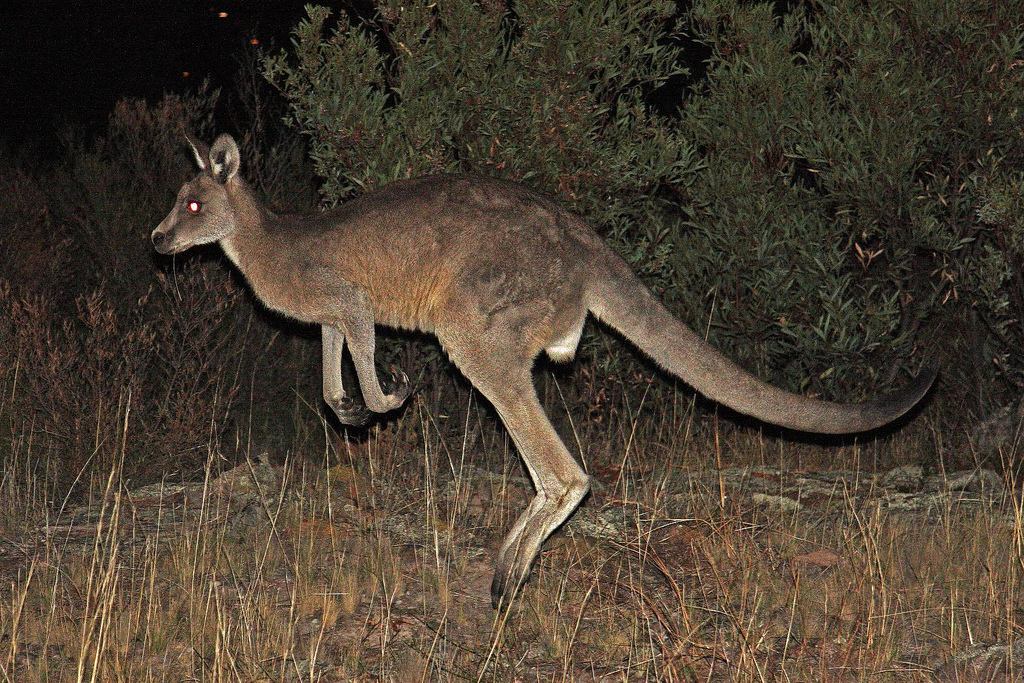
The Eastern Grey Kangaroo has large hind limbs and a long muscular tail. The Australian Museum describes the tail contributing to balance during hopping and acting as a fifth limb during slow movement. The same structure can therefore have different roles in different patterns of movement.
The supplied full-body photograph shows a tail and contrasting forelimb and hind-limb proportions. It records one moment. It cannot, on its own, establish the sequence of a hop, the forces at each contact or the energy cost of a journey. To explain a movement sequence we need appropriately timed observations or research, not just an impressive still image.
Worked example: calculate only what the data supports
Here are invented positions for an unspecified moving animal on a straight line: at 0 seconds, x = 0 metres; at 1 second, x = 2 metres; at 2 seconds, x = 5 metres. Average velocity in the first interval is (2 − 0)/1 = 2 metres per second. In the second it is (5 − 2)/1 = 3 metres per second. The average over both intervals is 5/2 = 2.5 metres per second.
The values show a difference between interval averages. They do not reveal the animal’s speed at every instant, its gait or its energy expenditure. They are not measurements of the photographed kangaroo. Labelling a fictional dataset clearly lets us practise the reasoning without giving an invented result the authority of a real study.
Ask a question with the right evidence in mind
A structure sketch, a movement sequence and an evolutionary explanation answer different questions. You might annotate a photograph with a reference-supported function, then list the further evidence needed for a motion claim. That is a complete enquiry on paper. There is no need to approach, feed, chase or imitate an animal, or to compare a person’s movement with its abilities.
Only if you feel like trying
Annotate a structure, then check a motion claim
- Mark the tail and hind limbs in a simple outline based on the supplied image. Add one function supported by the Museum reference.
- Calculate the three average velocities in the fictional dataset. Include units and label the numbers invented.
- Write one question the photograph can help with and one it cannot answer. Identify the additional kind of evidence needed.
Optional supplied-image analysis. No animal contact, night-time observation, physical imitation or live experiment is needed.
Look at the sources.
These references informed this introduction. You can check who published them, what evidence they use and whether you would ask another question.
- Australian MuseumEastern Grey Kangaroo
- Understanding Evolution, University of California Museum of Paleontology, UC BerkeleyAdaptation
Research checked 1 November 2026. External pages have their own content and privacy practices.
Where could this connect?
These are editorial links between subjects. You choose which, if any, to follow.
Evolution & Adaptation
An inherited adaptation shaped across generations must be distinguished from an individual learning or adjusting its behaviour.
Follow this connection
Forces & Motion
Positions and time intervals describe motion, while a force model addresses why a velocity changes.
Follow this connectionZoology
Zoology asks about animal structures and lives; this topic focuses on movement and the evidence needed to explain it.
Follow this connection