
A little room to wonder
Orbits & the Solar System
An orbit is a path shaped by gravity and motion. Size, distance and travel time need different scales when you represent the Solar System.
Why does an orbiting object keep moving around another object instead of simply dropping straight down?
Gravity changes a moving object’s path
Gravity is an attraction between masses. An object already moving sideways can have its direction continually changed by gravity rather than moving straight towards the attracting body. An orbit is a continuing path, not a solid track holding a planet in place.
In the simplified two-body model, a bound orbit has an elliptical shape, with the attracting body at a focus. A circle is a special ellipse. Real Solar System motion also includes the gravitational effects of other bodies, so a tidy diagram leaves out some interactions.
Locate the system before choosing a scale
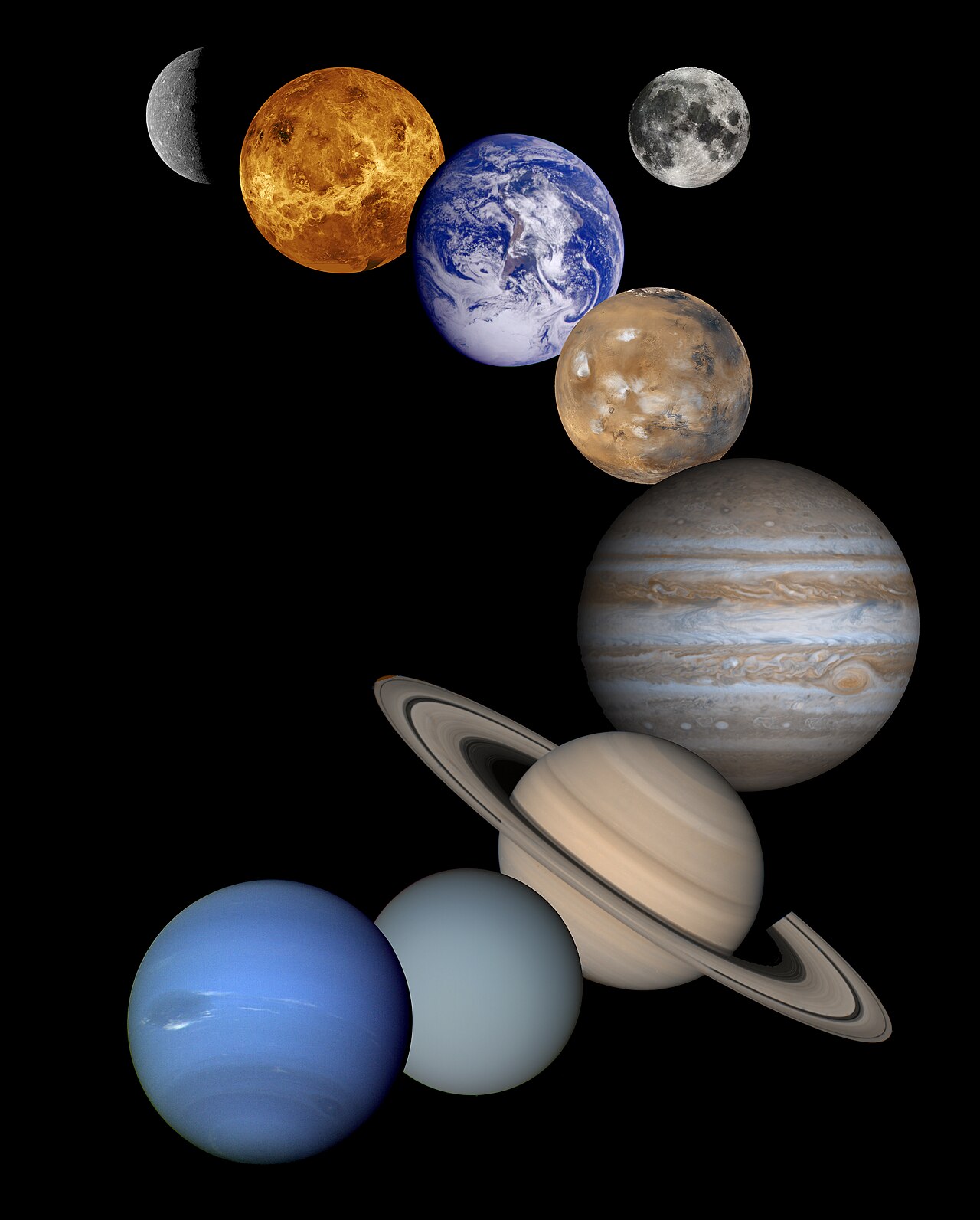
The Solar System includes the Sun, eight planets, their moons and many smaller bodies. A planet can orbit the Sun while a moon orbits the planet. The whole arrangement is within the Milky Way. “Solar System”, “galaxy” and “universe” therefore describe different scales of organisation.
An astronomical unit, or au, is a distance unit based on the Earth–Sun separation. It is useful for comparing planetary distances. A diagram that makes planets large enough to recognise will often compress the gaps; check what its scale applies to before measuring it.
Worked example: two fictional orbits on paper
Suppose a simplified model gives world A a circular orbital radius of 1 au and world B a radius of 4 au. Choose 2 centimetres to represent 1 au. A’s radius becomes 2 centimetres and B’s becomes 8 centimetres. Their diameters on the diagram are 4 and 16 centimetres, because a diameter is twice a radius.
If the page is only 14 centimetres wide, B will not fit at that scale. Changing to 1 centimetre per au gives radii of 1 and 4 centimetres, so both fit. The planet symbols should be labelled “sizes not to scale”. This model compares distances; it supplies no calculation of orbital speed or year length.
What the model cannot establish
Being farther away does not by itself mean a world has a larger physical diameter. A planet’s rotation is its spin; its revolution is its motion around another body. A model that uses both words interchangeably hides two separate motions.
A drawing also does not show a force switched on at the edge of a ring. Gravity acts throughout the system. To improve a model, decide whether the next question concerns positions, sizes or motion rather than trying to make one small picture show everything accurately.
Only if you feel like trying
Audit a Solar System model
- Draw the two fictional circular orbits using either scale in the example, or describe their sizes aloud.
- Add a key stating what the scale represents and which symbols are not to scale.
- Name a question about these worlds that your diagram cannot answer.
Optional. Work on paper, point to the example or talk it through. No account, purchase or public sharing is needed.
Look at the sources.
These references informed this introduction. You can check who published them, what evidence they use and whether you would ask another question.
- NASA ScienceBasics of Space Flight: Gravity & Mechanics
- NASA ScienceSolar System Facts
Research checked 1 November 2026. External pages have their own content and privacy practices.
Where could this connect?
These are editorial links between subjects. You choose which, if any, to follow.
Astronomy
Orbits explain how objects within a planetary system move and relate to one another.
Follow this connection
Forces & Motion
An orbit connects a changing velocity with the gravitational force acting on an object.
Follow this connectionMaps & Scale
A model needs an explicit scale and clear limits on what its distances represent.
Follow this connection