
A little room to wonder
Galaxies & Cosmic Scale
Galaxies contain vast systems of stars, gas and dust. Distance units and light-travel time help explain why an astronomical picture shows different pasts together.
Why can one image contain light that left different objects at very different times?
Place the smaller system inside the larger one
A galaxy is a large gravitationally bound system containing stars and other material. Galaxies have varied structures, including spiral, elliptical and irregular forms. Our Solar System belongs to the Milky Way; it is not a separate galaxy.
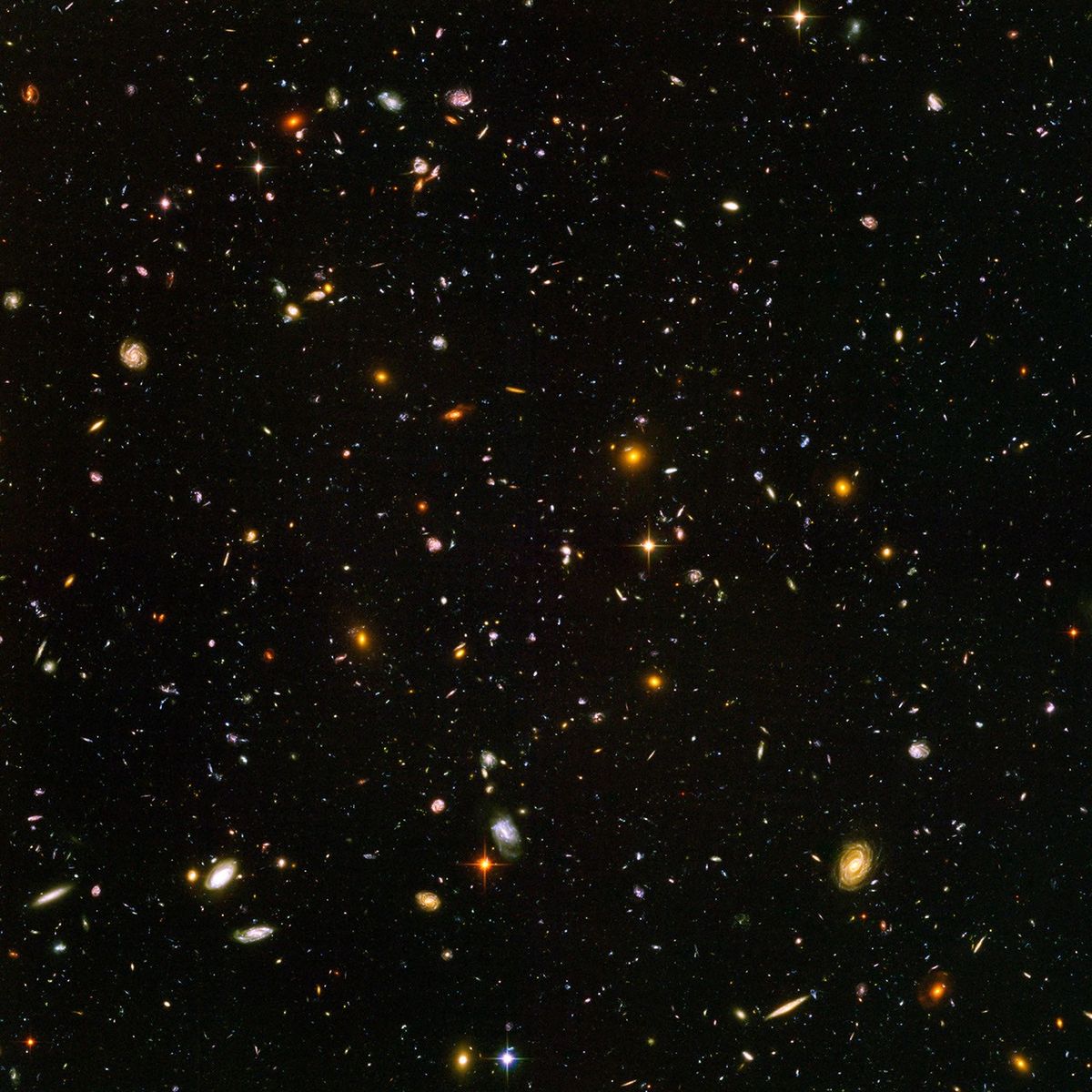
A bright speck in a deep-field image may be an entire distant galaxy rather than one nearby star. Appearance on the image is therefore a starting observation, not a direct measure of physical size. Distance, brightness and the instrument’s resolution influence what can be distinguished.
Use a distance unit for a distance question
A light-year is the distance light travels in one year, not a unit of time. Because light takes time to travel, observing a distant object means receiving light emitted in its past. Telescopes gather that arriving light; they do not make the journey instantaneous.
At very large cosmic distances, the expansion of the universe makes relationships between distance measures and look-back time more complicated. A simple distance-divided-by-speed calculation is a useful local model, not a complete calculator for every distant galaxy.
Worked example: a deliberately simplified light model
Imagine three stationary lights in a model with no cosmic expansion. Their distances from an observer are 2, 10 and 50 light-years. Light arriving together left the first light 2 years earlier, the second 10 years earlier and the third 50 years earlier. The same reception moment does not mean the same emission moment.
If the third light changed colour 20 years before the observation, light carrying that change would still need 30 more years to arrive in this model. The observer is not making the object change slowly; the information is travelling. This fictional model explains a relationship without claiming these are measured distances to actual galaxies.
A deep field is a selected sample
Long observations of a small patch of sky can reveal objects too faint to notice in a short exposure. A deep-field image is built from observations and processing choices; it is not a photograph of every galaxy in the universe.
A study might classify visible shapes, count objects within a defined area or compare wavelength bands. Those are different questions. Record the image, boundaries and counting rule before making a claim, and do not assume every faint mark can be classified confidently.
Only if you feel like trying
Follow information through the model
- Draw three fictional lights at distances labelled 2, 10 and 50 light-years; the spacing on the drawing need not be to scale.
- Mark when each received signal left its source.
- Add a note distinguishing this stationary model from an expanding-universe distance calculation.
Optional. Work on paper, point to the example or talk it through. No account, purchase or public sharing is needed.
Look at the sources.
These references informed this introduction. You can check who published them, what evidence they use and whether you would ask another question.
- NASA ScienceGalaxies
- NASA Space PlaceWhat Is a Light-Year?
- NASA ScienceHubble's Deep Fields
Research checked 1 November 2026. External pages have their own content and privacy practices.
Where could this connect?
These are editorial links between subjects. You choose which, if any, to follow.
Astronomy
Galaxies place individual stars and planetary systems within a larger cosmic structure.
Follow this connection
Evidence & Archives
Both distant light and surviving records provide evidence from the past with limits on what survives.
Follow this connectionMaps & Scale
A representation can change scale while needing clear definitions of its distances.
Follow this connection