
A little room to wonder
Movement Patterns & Sequences
A movement sequence records what happens in what order. Symbols become useful when their meaning, starting orientation and repetition rule are clear enough for another person to reconstruct on paper.
Why can the same move-and-turn commands finish in different places when their order changes?
Describe actions with a shared notation
Movement skills include changes of place and direction. A sequence selects particular actions and orders them. To analyse order without performing an exercise, use a drawn marker on a square grid: F means move forward one square, R means turn right a quarter-turn without moving, and L means turn left a quarter-turn without moving.
These symbols are conventions for this enquiry, not an official sport notation. A sequence also needs a starting location and facing direction. A marker facing east interprets forward differently from one facing north, even when the printed command is identical.
Worked example: order changes the endpoint
Start a fictional marker at (0,0), facing north. For F, R, F, it moves to (0,1), turns east and then moves to (1,1), still facing east. For R, F, F, it first turns east and then moves to (1,0) and (2,0). The same two forward actions and one turn have produced different endpoints.
Repeating F, R four times returns the marker to (0,0) facing north, tracing a square. Forward moves change location; turns change orientation. Recording both after each command makes it easier to find an error than checking only the final position.
A representation leaves details out
A drawn sequence does not capture timing, balance, effort or every small adjustment in a real movement. It is useful for a question about order, but cannot assess someone’s physical capability. Equal numbers of commands also do not mean equal durations unless a timing rule says so.
A compact instruction such as repeat four times needs a clear boundary around the repeated part. Repeating F then turning once differs from repeating the pair F, R. Parentheses or numbered steps can make that boundary unambiguous.
Adapt the explanation to the reader
You can give the commands as words, arrows, numbered cards or a spoken sequence while someone else marks the grid. The test is whether the record communicates the intended actions, not how quickly anyone moves. Keep the original version when revising an unclear instruction.
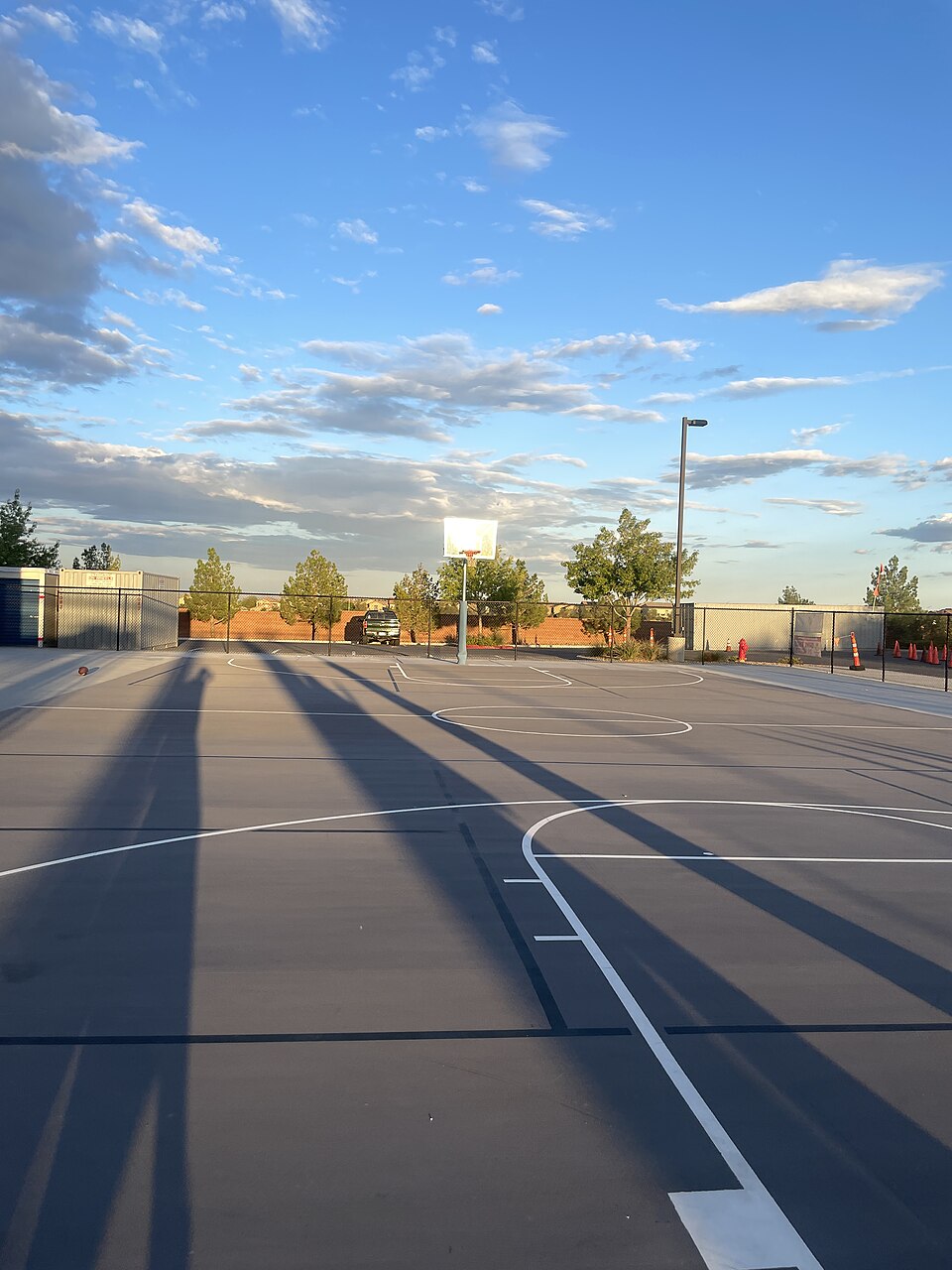
A complete paper reconstruction is a valid outcome. No running, balancing, stretching or bodily demonstration is required. The photographed court supplies a setting with directions and boundaries; it does not contain the invented grid or prescribe an activity.
Only if you feel like trying
Reconstruct a paper sequence
- Set a marker at (0,0), facing north. Copy the definitions of F, R and L before tracing both supplied three-command sequences.
- Record location and facing direction after every command. Then trace repeat (F, R) four times.
- Write a different four-command sequence and check it yourself. Identify which starting detail would make it ambiguous if omitted.
Optional drawing, movable paper marker or spoken reconstruction. There is no physical performance, fitness comparison or required movement.
Look at the sources.
These references offer further reading on the ideas here. Check who published them, what they support and what you would ask next.
- CS Unplugged, University of CanterburyKidbots
Research checked 1 November 2026. External pages have their own content and privacy practices.
Where could this connect?
These are editorial links between subjects. You choose which, if any, to follow.
Algorithms & Debugging
A command-by-command trace can expose a difference between intended and recorded instructions.
Follow this connection
Direction & Coordinates
Position and facing direction are different pieces of spatial information.
Follow this connectionSport & Movement
Sport and movement involve actions in order; a paper movement sequence makes direction, repetition and starting position explicit.
Follow this connection