
A little room to wonder
Spatial Puzzles
Spatial puzzles ask you to track shapes and their relationships under stated moves. Area can rule out an impossible fit, but equal area does not guarantee that pieces will fit.
What can you prove before trying every possible arrangement?
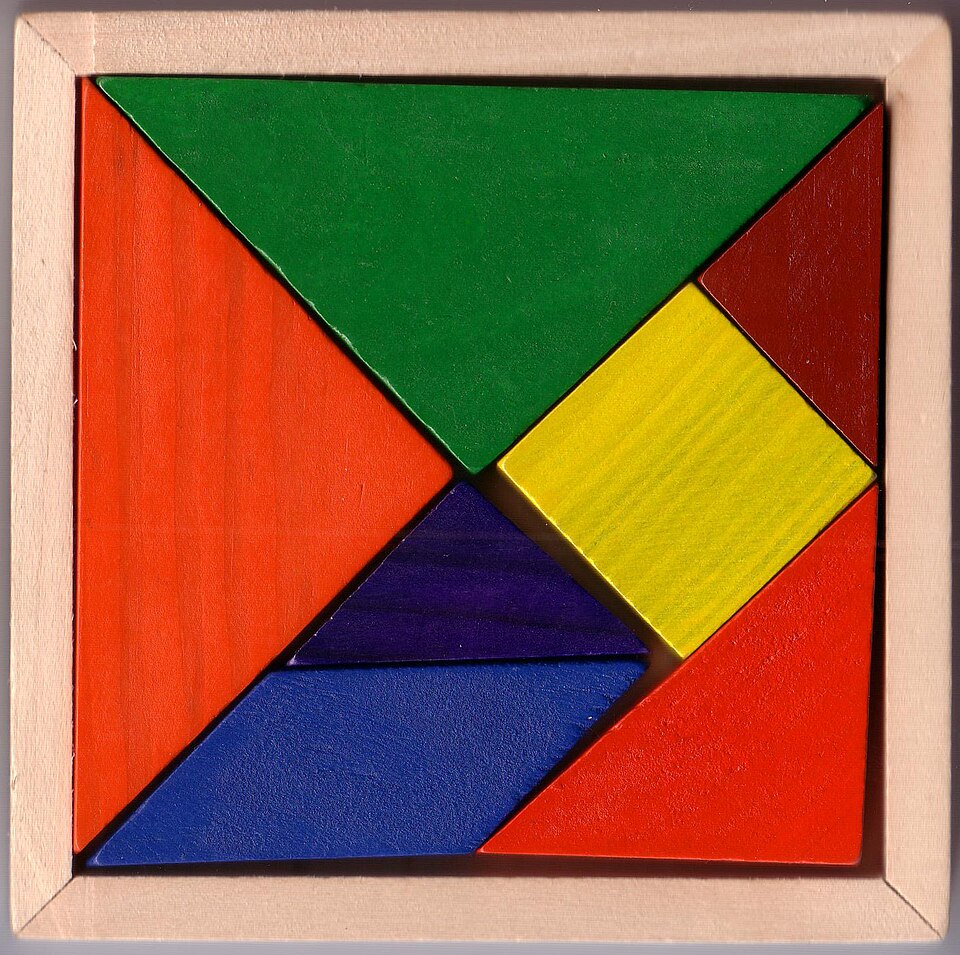
Identify the permitted moves
A translation slides a shape without turning it. A rotation turns it around a point. A reflection reverses orientation. Some puzzles allow turning pieces over; others do not. State that rule before deciding that two arrangements are equivalent.
A silhouette gives an outer boundary but may hide internal divisions. A diagram with piece edges supplies more information. The challenge changes when those clues are included or removed.
Use an invariant to reduce the search
An invariant is something a permitted move does not change. Sliding or rotating a flat piece preserves its area and side lengths. These facts can reject a proposed solution without guessing every position.
Area is a necessary check for covering a target without gaps or overlaps. It is not sufficient: the target’s shape and the pieces’ geometry also matter. A good explanation says what the check rules out and what remains uncertain.
Worked example: an original unit-square puzzle
Two 1-by-2 rectangles each have area 2 square units, giving 4 altogether. They can fill a 2-by-2 square by lying side by side. They can also fill a 1-by-4 strip end to end. Their total area stays 4 in both arrangements.
They cannot fill a 2-by-3 rectangle without gaps because its area is 6. No rotation changes the missing 2 square units. By contrast, checking an area-4 target would not alone prove a fit; an irregular boundary could still prevent the pieces from matching it.
A trial becomes useful when recorded
Record an attempted orientation and explain why it fails. Otherwise, you may repeat the same unsuccessful arrangement under a different drawing. Labels can make equivalent trials easier to recognise.
You can reason with outlined rectangles rather than cut pieces. Finishing quickly is not the purpose; a concise impossibility argument may explain more than a successful arrangement found by chance.
Only if you feel like trying
Explain one possible and one impossible fit.
- Draw the two supplied rectangles in the square and strip arrangements, marking unit squares.
- Explain why the 2-by-3 target is impossible under the no-gap/no-overlap rule.
- Invent an area-4 outline and distinguish “area matches” from “a fit has been demonstrated”.
Optional. Use the supplied fictional example, pencil and paper, or explain your choices aloud. No personal story, account, purchase, public sharing or contact is needed.
Look at the sources.
These references offer further reading on the ideas here. Check who published them, what they support and what you would ask next.
- NRICH, University of CambridgeTangrams
Research checked 1 November 2026. External pages have their own content and privacy practices.
Where could this connect?
These are editorial links between subjects. You choose which, if any, to follow.
Area & Perimeter
Area and boundary length answer different questions when comparing piece arrangements.
Follow this connection
Games
Spatial puzzles create decisions through permitted transformations and a target arrangement.
Follow this connectionPackaging & Nets
Mental folding and piece puzzles both require tracking orientation rather than counting parts alone.
Follow this connection