
A little room to wonder
Writing Systems
Explore the difference between a language and its script, and why a symbol need not be a picture of its meaning.
Can the same language be written in more than one way?
A language is not its alphabet
A language has patterns for creating meaning; a script is a set of graphic signs used to write language. A writing system includes conventions for how those signs are used. Several languages can use related scripts, and a language may be represented in more than one script. Sharing letter shapes does not make two languages identical.
Writing is also not a requirement for a language to be complete. Spoken and signed languages have their own structures whether or not a widely used written representation exists.
Graphic signs can do different jobs
Some writing represents sound units; other signs can represent syllables or words and meaningful units. Real systems often combine principles rather than fitting a perfectly pure box. Egyptian hieroglyphic writing, for example, included signs representing sounds; its pictorial appearance does not mean every sign was simply a picture-word.
A reader needs conventions about sequence, direction, grouping and context. Decorative resemblance alone cannot tell you how a script works. Avoid inventing meanings for unfamiliar cultural signs from their appearance.
Work through the Rosetta example
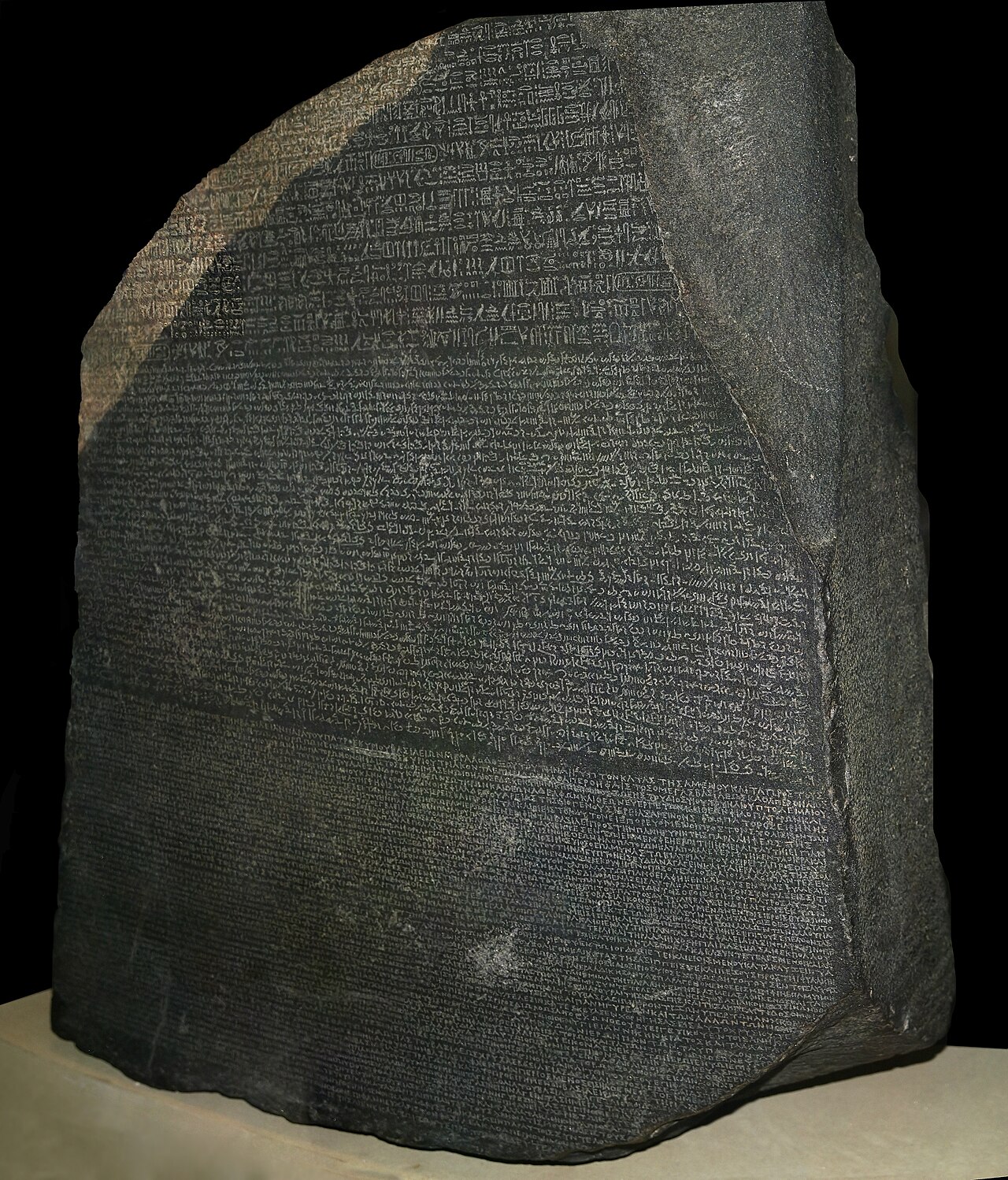
The Rosetta Stone records a decree using Egyptian hieroglyphic, Egyptian Demotic and Greek scripts. The Egyptian forms and Greek represent two languages in three scripts. Distinguishing those counts prevents the misleading statement that every different-looking writing style must be a different language.
Recognising related content across scripts helped researchers investigate the writing. A modern photograph is useful for noticing the bands, but decipherment required much more evidence and scholarship. Looking at one inscription does not make an observer able to read it.
Test a tiny invented system
For a fictional code, assign a circle to “robot” and a square to “door”. Those symbols alone do not say whether the robot opens the door or the door blocks the robot. Adding an order convention supplies a relationship. This invented demonstration shows why a collection of symbols is not yet a complete description of a writing system.
Only if you feel like trying
Separate symbols and conventions
- Invent three clearly labelled symbols for fictional objects; do not copy a cultural script.
- Define one rule for their order and write an example.
- Explain one meaning the symbols cannot express without another convention.
Optional invented-code activity. It is not a reconstruction of an existing script or a claim to teach another language.
Look at the sources.
These references informed this introduction. You can check who published them, what evidence they use and whether you would ask another question.
- British MuseumGuide for teachers: Hieroglyphs unlocking ancient Egypt
- British MuseumRoom 4 Touch Tour Guide
Research checked 1 November 2026. External pages have their own content and privacy practices.
Where could this connect?
These are editorial links between subjects. You choose which, if any, to follow.
Binary & Digital Data
A representation needs shared conventions that connect symbols with information.
Follow this connection
Evidence & Archives
An inscription needs provenance and context before it can support a historical claim.
Follow this connectionLanguages
A writing system represents language while remaining distinct from the language itself.
Follow this connection