
Computing · Make
Build a six-card search index
What makes a paper search return a useful match?
Build a small keyword-to-card index, combine exact matches and explain what a missing word does and does not mean.
15–25 minutes, or one query for a first try. More time is optional.
Start here
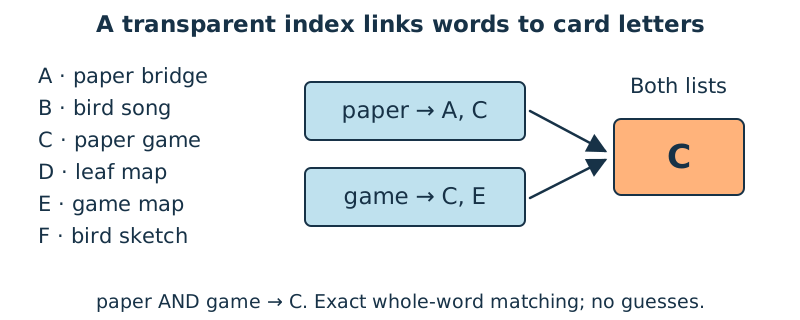
Use six invented titles: A paper bridge; B bird song; C paper game; D leaf map; E game map; F bird sketch.
Use your idea or the example below. Talk, write, draw, point or listen first. You can stop after one step.
Try it your way.
Define a matching rule
Use lowercase whole words exactly as written in the titles. Index every title word; do not guess synonyms, plurals or anyone’s interests.
Build the lists
For each word, list the matching card letters. For example paper → A, C; bird → B, F; game → C, E; map → D, E. Also include bridge → A, song → B, leaf → D, sketch → F.
Combine a query
For paper AND game, keep only card letters in both lists. The intersection of A, C and C, E is C. The word games has no exact match under this rule.
Explain the limit
A failed exact match does not show that the idea is uninteresting or unknown everywhere. It describes this small collection and this matching rule; you can edit the query.
One possible version
Constructed index: six complete cards
All six titles and their words are supplied. Card letters identify records, not people or user profiles.
- paper → A, C; bird → B, F; game → C, E; map → D, E.
- bridge → A; song → B; leaf → D; sketch → F.
- paper AND game returns C; games returns none under exact whole-word matching.
This is a tiny index model, not a prediction engine or a benchmark of real search speed. It cannot search words absent from its six supplied titles.
Something to keep?
Did I distinguish the collection’s contents from the search rule’s limits?
You can keep a question, a sketch or a change of mind. A finished product is optional.
This opens an editable starter in your project tools. It asks before replacing open work. Choosing it does not save or share your work automatically.