
Languages · Investigate
Two ways to express one idea
Which part of a meaning survives when the wording changes?
Compare paraphrases by checking which details they preserve.
10–20 minutes, or one small comparison for a first try. More time is optional.
Start here
Write the fictional instruction: After the bell, place the blue card inside the tray.
Use your idea or the example below. Talk, write, draw, point or listen first. You can stop after one step.
Try it your way.
Break up the meaning
Name the action, the blue card, the inside of the tray and the timing after the bell. These are the details to track.
Compare a paraphrase
Put the blue card in the tray once the bell has sounded keeps those details, despite changing several words.
Spot a changed instruction
Put a card near the tray before the bell changes colour information, destination and timing. It is not equivalent for this task.
Choose an audience
Write a clear version for an invented display sign or a longer explanation. Keep the required meaning, while noting that real translation also depends on context.
One possible version
Original example: a card and a tray
The bell, card and instruction are fictional. No real translation or delivery task is being assessed.
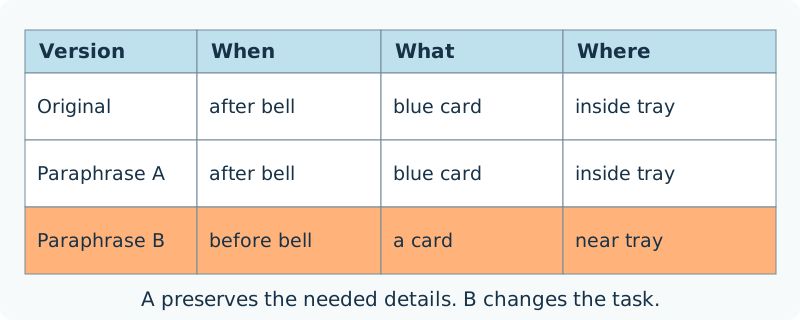
- Original: after the bell; blue card; inside the tray.
- Paraphrase A preserves those three details using once the bell has sounded and in the tray.
- Paraphrase B says before, drops blue and changes inside to near, so it changes the required task.
Near-equivalent wording can still differ in tone or context. Comparing English paraphrases does not qualify someone to translate another language.
Something to keep?
Did I preserve the needed meaning or only reuse some of the same words?
You can keep a question, a sketch or a change of mind. A finished product is optional.
This opens an editable starter in your project tools. It asks before replacing open work. Choosing it does not save or share your work automatically.