
Languages · Investigate
One sentence, two readings
How can punctuation change the way an invented message is understood?
Use the same words to compare direct address with the object of a sentence.
10–20 minutes, or one small comparison for a first try. More time is optional.
Start here
Write two messages about an imaginary robot: Let’s draw, Pip. and Let’s draw Pip.
Use your idea or the example below. Talk, write, draw, point or listen first. You can stop after one step.
Try it your way.
Keep the words fixed
Both messages use Let’s, draw and Pip in the same order. Only the comma changes.
Read the first
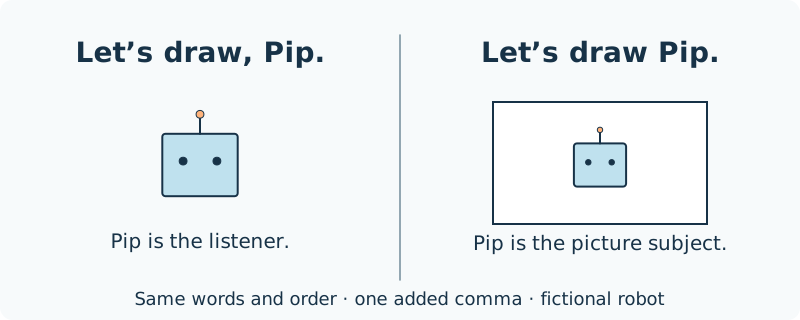
Let’s draw, Pip. addresses Pip: it invites the fictional robot to join the drawing. Pip is the listener.
Read the second
Let’s draw Pip. proposes drawing a picture of Pip. Pip is what the drawing will show.
Make the task explicit
Write a short explanation or add a sketch for each reading. You can compare silently; no particular voice or accent is required.
One possible version
Original example: Pip the invented robot
Pip is a fictional robot, not a real person or an existing character.
- With the comma: Pip is being addressed and invited to draw.
- Without the comma: Pip is the subject to be depicted in a drawing.
- A small punctuation mark changes the grammatical role of the same name.
Context and speech can add clues too. This pair illustrates one English sentence distinction, not a rule for every language.
Something to keep?
Which role changed when I moved from one reading to the other?
You can keep a question, a sketch or a change of mind. A finished product is optional.
This opens an editable starter in your project tools. It asks before replacing open work. Choosing it does not save or share your work automatically.