
Music · Explore
An imagined instrument on paper
Which design choices would need checking before claiming a particular sound?
Sketch a possible string instrument and label an aim, a prediction and the evidence still missing. The entire investigation stays on paper.
15–25 minutes, or one comparison for a first try. More time is optional.
Start here
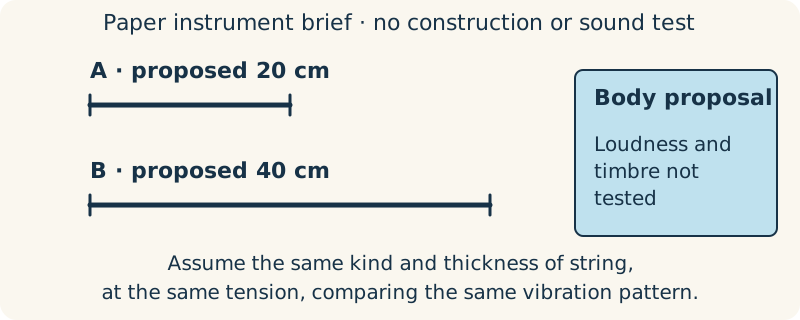
Draw two imaginary strings: A has a 20 cm vibrating length and B a 40 cm vibrating length. Label them as the same kind and thickness of string, at the same tension, comparing the same vibration pattern.
Use your idea or the example below. Talk, write, draw, point or listen first. You can stop after one step.
Try it your way.
Label the proposal
Sketch the strings beside a possible resonating body. State an aim, such as making two contrasting pitches. The 20 cm and 40 cm are proposed dimensions, not a measuring or building instruction.
Make a conditional prediction
For a simple comparison, assume the same kind and thickness of string, at the same tension, comparing the same vibration pattern. With only vibrating length different, expect the longer string to give a lower pitch. Keep the phrase “if the other conditions stay the same”.
Separate three sound questions
Pitch concerns how high or low a sound seems. Loudness and timbre are different questions. A longer string or bigger drawn box does not by itself prove a louder or particular-coloured sound.
Write a checking plan
List what an actual controlled comparison would have to hold fixed: string kind, thickness, tension and vibration pattern. Plan to change only vibrating length and observe the resulting pitch. You can finish with this paper plan; do not build or tension strings for this activity.
One possible version
An instrument brief, not an invented test result
Two proposed lengths differ by a factor of 2: 40 / 20 = 2. No instrument was constructed.
- Aim: two contrasting pitches. Assume uniform strings of the same kind and thickness, giving the same mass per centimetre, at the same tension and with the same vibration pattern. With only vibrating length different, B would have the lower pitch.
- A body might couple string vibration into surrounding air, but this drawing supplies no loudness measurement. “Twice as long” does not mean “twice as loud”.
- Next evidence needed: a controlled record of vibrating length, string kind and thickness, tension, vibration pattern and resulting sound. The exact pitch and timbre remain unknown.
Real strings, bodies and playing methods interact. The sketch is not a guarantee that a proposed instrument will work.
Something to keep?
Have I described a design intention as though it were something I actually heard or tested?
You can keep a question, a sketch or a change of mind. A finished product is optional.
This opens an editable starter in your project tools. It asks before replacing open work. Choosing it does not save or share your work automatically.