
Physics · Investigate
An energy-transfer explanation
Which transfers belong in a clear model of an invented machine?
Complete a fictional machine’s energy ledger, distinguish transfers from stores and account for every stated joule without building anything.
15–25 minutes, or one balance for a first try. More time is optional.
Start here
Draw a fictional battery-driven wheel and its surroundings as one model boundary. The battery’s chemical store begins at 140 J and ends at 40 J during one stated interval.
Use your idea or the example below. Talk, write, draw, point or listen first. You can stop after one step.
Try it your way.
Account for the decrease
Calculate 140 − 40 = 100 J transferred from the battery during that interval. J means joules, a unit of energy; these are invented values, not instrument readings.
Allocate the stated transfers
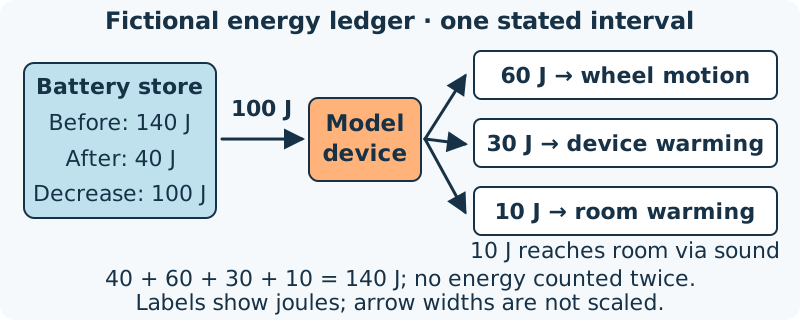
The model assigns 60 J to an increase in the wheel’s kinetic store, 30 J to increased thermal stores of the device, and 10 J transferred by sound then absorbed into the room’s thermal store.
Check both balances
The assigned transfers total 60 + 30 + 10 = 100 J. Including the 40 J left in the battery gives 40 + 60 + 30 + 10 = 140 J. Do not add the sound transfer again as another permanent store.
Name what the model cannot show
Explain which quantities were supplied rather than measured. The ledger balances, but does not establish the machine’s design, speed, temperature or performance. Choose a label or diagram change that would make the account clearer.
One possible version
Fictional machine: keep all 140 J accounted for
This is an invented energy ledger over one interval. It is not a measured machine, construction plan or claim about a real battery.
- Before: 140 J in the battery’s chemical store. After: 40 J remains there, 60 J is in wheel motion, 30 J increases device thermal stores, and 10 J ends in the room’s thermal store after sound is absorbed.
- Battery decrease = 100 J; stated destinations = 60 + 30 + 10 = 100 J. The complete before/after total is 140 J.
- Sound is a transfer process here, not a separate store to count twice. Energy in the surroundings remains part of the account even when it is less useful for turning the wheel.
Numerical balance is necessary for this account, but is not evidence that a machine with these values exists. Arrow labels carry the numbers; their widths in this simple diagram are not a scaled Sankey chart.
Something to keep?
Have I followed the stated energy to its destination without counting a transfer twice?
You can keep a question, a sketch or a change of mind. A finished product is optional.
This opens an editable starter in your project tools. It asks before replacing open work. Choosing it does not save or share your work automatically.