
A little room to wonder
Animal Classification & Diversity
Classification organises animals into nested groups using evidence about their characteristics and relationships. A useful identification also says what the available evidence cannot establish.
Which group does the evidence support, and when should an identification remain open?
A nested group is more than a matching appearance
Taxonomy involves describing, naming and classifying organisms; systematics also investigates their relationships. Biological classification uses nested groups. An animal can belong to a broad group and several more specific groups at the same time. Being an insect does not stop it being an arthropod or an animal.
Appearance supplies useful evidence, but one shared feature need not show close relationship. Birds and insects can both fly, yet their wings have very different structures and evolutionary histories. A sorting rule such as “things that fly” serves a practical question; it is not automatically a biological branch of the animal family tree.
Worked example: follow two real classifications
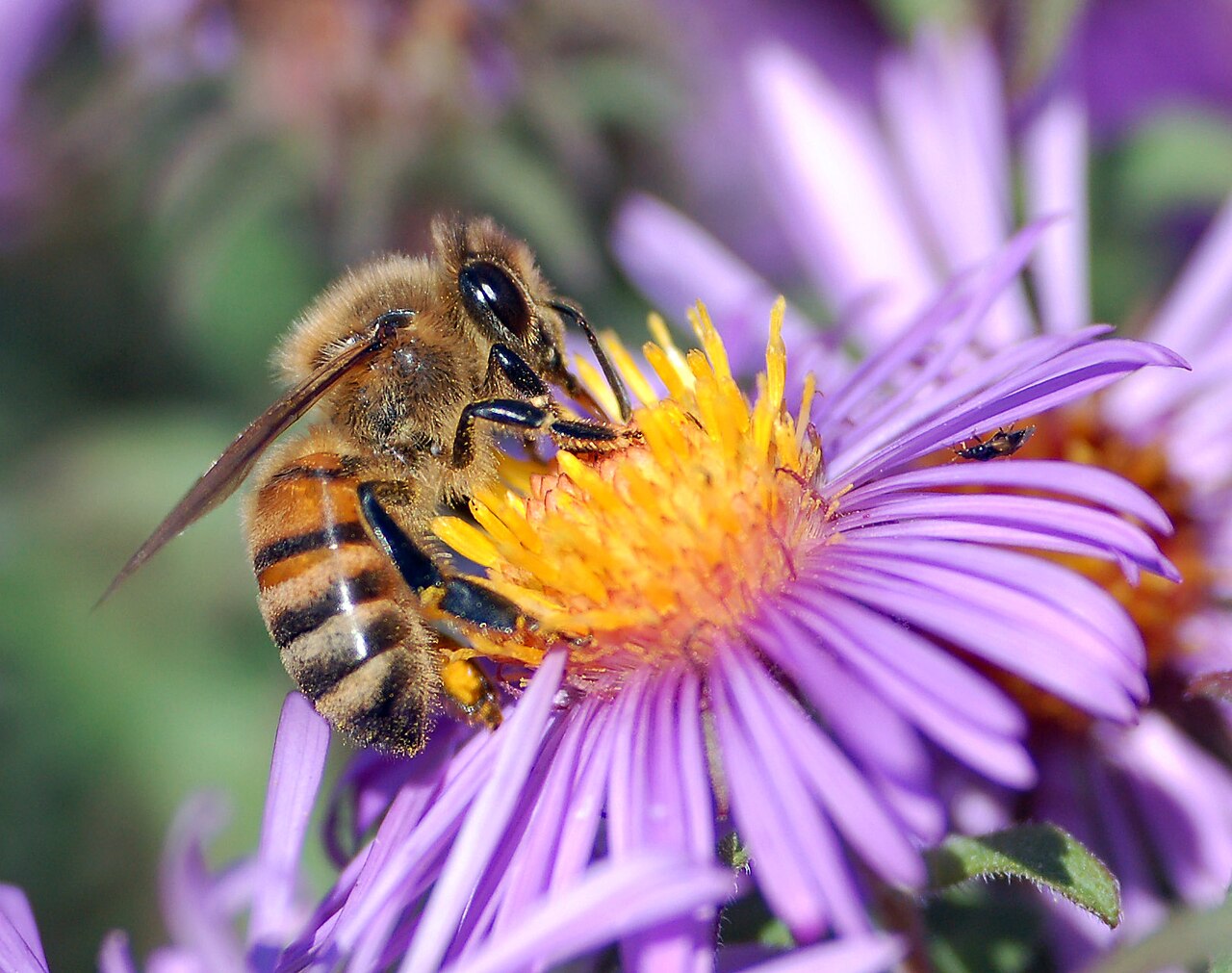
The European Honey Bee is an animal, an arthropod and an insect. Its classification includes the order Hymenoptera and the genus Apis; its scientific species name is Apis mellifera. The Eastern Grey Kangaroo is an animal, a chordate and a mammal; it is also a marsupial. Its species name is Macropus giganteus. The shared animal group does not erase their many differences.
These names make a comparison more specific than “a small flying thing” and “a large hopping thing”. A scientific species name contains a genus name followed by a specific epithet; write the full pair when identifying the species. The short list here is selected from a larger classification, not a complete account of every level or every current taxonomic question.
Use missing information honestly
Imagine three fictional observation cards. A says “feathers visible”; B says “six jointed legs, antennae and three main body regions visible”; C says only “a dark shape with wings”. A supports identifying a bird, and B is consistent with an adult insect. C does not supply enough detail to choose between many possible animals. The correct next entry can be “not enough information”.
A photograph can hide a feature that is present. Not seeing a tail does not prove there is no tail, and a cropped image may conceal legs. A tentative group identification is different from an exact species identification. Use an appropriate reference and record uncertainty instead of adding details the image does not show.
Classification is a tool for asking better questions
Once a group is identified, it can guide questions about life cycles, movement or ecological relationships. It should not be used as a ladder from supposedly inferior to superior animals. Classifications are scientific models that can be revised as evidence changes. You can compare supplied images and references without collecting, handling or disturbing an animal.
Only if you feel like trying
Make an evidence-labelled classification
- Draw two nested chains for the bee and kangaroo using only the groups supplied above. Put the shared animal group around both.
- For fictional cards A, B and C, write a supported group, the evidence used and one limit. Leave C open where necessary.
- Choose one visible feature in the supplied photograph and one hidden or uncertain feature. Keep observation separate from reference information.
Optional image and paper work. No wildlife handling, collection, field identification or exact species guess from a blurry image is needed.
Look at the sources.
These references informed this introduction. You can check who published them, what evidence they use and whether you would ask another question.
- Australian MuseumWhat is classification?
- Australian MuseumHoney Bee
- Australian MuseumEastern Grey Kangaroo
Research checked 1 November 2026. External pages have their own content and privacy practices.
Where could this connect?
These are editorial links between subjects. You choose which, if any, to follow.
Algorithms & Debugging
An explicit decision rule can reveal which evidence is missing, while biological classification requires more than mechanically following a simple visual key.
Follow this connection
Evolution & Adaptation
Modern classification considers evolutionary relationships, rather than simply placing similar-looking animals together.
Follow this connectionZoology
Zoology introduces animal diversity; classification gives us named groups and explicit evidence for comparing that diversity.
Follow this connection