
A little room to wonder
Animal Tracks & Clues
Tracks are traces left by contact with a surface. Their arrangement can prompt questions about movement, but a single unclear print rarely supports every claim about the animal that made it.
How do alternating-print spacing and the distance between repeated prints of the same foot differ?
A trace is evidence with a context
Footprint shape can contribute to identifying an animal, but the surface and completeness of a print affect what is visible. Similar-looking traces can be confused. The New Zealand Council for Educational Research uses footprint comparisons to explore how observable features support identification.
A track record is stronger when it includes a scale, a sequence and the conditions under which the traces were recorded. A photograph with no scale cannot establish centimetres from appearance alone. Our activity supplies all positions as fictional numbers instead of asking for field tracking.
Worked example: define two distances
Imagine an invented two-foot walking pattern on a straight paper line. Left prints occur at positions 0, 40 and 80 centimetres; right prints at 20, 60 and 100. For this model, a step is the forward distance from one print to the next opposite-foot print, while a stride is the distance from one left print to the next left print.
Each supplied step is twenty centimetres and each left-to-left stride forty. The distinction follows the stated definitions. These marks are not a kangaroo trackway or measurements from the photograph. Their positions alone provide no elapsed time, so they cannot establish walking speed.
Do not ask a clue to answer everything
A wider spacing might reflect a different movement pattern, body size, surface or recording method. It is not automatically evidence of greater speed. Missing or overlapping prints can also change an apparent sequence. Keep alternative explanations visible until suitable observations distinguish them.
Even a confident identification does not establish exactly when a track was made or how many animals visited over a whole period. Separate presence, count, timing and behaviour questions. Each needs evidence appropriate to its claim.
Show what is supplied and what is inferred
An annotated diagram can use a solid symbol for supplied print positions and a separate note for a proposed interpretation. Label forward direction and units. If a print is missing, leave a gap rather than drawing it as an observed fact.
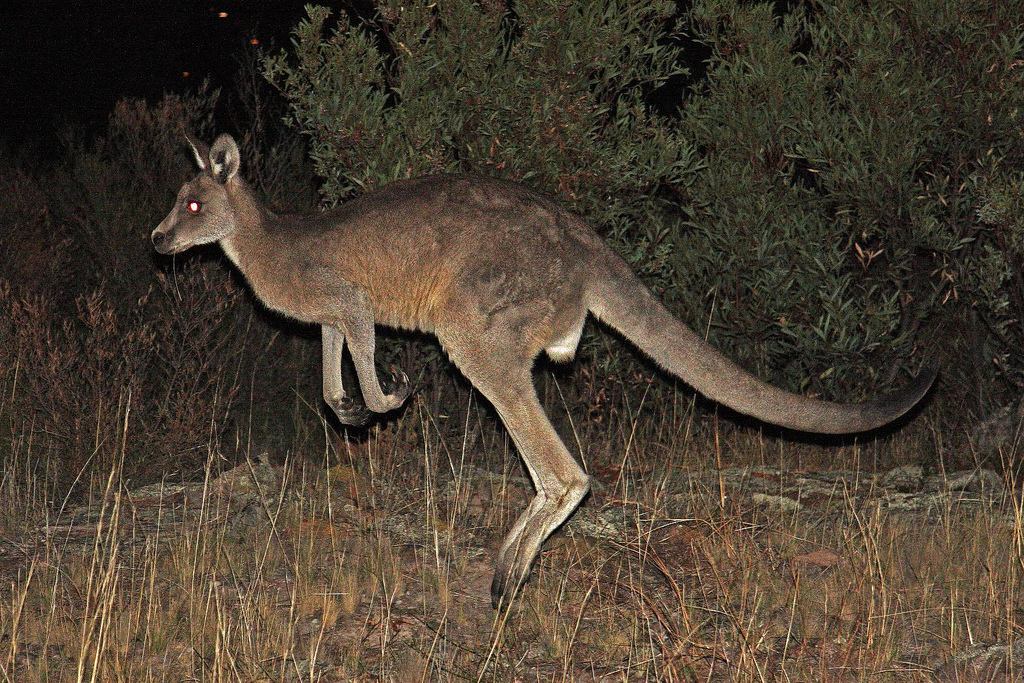
You can reason from the invented positions entirely indoors on paper. The kangaroo photograph gives visible limbs and feet for a structural comparison, but contains no track evidence. There is no need to follow wildlife, set traps, make footprint traps or visit an unfamiliar location.
Only if you feel like trying
Audit a fictional track sequence
- Mark the supplied left and right positions on a centimetre-labelled number line, using different letters rather than relying only on colour.
- Calculate opposite-foot step spacing and repeated-left stride spacing under the stated model definitions. Explain why speed is unknown.
- Hide the right print at sixty. Mark it missing and distinguish what remains supplied from a position you might predict.
Optional paper diagram. No wildlife following, animal handling, traps, outdoor search or private-location record is required.
Look at the sources.
These references offer further reading on the ideas here. Check who published them, what they support and what you would ask next.
- Assessment Resource Banks, New Zealand Council for Educational ResearchFootprints
Research checked 1 November 2026. External pages have their own content and privacy practices.
Where could this connect?
These are editorial links between subjects. You choose which, if any, to follow.
Measuring Motion & Speed
Distance evidence alone does not supply elapsed time or speed.
Follow this connection
Species Records & Field Notes
An indirect observation needs context and an identification limit just as a sighting does.
Follow this connectionZoology
Zoology can use indirect signs of movement; a track record needs scale, position and uncertainty before it can support an interpretation.
Follow this connection