
A little room to wonder
Animation & Timing
Separate frame rate, duration and spacing, then use numbers to explain an imagined movement.
Why can the same drawing sequence feel slow, quick or hesitant?
Frames and duration are connected
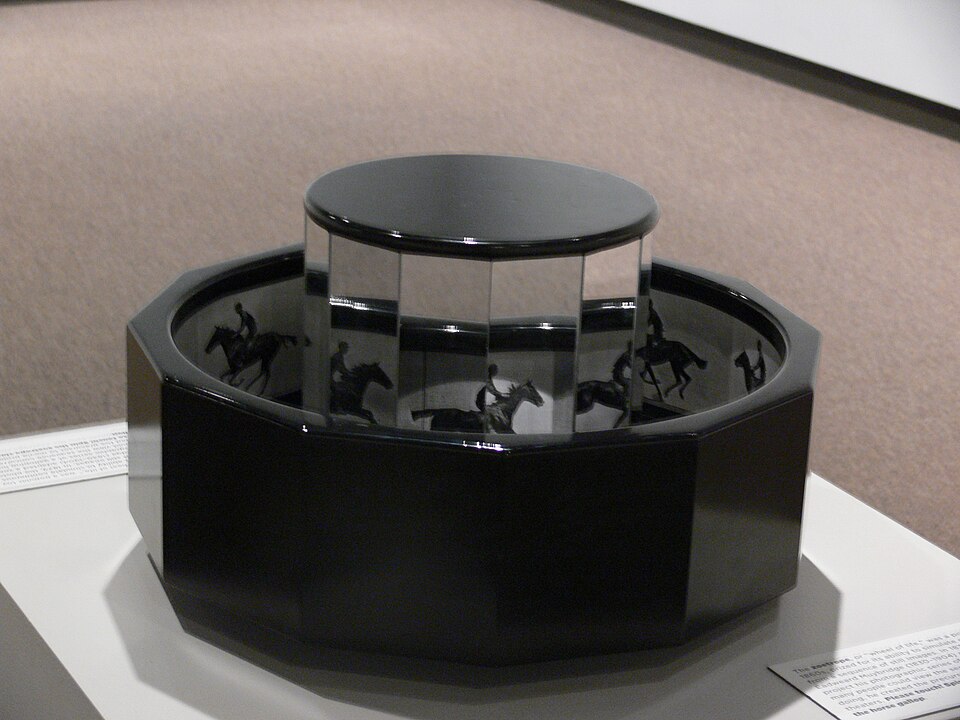
Animation presents images in sequence to create apparent movement. Frame rate is the number of frames presented per second. If 24 frames are played at 12 frames per second, they last 2 seconds. At 24 frames per second, that same frame count lasts 1 second. State both numbers when describing duration.
A frame need not contain a completely new drawing. Holding one drawing for several frames creates a pause. The playback frame rate and the rate at which the artwork changes are related but different pieces of information.
Spacing describes the change
Timing concerns when events occur and how long they take. Spacing concerns how far a feature changes position between images. Equal position changes over equal time steps represent constant speed in a simple motion model. Increasing changes suggest acceleration; decreasing changes suggest slowing.
More images do not automatically make a movement more convincing. If the positions jump inconsistently, the movement may still appear uneven. A deliberate sudden change can also be expressive. Ask whether the spacing supports the action you want the viewer to understand.
Work through a paper motion plan
For a fictional dot moving along a line, record six positions at equal time steps: 0, 1, 3, 6, 10 and 15 units. The successive changes are 1, 2, 3, 4 and 5 units. Because those steps take equal times, the increasing distances describe increasing speed.
Compare that with positions 0, 3, 6, 9, 12 and 15. Both sequences begin and end in the same places over the same number of time intervals, but their movement between those places differs. The endpoint alone does not describe the motion.
A pause communicates too
Imagine a robot reaching a door, pausing, then opening it. A longer hold before opening may let the audience anticipate the action. An animatic tests storyboard panels with rough timing. It can expose a rushed clue before detailed animation begins. A paper timing table is also a complete way to explore the decision.
Only if you feel like trying
Compare two timing plans
- Mark six equally timed positions for an invented moving dot.
- Calculate each change in position and label constant, increasing or decreasing steps.
- Add a hold at one position and explain how that changes the duration or anticipation.
Optional paper calculation. No flashing animation, recording, app or moving equipment is required.
Look at the sources.
These references informed this introduction. You can check who published them, what evidence they use and whether you would ask another question.
- Australian Film Television and Radio SchoolStop Motion
- Australian Film Television and Radio SchoolStop motion learning resource
Research checked 1 November 2026. External pages have their own content and privacy practices.
Where could this connect?
These are editorial links between subjects. You choose which, if any, to follow.
Film & Animation
Frame sequence and timing create the action an animation communicates.
Follow this connection
Forces & Motion
Distance changes over equal times help distinguish speed from acceleration.
Follow this connectionRhythm & Metre
Both rhythmic grouping and animation timing organise events and pauses in time.
Follow this connection