
A little room to wonder
Communication through Time
Compare messages, signals and networks without assuming that a faster signal solves every communication problem.
What has to happen between sending a signal and understanding a message?
Separate a message from its carrier
A message has meaning for a sender and intended audience. It can be represented as writing, sound, a sequence of signals or other forms. A communication system also needs a route, a shared code and some way to recognise where a message begins and ends.
An electric telegraph used signals to represent a message that an operator could encode and decode. A signal travelling quickly does not mean a complete message reaches its final reader instantly. Access, queues, transcription and delivery can all be separate parts of the process.
A network changes a possibility
The National Museum of Australia records the completion of the Adelaide-to-Darwin Overland Telegraph line in 1872 and its connection with an overseas cable. The network reduced communication times with Europe substantially compared with carrying letters by ship. The achievement depended on connected infrastructure, not a single key on a desk.
When comparing technologies, ask who could use them, which places were connected and what evidence describes an actual service. A new network did not make every older communication method disappear or make everyone’s access identical.
Work through an invented code
Suppose an imaginary system has two signal types, written 0 and 1, and exactly three signals per codeword. There are eight possible patterns: 000, 001, 010, 011, 100, 101, 110 and 111. These are an invented teaching code, not Morse code.
If you assign 001 to “open” and 010 to “wait”, the receiver needs that codebook and the three-signal grouping. Without boundaries, 001010 could be misread. The example shows why a channel’s ability to carry signals differs from the audience’s ability to interpret them.
Compare more than speed
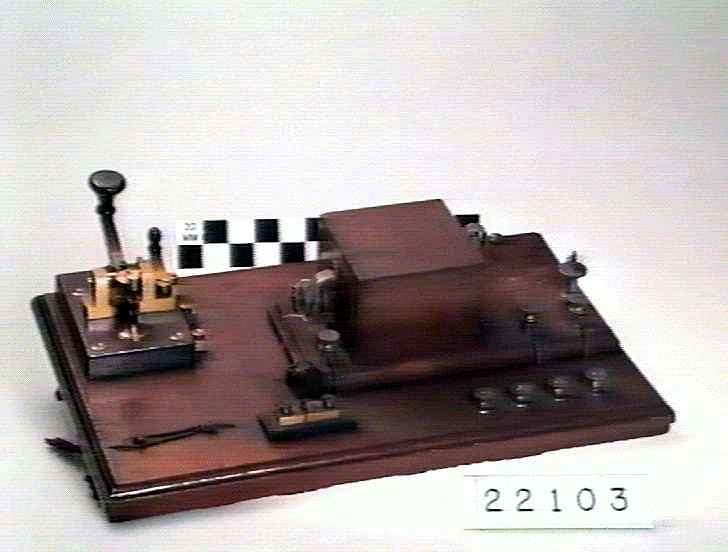
A useful historical comparison can consider reach, reliability, detail preserved and the skills required. Keep claims tied to a time and place. An object photograph helps identify parts of a system, but records of use are needed to explain how people actually communicated through it.
Only if you feel like trying
Design and test a tiny code
- Assign four three-signal patterns to four fictional robot instructions.
- Encode two instructions and mark their boundaries.
- Decode them using only your written codebook, then explain one error the boundaries prevent.
Optional paper code. No real contact details, secret personal messages, electrical equipment or online communication is needed.
Look at the sources.
These references informed this introduction. You can check who published them, what evidence they use and whether you would ask another question.
- National Museum of AustraliaOverland telegraph
- Museums VictoriaTelegraph Key & Relay - Victorian Telegraph Service, 1860s
Research checked 1 November 2026. External pages have their own content and privacy practices.
Where could this connect?
These are editorial links between subjects. You choose which, if any, to follow.
Binary & Digital Data
A small set of signals can encode different meanings when a shared representation is defined.
Follow this connection
History
Changes in communication need evidence about systems and actual use in their period.
Follow this connectionNetworks & the Internet
A working communication path depends on connected stages rather than the sender alone.
Follow this connection