
A little room to wonder
Networks & the Internet
Networks move information between connected devices. The internet connects networks; the web is one service that uses that infrastructure.
Why is a website more than a picture stored somewhere on your own screen?
Separate the connection from the service
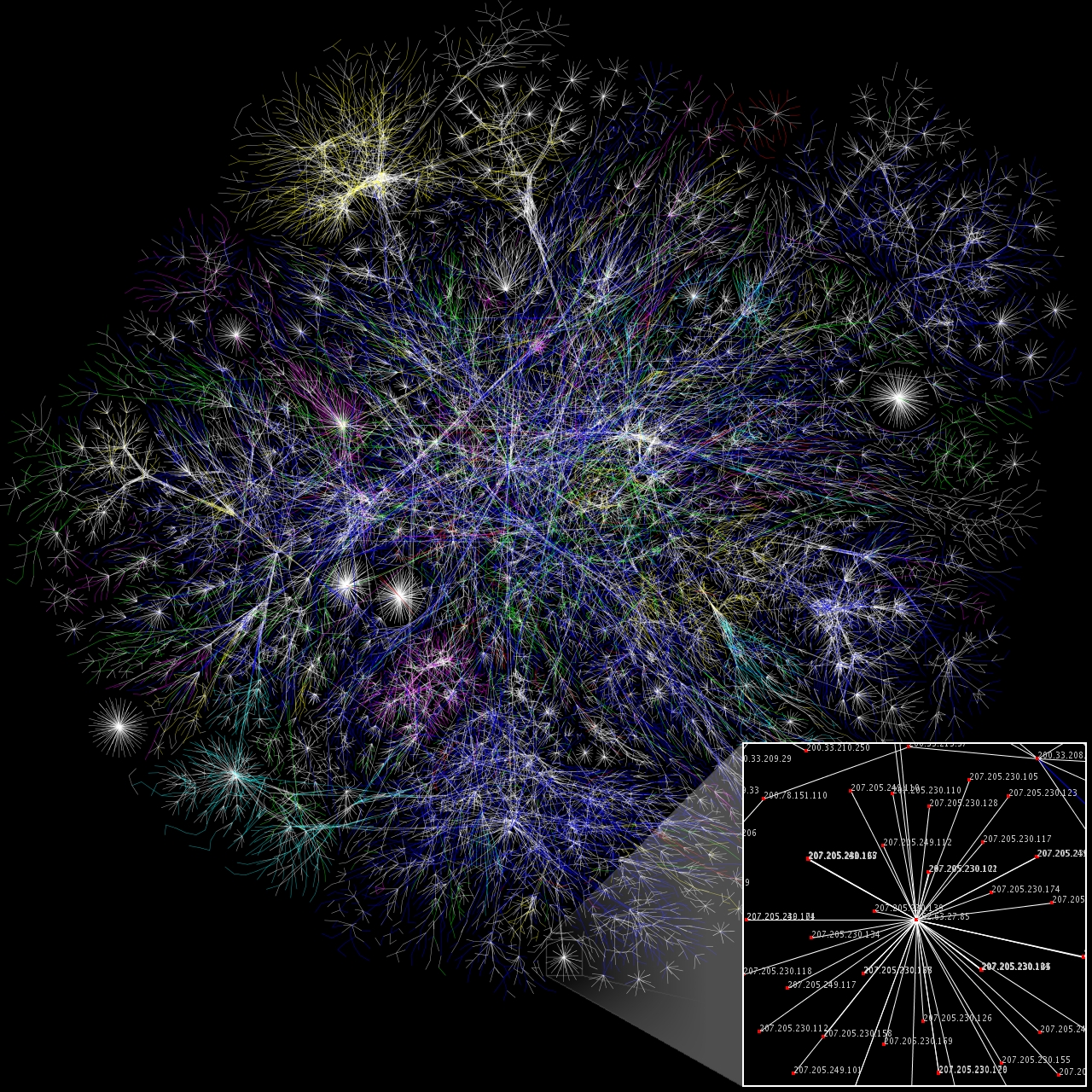
A network connects devices so they can exchange information. The internet connects many networks using agreed communication rules. The web uses this infrastructure to request and deliver resources such as pages, scripts and images; email and other services also use networks.
Wi-Fi describes a local wireless connection, not the whole internet. A device can be connected to a local network while the wider internet connection is unavailable. Distinguishing these layers makes an explanation more useful than saying that everything online is simply “the Wi-Fi”.
Follow a request and a response
A client, such as a browser, requests resources from a server. Domain-name lookup helps translate a human-readable name into addressing information. The server’s response and the browser’s assembly of the resources contribute to the page you see.
Data travels in packets rather than one continuous object shaped like the finished page. Routers forward packets between networks. Depending on the protocols involved, missing information may need retransmission and pieces may need to be placed in the correct order.
Worked example: rebuild a fictional message
A paper model splits “KEEP THE KEY” into numbered pieces: 1 is “KEEP ”, 2 is “THE ” and 3 is “KEY”. They arrive in the order 3, 1, 2. The receiver uses their sequence labels to assemble 1–2–3 and recover the intended message.
If piece 2 never arrives, simply joining the others gives “KEEP KEY”, which is incomplete. The receiver needs a way to notice the gap rather than silently guess. This illustrates one function of communication protocols; real packets also carry addressing and other information, and not every protocol guarantees the same delivery behaviour.
A map of connections is not the whole experience
In another fictional model, route A–B–D and route A–C–D both connect the same endpoints. Losing the B–D connection may leave an alternative path through C. Whether a real network can use an alternative depends on its configuration and conditions; a drawn line alone does not prove availability or speed.
Encryption, access permissions and trustworthy content address different questions. A successfully loaded page is not automatically accurate or private. Practise using paper messages and invented nodes here: do not scan networks, request passwords or send identifying information to test the idea.
Only if you feel like trying
Deliver an invented message on paper
- Divide a harmless invented sentence into three numbered pieces and read them in a different order.
- Reassemble them from the labels, then remove one piece and describe the missing information.
- Draw two possible routes between fictional endpoints and label what the model leaves out.
Optional. Work on paper, point to the example or talk it through. No account, purchase or public sharing is needed.
Look at the sources.
These references informed this introduction. You can check who published them, what evidence they use and whether you would ask another question.
- MDN Web Docs, MozillaHow does the Internet work?
- MDN Web Docs, MozillaHow the web works
Research checked 1 November 2026. External pages have their own content and privacy practices.
Where could this connect?
These are editorial links between subjects. You choose which, if any, to follow.
Communication through Time
Communication systems have always needed ways to address, carry and interpret messages.
Follow this connection
Computing
Network protocols make exchanges between different computing systems interpretable.
Follow this connectionGame Worlds & Level Design
A graph of connections can model both communication routes and the choices available between game locations.
Follow this connection