
A little room to wonder
Crystals & Regular Patterns
Use a repeating-unit model to connect regular structure with a larger pattern, while keeping atomic arrangements separate from visible faces.
How can a small repeated unit describe a much larger crystal model?
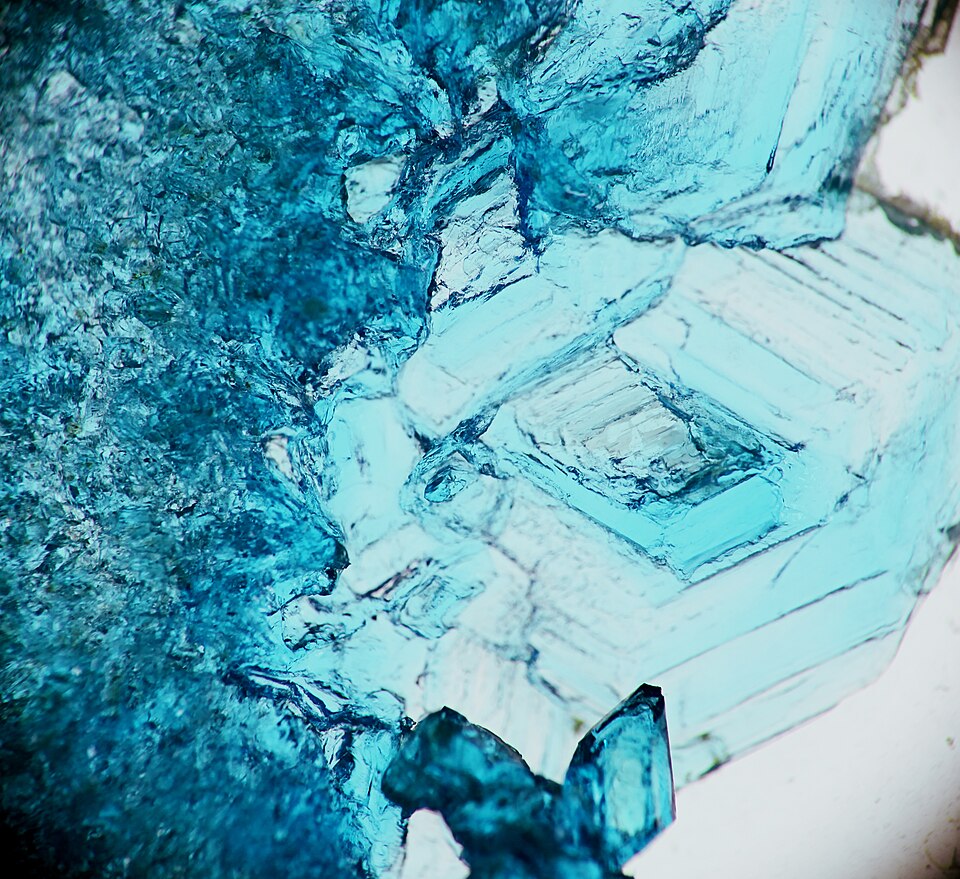
A visible shape and an internal arrangement differ
A crystal can have recognisable flat faces and edges, but the visible object is vastly larger than its atoms, ions or molecules. A photograph of a crystal is not an image of individual particles. The regular appearance prompts a structural question rather than directly answering it.
An introductory lattice model represents an ordered repeating arrangement. A unit cell describes a repeat that can extend through three dimensions. This is a way to organise a structure, not a claim that real particles are coloured beads joined by visible sticks.
Separate a repeat position from its contents
A simple paper analogy uses identical rectangles repeated across a grid, with a chosen motif inside each rectangle. Moving by one repeat width preserves the pattern. The grid supplies positions; the motif says what is repeated at those positions.
A two-dimensional paper pattern leaves out a crystal’s third direction and the physical interactions between particles. It can teach repetition and counting without pretending to be a complete chemical structure. Use an explicit key rather than assigning real chemical identities to decorative dots.
Worked example: count an invented motif
Put two blue dots and one orange dot strictly inside each paper repeat cell, with no dot on a boundary. A 2-by-3 array has six cells, so it contains 12 blue dots and 6 orange dots. The overall ratio 12:6 simplifies to 2:1, matching each individual motif.
An array of 4-by-3 cells has 12 repeats and therefore 24 blue dots and 12 orange dots. The amounts double while the ratio stays 2:1. This arithmetic works because the dots are interior to their cells; a model with shared boundary points would require a different counting rule.
Regular does not mean fully explained
A repeated arrangement can help explain some material properties, but a repeating picture alone does not establish composition, bonding or strength. Different arrangements and interactions matter. A neat visual pattern is therefore a model to investigate, not a complete material specification.
The activity uses drawn symbols only. It does not involve growing crystals, mixing substances or reproducing the material in the photograph. Its useful result is a clear account of what repeats, what is counted and which physical questions the paper analogy leaves unanswered.
Only if you feel like trying
Design and count a paper lattice
- Draw six repeat rectangles in two rows of three and place the supplied three-dot motif strictly inside each.
- Calculate the two dot totals and their ratio, then predict a four-by-three version.
- Explain why placing dots on cell borders would make a naive count unreliable.
Optional. Use paper or talk through the supplied fictional example. No purchase, personal information, account, public sharing or practical experiment is needed.
Look at the sources.
These references offer further reading on the ideas here. Check who published them, what they support and what you would ask next.
- OpenStax / Rice University10.6 Lattice Structures in Crystalline Solids
Research checked 1 November 2026. External pages have their own content and privacy practices.
Where could this connect?
These are editorial links between subjects. You choose which, if any, to follow.
Chemistry
Crystalline structures connect chemical arrangements with repeated spatial organisation.
Follow this connection
Ratio & Proportion
Repeating the same motif changes amounts while preserving its count ratio.
Follow this connectionTessellations & Tilings
A plane tiling makes repeated cells visible while leaving crystal depth outside the model.
Follow this connection