
A little room to wonder
Tessellations & Tilings
Test how shapes cover a flat plane by examining both local angle sums and a repeatable whole pattern.
When do shapes meeting at one point become a tiling that can keep going?
Define the kind of tiling
A tessellation covers a flat plane without gaps or overlapping interiors. A regular polygon has equal sides and equal interior angles. A regular tessellation uses one kind of regular polygon, with the same arrangement at every vertex. These conditions are stricter than making a decorative patch from several shapes.
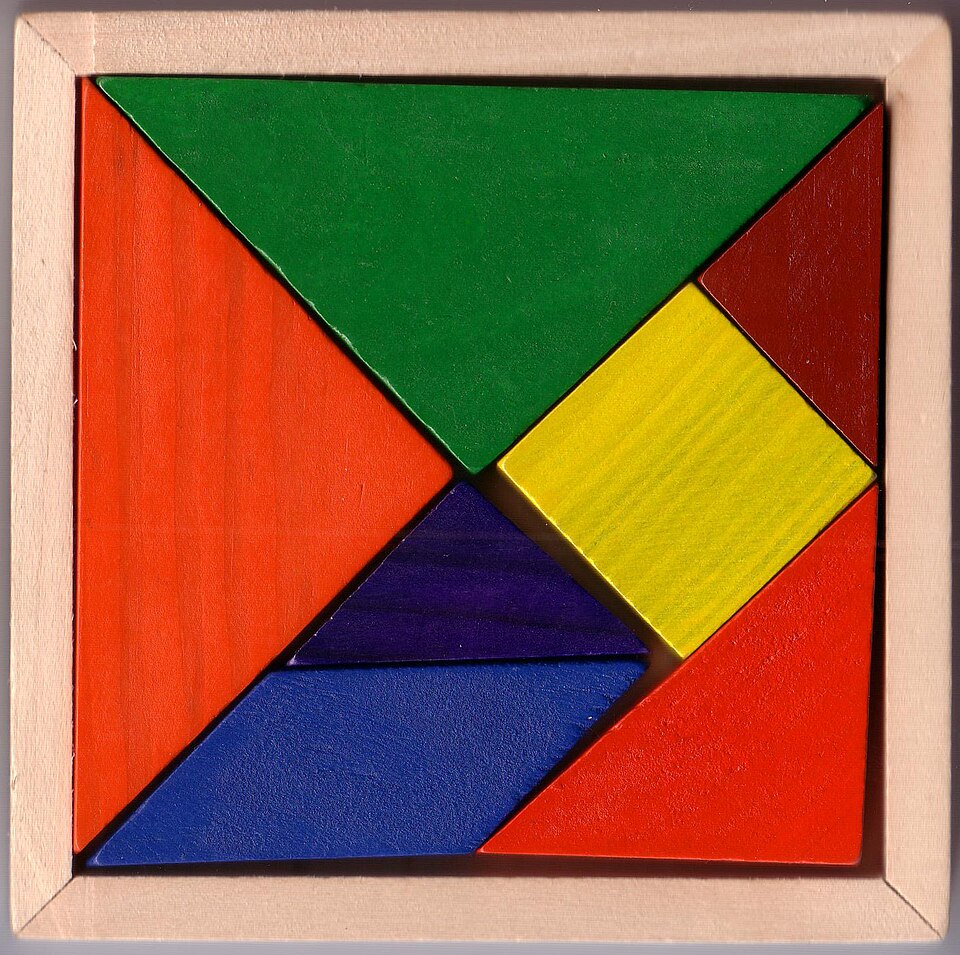
A tangram fills a bounded square using different pieces. That is a useful example of fitting regions together, but it does not by itself demonstrate an infinite regular tessellation. State whether you are filling one outline or proposing a pattern that can continue across the plane.
Worked example: check one vertex
Angles around a point total 360°. Six equilateral triangles contribute 6 × 60° = 360°; four squares contribute 4 × 90° = 360°; three regular hexagons contribute 3 × 120° = 360°. Repeated rows or matching arrangements can extend each of these into a regular tessellation.
A regular pentagon has a 108° interior angle. Three leave a 36° gap because 3 × 10⁸° = 324°, while four overlap because their angles total 432°. This rules out an edge-to-edge regular tessellation made only from regular pentagons. It does not rule out every irregular pentagon or every mixed pattern.
Distinguish a necessary check from a complete proof
Two regular octagon angles and one square angle total 135° + 135° + 90° = 360°. This passes a local vertex check and can be extended in the familiar square-and-octagon tiling. Merely finding a different combination totalling 360° would still require checking consistent edges and neighbouring vertices.
A local arrangement describes one meeting point; a whole tiling requires compatible choices everywhere. When drawing a small patch, examine its boundary and explain how another row would attach. A pretty centre with an impossible edge has not established continuation.
Use counterexamples carefully
One failed arrangement does not prove that all arrangements fail. Equally, one successful corner does not prove unlimited continuation. Keep the claim as narrow as the reasoning: which shapes, which matching rule and which surface are being considered?
You can investigate using pencil outlines and labelled angles, without cutting tiles or borrowing culturally specific designs. If you choose a visual inspiration later, identify its maker and context separately from the geometric argument. Geometry does not erase the authorship of a pattern.
Only if you feel like trying
Test a tiling on paper
- Write the triangle, square, hexagon and regular-pentagon angle sums supplied above.
- Sketch a small square grid and explain how another row can attach without changing the rule.
- Explain why the seven-piece tangram and an infinite regular tessellation make different claims.
Optional. Use paper or talk through the supplied fictional example. No purchase, personal information, account, public sharing or practical experiment is needed.
Look at the sources.
These references offer further reading on the ideas here. Check who published them, what they support and what you would ask next.
- Illustrative MathematicsRegular Tessellations of the Plane
- NRICH / University of CambridgeSemi-Regular Tessellations
Research checked 1 November 2026. External pages have their own content and privacy practices.
Where could this connect?
These are editorial links between subjects. You choose which, if any, to follow.
Crystals & Regular Patterns
Crystal models also repeat a unit, although atomic arrangements and flat polygon tilings are different models.
Follow this connection
Geometry & Symmetry
Translations and rotations help describe repeated tile arrangements and distinguish repetition from symmetry.
Follow this connectionMathematics
Mathematics separates definitions, necessary conditions, examples and proofs.
Follow this connection