
A little room to wonder
Geometry & Symmetry
Distinguish moving a shape from finding a symmetry, then test which properties remain unchanged.
What must match before you can call two shapes congruent?
Describe a transformation precisely
A translation moves every point by the same directed amount. A rotation turns a shape around a stated centre through a stated angle. A reflection maps points across a stated line. In the plane, these transformations preserve lengths and angles, so the resulting shape is congruent to the original.
Congruent means matching shape and size, even if position or orientation differs. Similar shapes can differ in size. An enlargement can preserve angles while changing lengths, so resemblance alone does not establish congruence.
Work through a point movement
For an original coordinate example, point P is at (2, 1). Reflecting in the vertical y-axis gives P at (−2, 1): the horizontal coordinate changes sign while the vertical coordinate stays the same. Translating the original point by 3 units right and 1 down gives (5, 0). State which starting point each operation uses.
Transformations can be combined, and order can matter. Translating P first and then reflecting gives (−5, 0). Reflecting first and then applying the same translation gives (1, 0). The two results differ, even though the named operations are the same.
A symmetry maps a figure onto itself
A transformation is a symmetry of a figure when the transformed figure coincides with the original. A non-square rectangle has two reflection axes through its centre and rotational symmetry under a half-turn. A square has additional symmetries. Marked colours or labels can remove symmetries that the unmarked outline has.
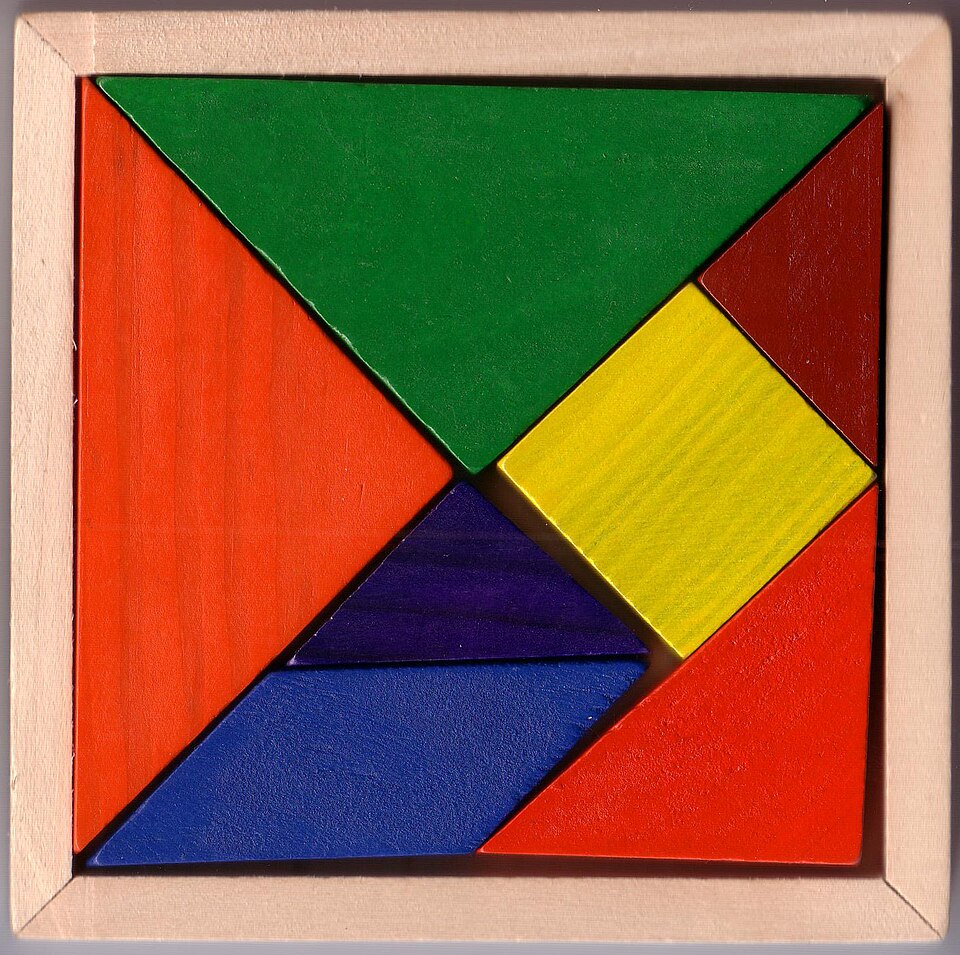
Specify what counts as part of the figure. Rotating a square frame may preserve its outline while moving a red corner to a blue corner. If colour matters to the comparison, that rotation may no longer be a symmetry of the complete design.
Test rather than trust an impression
A roughly drawn shape can look symmetrical without exact matching lengths or positions. Use a labelled model to explain the property you mean. Measurements can suggest a relationship; a geometric argument explains why it follows from the given conditions. A neat picture alone is not a proof.
Only if you feel like trying
Test a marked square
- Draw a square and mark one corner with a dot.
- List transformations that preserve the plain outline, then reconsider them with the dot included.
- Use the coordinate example to compare the two orders of reflection and translation.
Optional drawing activity. A sketch is enough; no cutting tools or specialist geometry software is needed.
Look at the sources.
These references informed this introduction. You can check who published them, what evidence they use and whether you would ask another question.
- Australian Mathematical Sciences InstituteCongruence
- Australian Mathematical Sciences InstituteIntroduction to plane geometry
Research checked 1 November 2026. External pages have their own content and privacy practices.
Where could this connect?
These are editorial links between subjects. You choose which, if any, to follow.
Colour & Contrast
Colour markings can change the symmetries of a visual design.
Follow this connection
Mathematics
Geometric claims need definitions and reasons as well as visual intuition.
Follow this connectionStructures & Bridges
A frame’s geometry constrains the movements its members can make.
Follow this connection