
A little room to wonder
Everyday Inventions
An everyday object can have many versions and uses. Comparing dated evidence helps separate a particular design change from the much stronger claim that one person invented an entire idea.
What does an older catalogue prove about a design, and what does it leave unresolved?
Look for the problem and the version
An invention combines an idea with a practical way of doing something. Objects can then be redesigned for materials, manufacture or a different use. The history of a category such as paper clips is broader than the history of one particular clip shape.
London Museum records a tinplate letter clip shaped like a gloved hand, with an approximate production range of 1880–1905. This is evidence of one surviving design and its catalogue description. It does not show that this was the first paper clip or that all clips in that period looked alike.
Worked example: two fictional catalogues
An invented 1900 catalogue shows Clip A with one loop and a stated capacity of five paper sheets. An invented 1908 catalogue shows Clip B with two loops and a stated capacity of eight. Both statements are claims in the fictional catalogues, not independent test results.
The difference in stated capacity is three sheets, and the later claim is 8/5 = 1.6 times the earlier one. The records support a comparison between these two advertised versions. They do not prove that the extra loop caused the difference, that every user achieved it or that no two-loop design existed before 1908.
First surviving evidence is a limited claim
An early dated illustration establishes that a form was recorded by that date, if the record is authentic. It does not automatically identify the first person ever to imagine it. A patent, catalogue, surviving object and recollection each have different purposes and evidential limits.
A material change may affect cost, flexibility, durability or appearance in different ways. A more recent object is not necessarily better for every use. Explain which criterion a comparison uses rather than treating newness as a universal score.
Keep observation apart from explanation
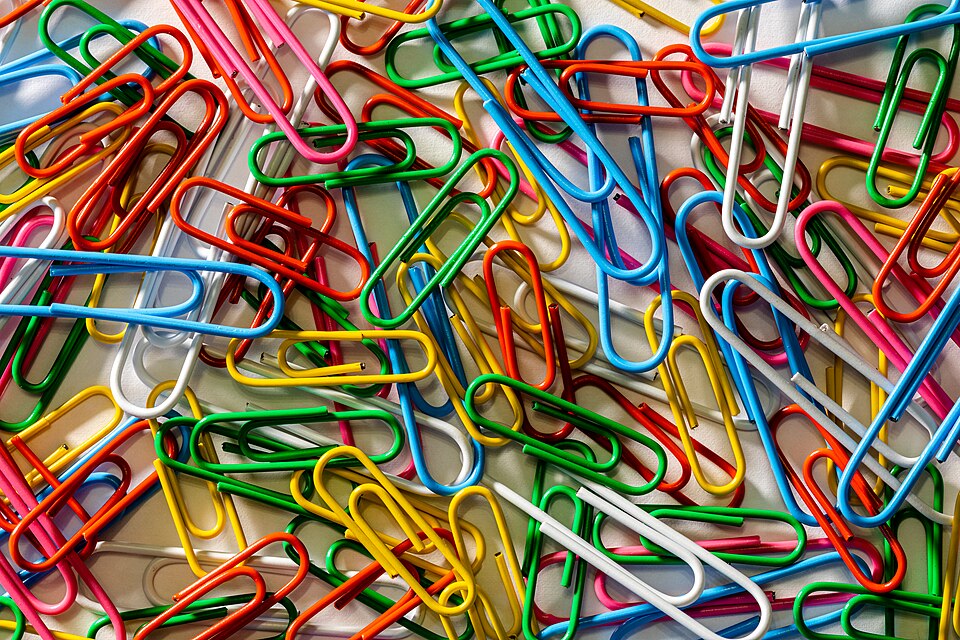
The colourful clips in the photograph have overlapping loop forms, but the image cannot date each design or measure holding capacity. A visible difference is a starting point for a question, not a complete invention history. Named records are needed for historical claims.
You can explore the fictional catalogues as drawings and written specifications. There is no need to unbend metal, test a device, buy materials or publish an invention claim. An annotated comparison can show both what changed and what remains unknown.
Only if you feel like trying
Compare two catalogue claims
- Draw and label the two fictional clip versions, their dates and their advertised capacities.
- Calculate the difference and ratio of the claimed capacities. Mark these as catalogue claims rather than measured results.
- Write one conclusion supported by the two records and one further source needed before making a first-invention or cause claim.
Optional paper comparison. No bending wire, dismantling objects, device use, purchase or public submission is required.
Look at the sources.
These references offer further reading on the ideas here. Check who published them, what they support and what you would ask next.
- London MuseumPaper clip, letter clip: object Z6182
Research checked 1 November 2026. External pages have their own content and privacy practices.
Where could this connect?
These are editorial links between subjects. You choose which, if any, to follow.
Design
A changed form needs a stated purpose and criterion before it can be called an improvement.
Follow this connection
History
History can investigate ordinary objects by comparing surviving designs, uses and records rather than assuming one familiar form appeared all at once.
Follow this connectionKnowledge & Evidence
A surviving example supports a narrower claim than a universal first-invention story.
Follow this connection