
A little room to wonder
Fractions & Equivalence
Rename a fraction without changing its value, and keep the size of the whole visible.
How can more pieces represent exactly the same amount?
Name the whole before the pieces
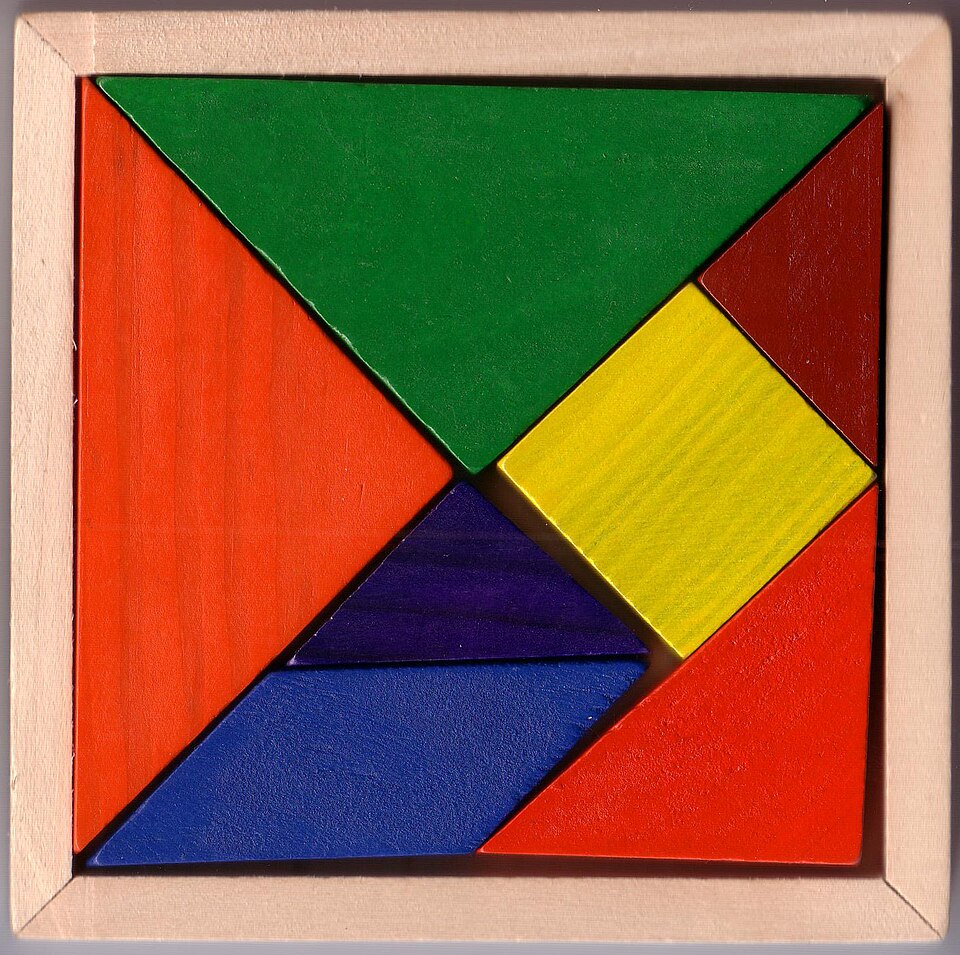
A fraction can describe a number or a share of a specified whole. In an equal-part area model, the denominator counts the equal parts in the whole and the numerator counts the parts selected. Two of three equal regions represent two-thirds, written 2/3. Unequal-looking shapes can have equal area, but counting arbitrary pieces does not establish equal shares.
The chosen whole matters when comparing amounts. Half of a small rectangle and half of a larger rectangle have the same fractional value, yet can cover different areas. Label the whole before deciding whether two shaded pictures represent the same amount of paper.
Worked example: rename two-thirds
Imagine one rectangle divided into three equal strips, with two shaded. Split every strip in half. There are now six equal pieces and four are shaded: 2/3 = 4/6. Split each original strip into four instead and the same region becomes 8/12. The shaded boundary has not moved; only the counting unit changed.
Numerically, multiplying numerator and denominator by the same non-zero factor multiplies the fraction by one. Adding the same number to both does something different: 2/3 becomes 3/4 after adding one, and 3/4 is larger. A rule should explain the preserved value, rather than resemble the correct pattern.
Combine compatible pieces
Suppose a fictional paper design uses 2/3 of a strip for blue and another 1/6 for a separate yellow region. Rename 2/3 as 4/6. The total is then 4/6 + 1/6 = 5/6 of that same strip. Adding the denominators would change the size of the unit midway through the calculation.
A number line offers another check: equivalent fractions occupy one position even when their labels differ. Draw zero and one first, then locate thirds and sixths between them. If a proposed equivalent fraction lands elsewhere, inspect the renaming rather than adjusting the drawing to fit the answer.
Choose a useful representation
Equivalent forms help compare, combine and interpret quantities. The smallest denominator is not always the most useful: sixths make the addition above easier, while twelfths might suit a different diagram. Explain why a chosen form helps the particular question.
The tangram image is useful for questioning equal shares: its seven pieces are not seven equal areas. It does not illustrate the fictional strip calculation. A convincing explanation connects a labelled whole, an unchanged value and the operation that renamed it.
Only if you feel like trying
Make three names for one region
- Sketch the supplied same-sized strip models for 2/3, 4/6 and 8/12.
- Show the separate 1/6 addition using sixths and label the unfilled share.
- Invent one incorrect renaming and explain exactly what changed.
Optional. Use paper or talk through the supplied fictional example. No purchase, personal information, account, public sharing or practical experiment is needed.
Look at the sources.
These references offer further reading on the ideas here. Check who published them, what they support and what you would ask next.
- OpenStax / Rice University4.1 Visualize Fractions
Research checked 1 November 2026. External pages have their own content and privacy practices.
Where could this connect?
These are editorial links between subjects. You choose which, if any, to follow.
Geometry & Symmetry
Geometric partitions help test equal areas; counting shapes alone does not prove equality.
Follow this connection
Mathematics
Mathematics uses equivalent representations to preserve a value while making a question easier to solve.
Follow this connectionRatio & Proportion
A part-to-part ratio becomes a part-to-whole fraction only after the whole is identified.
Follow this connection