
A little room to wonder
Mechanisms & Simple Machines
Explore what a lever, pulley or gear can change, and the distance or motion traded for that change.
How can a machine reduce the force needed without creating energy?
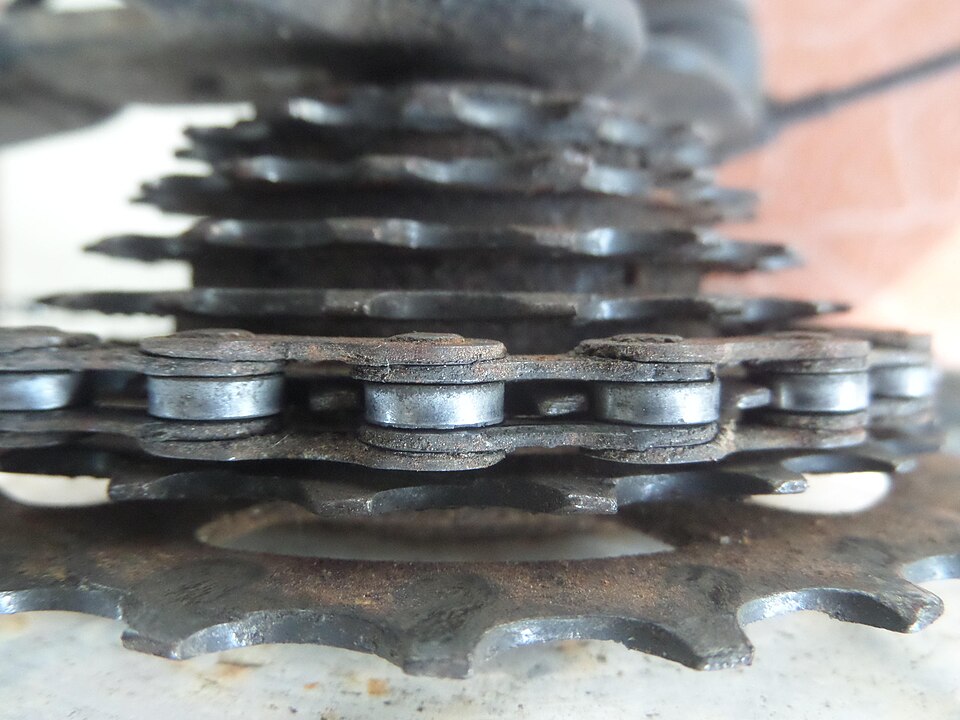
A mechanism connects movements
A mechanism is an arrangement of parts whose movement affects other parts. A bicycle chain transfers movement between toothed wheels. A lever rotates around a pivot, called a fulcrum. A machine can be useful without a motor: its arrangement may change a force’s direction or trade a larger movement for a larger output force.
Identify input and output before judging what the mechanism does. The input is where an action is applied; the output is the resulting action you care about. The same arrangement can behave differently when you change which part is driven.
Work through an ideal lever
Imagine an ideal lever with an effort applied 30 centimetres from its pivot and a load acting 10 centimetres from it. For perpendicular forces in balance, 2 newtons at the effort end can balance 6 newtons at the load end: 2 × 30 = 6 × 10. This is a calculation for a stated model, not a lifting instruction.
The longer arm moves through a greater distance during the same rotation. If the input point moves about three times as far, a threefold force increase does not give free work. Work involves force acting through a distance. Real mechanisms also transfer some energy into heating and sound.
Direction and speed are choices too
A fixed pulley can change the direction of a pull without multiplying its force in an ideal model. Arrangements with several supporting rope sections can trade a longer pull for a larger output force. Counting pulleys alone is insufficient; trace which rope sections actually support the moving load.
Gears also connect motion. For two meshing gears with 12 and 36 teeth, three turns of the smaller gear correspond to one turn of the larger, in the opposite direction. Friction, alignment and material limits affect a real mechanism.
A useful machine has limits
Mechanical advantage compares output force with input force. It is not the same as efficiency, which compares useful output energy with input energy. A mechanism may multiply force while wasting substantial energy. Draw the motion and state what your ideal model ignores before making claims about performance.
Only if you feel like trying
Trace a paper mechanism
- Draw a lever with a pivot and label a long input arm and short output arm.
- Choose two arm lengths and a pair of perpendicular forces that would balance in an ideal model.
- Draw the input and output movements and explain the distance trade.
Optional diagram activity. Do not improvise lifting equipment or work with heavy loads, moving machinery or tensioned ropes.
Look at the sources.
These references informed this introduction. You can check who published them, what evidence they use and whether you would ask another question.
- OpenStax, Rice UniversitySimple Machines
- OpenStax, Rice UniversitySimple Machines
- TeachEngineering, University of Colorado BoulderGet in Gear
Research checked 1 November 2026. External pages have their own content and privacy practices.
Where could this connect?
These are editorial links between subjects. You choose which, if any, to follow.
Animation & Timing
Tracing connected movements can inform the believable timing of an animated machine.
Follow this connection
Energy & Power
Force multiplication still has to respect energy transfer and losses.
Follow this connectionEngineering
Engineers choose mechanisms according to the motion and force a task needs.
Follow this connection