
A little room to wonder
Plant Cells & Specialisation
Connect different plant-cell features with their roles without assuming every plant cell has the same appearance or job.
Why is one textbook cell drawing not a complete picture of a plant?
A general diagram is a starting point
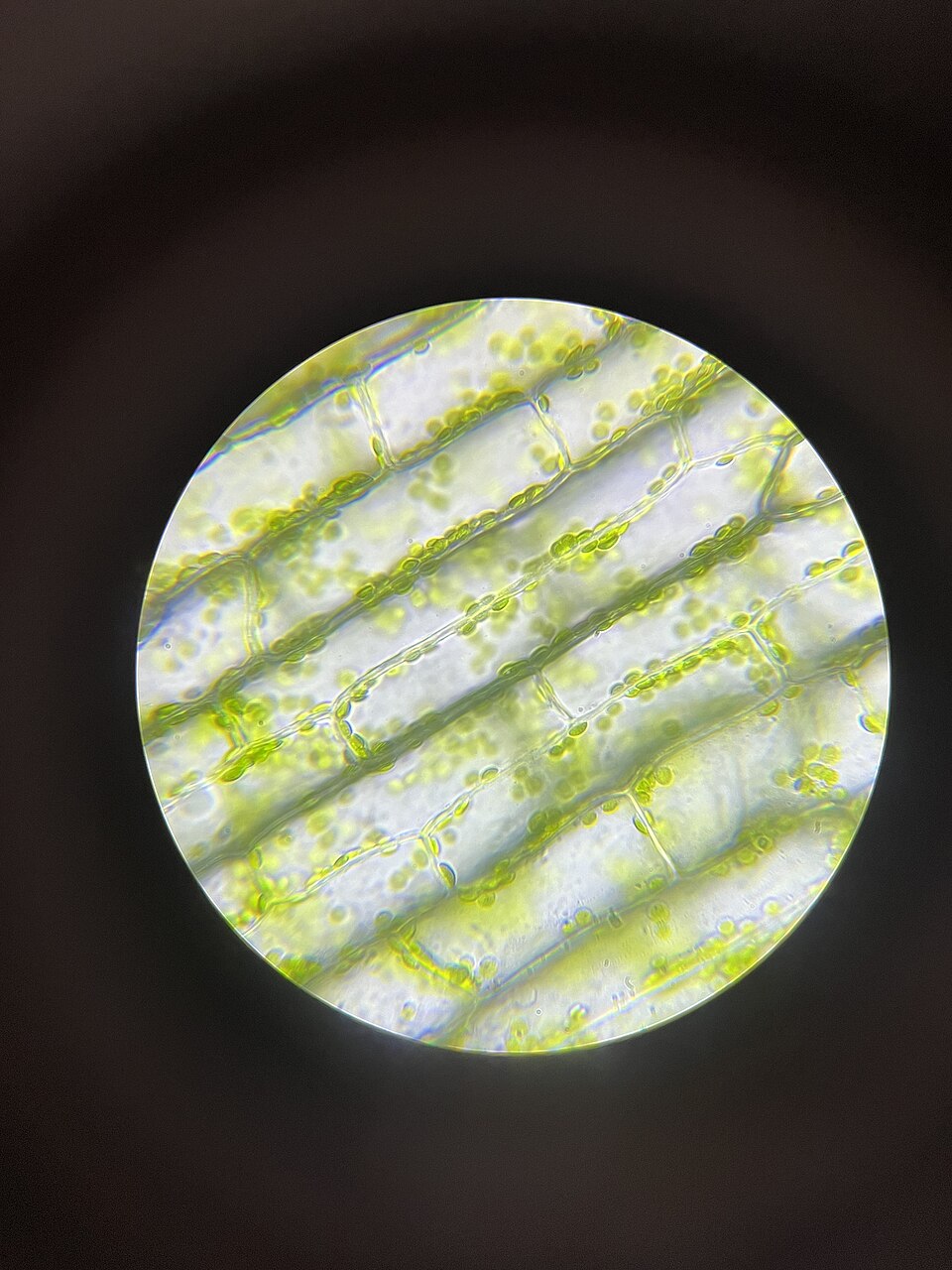
A typical plant-cell diagram collects useful structures into one simplified view. A real plant contains many cell types arranged in tissues. Photosynthetic tissue, protective surfaces and transport tissues contribute differently to the whole organism. One convenient drawing does not represent every cell equally well.
Cell specialisation means that structural features suit a particular role. The explanation should connect a feature with what it enables, rather than say that a cell consciously decided which job to do. Cells also work within a tissue arrangement, not as unrelated miniature objects.
Compare features with a question in mind
A photosynthetic leaf cell may contain many chloroplasts. A root-hair cell has a long surface extension useful for exchange with its surroundings. Guard cells help regulate an opening in the leaf surface. These are different structural questions, so “Which cell is best?” needs a stated purpose.
Transport tissue also contains specialised structures, while surrounding cells provide support, storage or other functions. Finding no green bodies in a particular plant cell does not show that it is not a plant cell. A green appearance alone is likewise not a measurement of photosynthetic rate.
Worked example: interpret a fictional sample
An invented viewing field contains eight clearly separated cell outlines; six show visible green structures under the stated imaging conditions. The observed fraction is 6/8 = 3/4, or 75%. This describes the recorded field, not every cell in the plant.
If two additional outlines are too blurred to classify, record them as uncertain instead of quietly assigning them to either group. The result then becomes six positive observations, two negative observations and two uncertain outlines in that wider field. A new denominator changes the question, so keep the counting rule visible.
Use more than one kind of evidence
A feature can support a functional explanation without uniquely identifying the cell. To strengthen an interpretation, ask where it sits, what neighbouring tissue looks like, which imaging method was used and whether other expected features can be seen. A single colour or outline is usually incomplete evidence.
The example and activity concern plant structures only. They do not require specimens, stains or microscope handling. A paper comparison can practise careful classification while making it clear which features were supplied and which biological role is still an interpretation.
Only if you feel like trying
Compare three invented cell descriptions
- Write cards for a cell with many green structures, a cell with a long surface extension and a pair of cells around an opening.
- Match each to a plausible plant role and explain the structural connection without claiming the card proves its identity.
- Calculate the eight-outline sample fraction, then add the two uncertain outlines as a separate category.
Optional. Use paper or talk through the supplied fictional example. No purchase, personal information, account, public sharing or practical experiment is needed.
Look at the sources.
These references offer further reading on the ideas here. Check who published them, what they support and what you would ask next.
- OpenStax / Rice University30.1 The Plant Body
- OpenStax / Rice University30.4 Leaves
- OpenStax / Rice University30.3 Roots
Research checked 1 November 2026. External pages have their own content and privacy practices.
Where could this connect?
These are editorial links between subjects. You choose which, if any, to follow.
Biology
Specialised cells show how biological structures contribute to different tissue functions.
Follow this connection
Categories & Counterexamples
A useful category must allow counterexamples to an overly simple rule such as all plant cells look green.
Follow this connectionRoots, Stems & Leaves
A whole plant links these different tissues through roots, stems and leaves.
Follow this connection