
A little room to wonder
Roots, Stems & Leaves
Follow how roots, stems and leaves work as a connected vegetative system rather than as unrelated labels.
How do different plant parts contribute to the same living system?
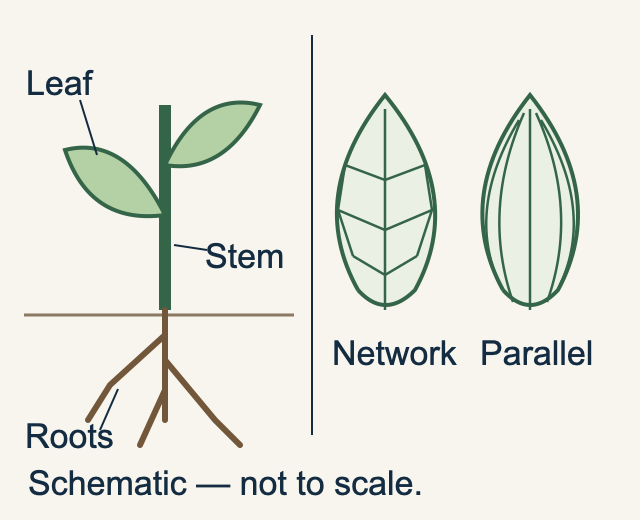 Launch Horizon HQ · Source · Original Horizon diagram
An organ is part of a system
Roots help anchor a plant and absorb water and mineral nutrients. Stems support other parts and connect transport routes. Leaves commonly provide a large area for photosynthesis and exchange with the surroundings. The useful question is how their roles connect, not which single part does everything.
These are broad patterns, not a rule that every stem is above ground or every leaf has the same outline. A diagram deliberately simplifies a particular plant arrangement. Label its structures without treating it as a complete catalogue of plants.
Matter follows different routes
Water and mineral nutrients absorbed by roots can move through xylem towards above-ground parts. Sugars produced in photosynthetic parts can move through phloem to regions that use or store them. The direction of sugar transport depends on sources and destinations, so “everything moves up” is not an adequate model.
A root does not absorb ready-made plant food from soil in place of photosynthesis. Water, mineral nutrients and carbon-containing sugars have different roles and origins. Naming them separately prevents the common mistake of using the word food for every material entering a plant.
Worked example: read a fictional stem drawing
On a paper stem, leaves attach at positions 2 cm, 5 cm and 9 cm above a chosen baseline. The attachment points are nodes. The two internode lengths between those nodes are 5 − 2 = 3 cm and 9 − 5 = 4 cm. Together they span 7 cm.
A fourth mark at 7 cm is a ruler tick, not automatically another node. The biological label depends on an attachment feature, while the ruler supplies a position. Counting every visible mark as a plant structure confuses the representation with the organism.
Connect a feature to a limited explanation
A diagram can show a support path from a leaf through a stem towards roots, but it does not measure how much force the real plant can carry. Similarly, an arrow for water indicates a route, not a measured flow rate. Different evidence is needed for those numerical claims.
Use the simplest representation that answers the question. A labelled external view is helpful for locating organs; a tissue diagram is better for separating transport systems. Neither needs an actual plant-cutting, growing or handling activity to make the reasoning clear.
Only if you feel like trying
Draw and audit a plant system
- Draw a fictional root–stem–leaf system and mark nodes at the supplied positions.
- Calculate the two internodes, then add separately labelled water/mineral and sugar routes.
- Write one structural claim the drawing supports and one rate or strength claim it cannot establish.
Optional. Use paper or talk through the supplied fictional example. No purchase, personal information, account, public sharing or practical experiment is needed.
Look at the sources.
These references offer further reading on the ideas here. Check who published them, what they support and what you would ask next.
- OpenStax / Rice University30.1 The Plant Body
- OpenStax / Rice University30.2 Stems
- OpenStax / Rice University30.3 Roots
Research checked 1 November 2026. External pages have their own content and privacy practices.
Where could this connect?
These are editorial links between subjects. You choose which, if any, to follow.
Biology
Biology connects the roles of plant organs with the tissues that link them.
Follow this connection
Plants & Photosynthesis
Photosynthesis explains why sugar supply differs from water and mineral uptake.
Follow this connectionWater Networks & Flow
A network representation helps trace connections, while its flow-rate assumptions must remain explicit.
Follow this connection