
A little room to wonder
Printmaking & Repeating Patterns
Printmaking transfers an image from a prepared surface. Repeating a motif adds another design question: how does each impression meet the next?
What must stay consistent for a repeated design to read as one pattern?
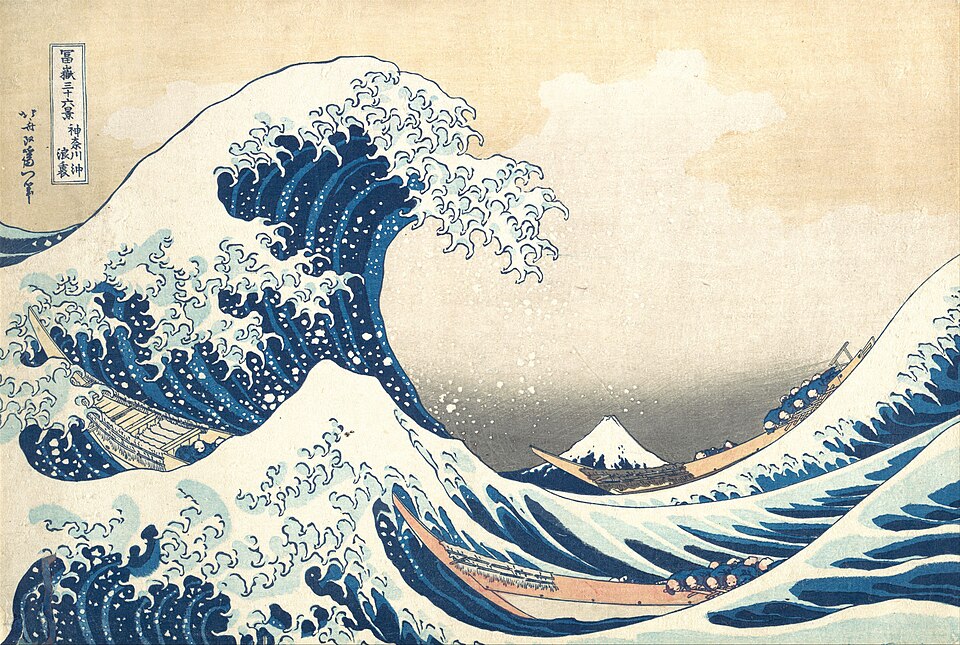
Separate matrix, impression and repeat
A matrix is the prepared surface from which an image is printed. An impression is one transferred image. In relief printing, raised areas carry ink to the receiving surface. The contact normally reverses the image from side to side.
A motif is a recognisable design unit. Repeating it can create a band or field, but a print is not necessarily a repeating pattern. A single landscape print and a repeated leaf border use different compositional plans.
Plan the repeat before making multiples
Translation moves a motif without rotating or reflecting it. Rotation turns it around a point; reflection reverses its orientation. Distinguishing these operations helps explain how a pattern develops instead of merely describing it as “the same again”.
Spacing is part of the repeat. If the motif is 2 cm wide and starts every 3 cm, the gap between neighbouring motifs is 1 cm. A repeat unit can include both the visible motif and the surrounding empty space.
Worked example: a fictional arrow border
A designer draws four right-pointing arrow motifs, each 2 cm wide, starting at 0, 3, 6 and 9 cm. The final arrow ends at 11 cm, giving three internal 1 cm gaps. Four motifs do not occupy 12 cm unless a final gap is included.
If the arrow is drawn right-pointing on a relief matrix, its impression points left. To obtain right-pointing impressions, the matrix must carry the reversed version. This is a planning model; no carving, inks or printing tools are required to test it on paper.
Repetition does not mean perfect identity
Real impressions can vary through pressure, alignment and ink. Such variations may be deliberate or unintended. A repeated structure can remain clear despite small differences, while one misaligned edge can interrupt a tightly matched pattern.
Registration concerns alignment between impressions or layers. It is different from counting repeats. Compare the planned positions with the actual marks before deciding whether a change is expressive variation or an error against the brief.
Only if you feel like trying
Plan a repeat on paper.
- Draw the four-arrow border using the supplied widths and start positions, or describe it using labelled boxes.
- Draw a second border that alternates the arrow direction. Name the operation that changed each second motif.
- Mark which gaps belong inside your repeat unit and explain what would happen at the border’s end.
Optional. Use the supplied fictional example, pencil and paper, or explain your choices aloud. No personal story, account, purchase, public sharing or contact is needed.
Look at the sources.
These references offer further reading on the ideas here. Check who published them, what they support and what you would ask next.
- Getty Research InstituteRelief printing processes — Art & Architecture Thesaurus
Research checked 1 November 2026. External pages have their own content and privacy practices.
Where could this connect?
These are editorial links between subjects. You choose which, if any, to follow.
Art
A printed image connects material processes with choices about shape and repetition.
Follow this connection
Patterns & Variation in Music
A repeated motif can remain recognisable while selected details change in an image or a musical phrase.
Follow this connectionTessellations & Tilings
Tiling asks how repeat units cover an area without gaps or overlaps; a border need not meet that condition.
Follow this connection