
A little room to wonder
Art
Art uses materials, images and deliberate choices to explore ideas, experiences and ways of seeing. Looking closely is a skill you can practise.
How can changing one visual choice change what an image communicates?
Look for the choices
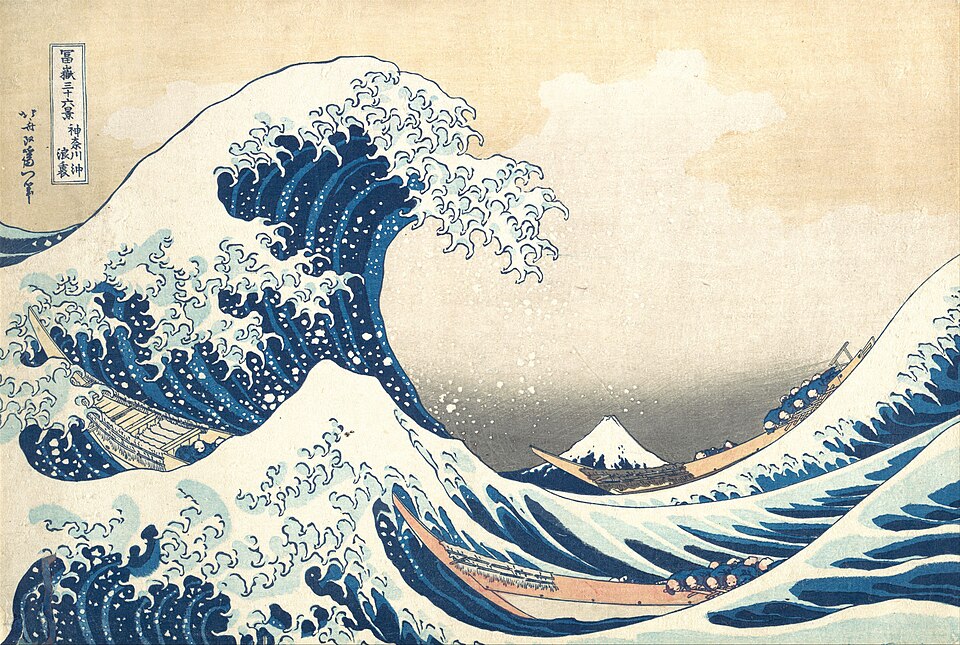
Line can guide your eye, shape can organise a picture, and differences in colour or tone can make one area stand out. Texture may be something you can feel or something an image suggests. These elements give you a way to describe what you notice before deciding whether you like it.
Observation and interpretation
“The wave fills most of the picture” describes a visible feature. “The wave feels threatening” is an interpretation. Both can start a useful conversation, but they do different jobs. Point to the details supporting your reading, then consider whether someone else could reasonably read those details differently.
An artwork has a context
Who made an artwork, where it was made and what it was made for can change your understanding. A reproduction cannot show every detail of the original material or scale. Learn about cultural meanings rather than assuming a motif is yours to copy; you can develop an original visual response instead.
Only if you feel like trying
One scene, two moods
- Draw the same imaginary doorway twice using only lines and three shapes.
- Change line direction, spacing or dark/light areas in the second version.
- Write one visible change and one possible interpretation. Keep them separate.
Optional. Use paper or talk through the idea; no account, purchase or public sharing is needed.
Look at the sources.
These references informed this introduction. You can check who published them, what evidence they use and whether you would ask another question.
- National Gallery of VictoriaExplore the Art Elements
- National Gallery of ArtThe Elements of Art
Research checked 1 November 2026. External pages have their own content and privacy practices.
Where could this connect?
These are editorial links between subjects. You choose which, if any, to follow.
Colour & Contrast
Colour is one of the relationships artists use to organise an image and guide attention.
Follow this connection
Drawing & Observation
Drawing turns close looking into deliberate choices of line, shape and tone.
Follow this connectionFilm & Animation
Composition and colour still guide attention when images are arranged into moving sequences.
Follow this connectionGames
Character art, environments and visual clues can help players recognise a role or notice a possible action.
Follow this connectionPhotography & Framing
Framing, tone and arrangement turn a selected view into a visual composition.
Follow this connectionSculpture & Materials
Sculpture extends choices of shape and texture into volume and surrounding space.
Follow this connectionStorytelling
An image can reveal information, hide it or invite a viewer to imagine what happens next.
Follow this connection