
A little room to wonder
Sculpture & Materials
Sculpture occupies space. Its material, joints, surface and surrounding gaps influence what it can do and how it is experienced.
How does a material change both the structure and meaning of a sculpture?
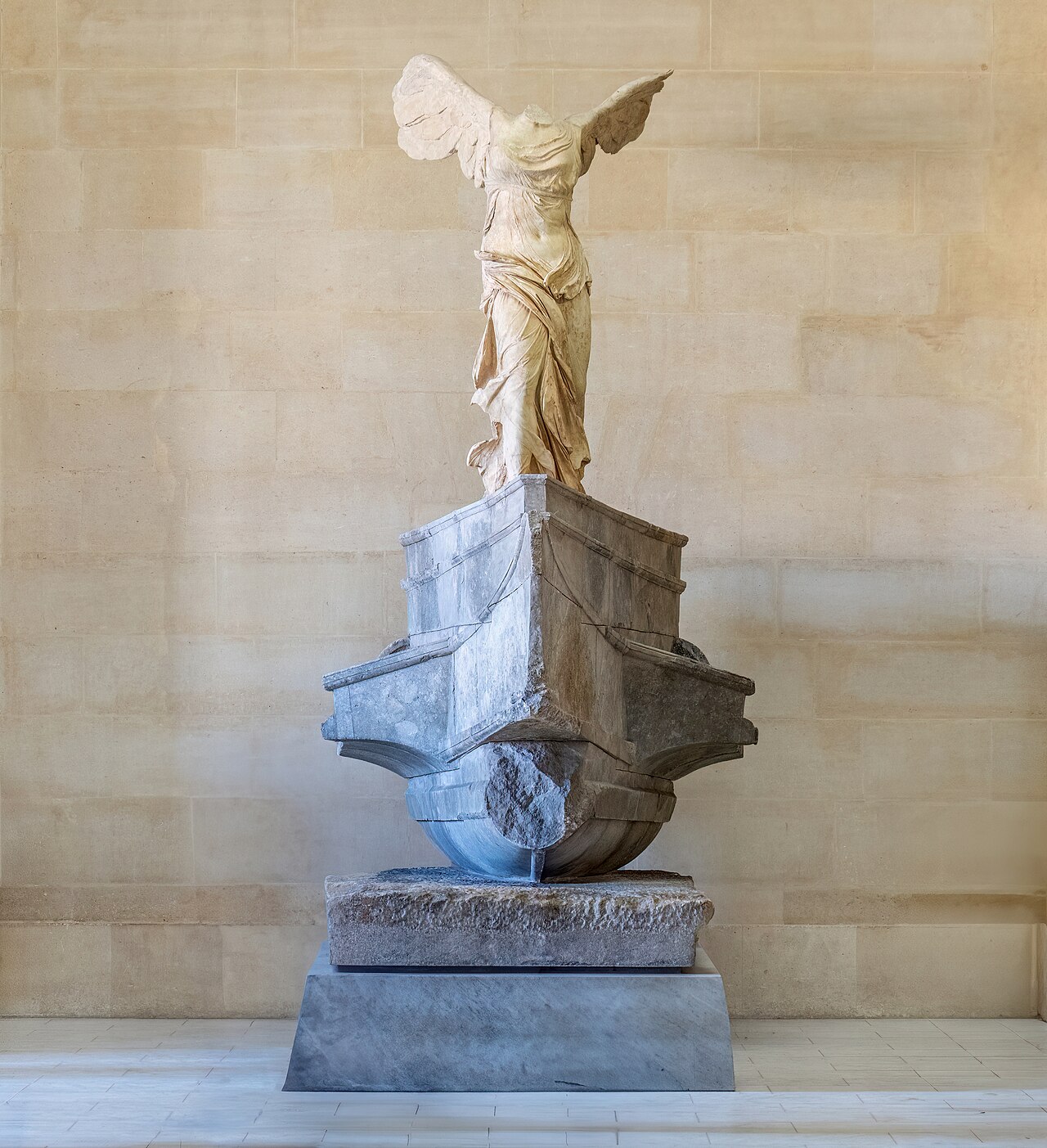
From a flat shape to a form
A drawn circle is a two-dimensional shape; a sphere has volume. Sculptures can combine geometric forms with irregular forms. The space around and through a work matters too: an opening can direct a view or make a heavy material appear airy.
A photograph gives one view of that arrangement. A projecting arm may look short from the front and long from the side. To understand a form, compare views or describe which information a single image cannot supply.
Materials offer possibilities and constraints
An additive process builds up or joins material; a subtractive process removes it. Folding, assembling, modelling and carving lead to different kinds of decisions. A thin sheet may curve easily but buckle under a load; a heavy block may stand firmly but be difficult to move.
Texture may be physically rough or smooth, while light can emphasise or hide that surface. Materials can also carry associations with ordinary objects, places or histories. Those meanings need context, not an assumption that everyone interprets a material in the same way.
Worked example: a fictional paper arch
A learner wants a small sculpture with an opening beneath it. In version A, a flat paper strip lies between two low supports and sags. Version B folds the same strip lengthwise into a shallow channel. Version C rolls another strip into a tube. These are different structures, even when they use the same paper.
The learner compares whether each version keeps its opening for ten seconds without extra load. A and B sag; C remains open in this invented trial. The record supports “C held this opening in this test”. It does not prove that tubes are always best, or that the sculpture is safe to climb on. Its next artistic decision might concern the shadow cast through that opening.
Test the question you actually have
A small model can explore appearance, balance or a joining method. It cannot automatically establish the strength of a full-sized work. Changing scale also changes practical demands, and a model may substitute materials that behave differently.
Use paper, existing packaging or a drawn proposal for this enquiry. You do not need cutting tools, wire ends, hot glue or heavy objects. Studying an artwork also does not require copying a culturally significant motif; develop an original form and acknowledge the source of your observations.
Only if you feel like trying
Give an opening a shape
- Fold or loosely roll a sheet of scrap paper into a freestanding form, or sketch two possible forms instead.
- Describe the form from the front and side. Identify one solid part and one empty space.
- Change one fold or proportion. Explain its effect on shape, shadow or stability without adding a load.
Optional. Work on paper, point to the example or talk it through. No account, purchase or public sharing is needed.
Look at the sources.
These references informed this introduction. You can check who published them, what evidence they use and whether you would ask another question.
- National Gallery of ArtThe Elements of Art: Form
- Government Digital Service, GOV.UKMaking prototypes
Research checked 1 November 2026. External pages have their own content and privacy practices.
Where could this connect?
These are editorial links between subjects. You choose which, if any, to follow.
Art
Sculpture extends choices of shape and texture into volume and surrounding space.
Follow this connection
Products & Prototypes
A small model can isolate one question before anybody commits to a finished object.
Follow this connectionStructures & Bridges
Both sculpture and bridges raise questions about how material and form support a chosen span.
Follow this connection