
A little room to wonder
Senses & Behaviour
Sensory structures help animals receive information; behaviour is what they do in a context. Observations can suggest explanations while leaving important alternatives unresolved.
When does an observation support a preference, and when could another feature explain it?
Start with a description somebody else could check
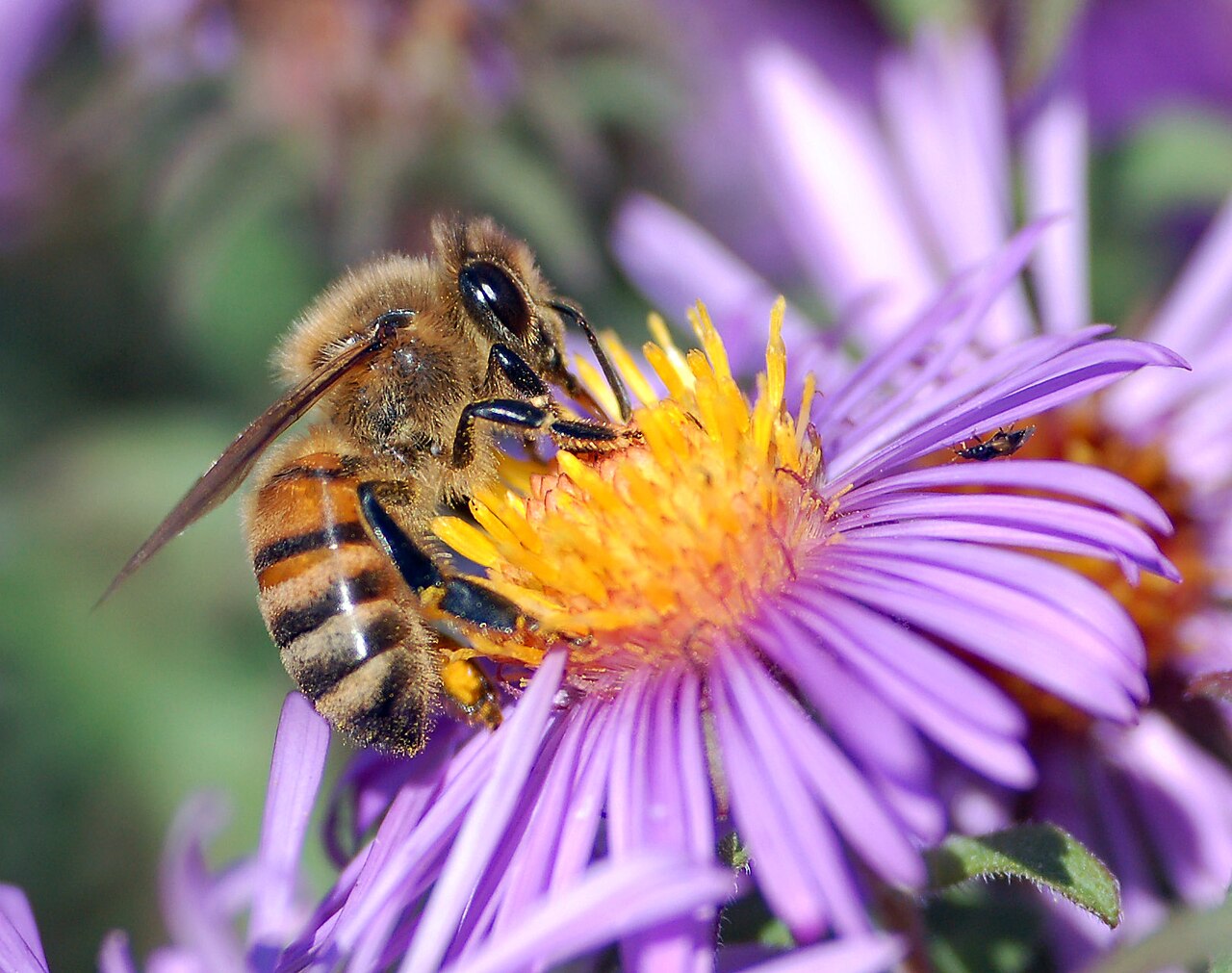
A sensory structure detects some kind of information from the surroundings. Adult insects have antennae that help them sense their environment. Eyes and other sensory structures provide further information, depending on the animal. We should not assume every animal detects the same signals or experiences them in the same way a person does.
Behaviour can be described as an action in a context: an animal approaches a flower, stays for a period, then leaves. “It loves this flower” adds an interpretation about an inner state. That interpretation needs more support than the movement alone. Careful description makes a claim more testable without dismissing the animal’s capacities.
Worked example: a colour pattern has a rival explanation
Imagine a fictional record of visits to two artificial flowers. In round one, blue is on the left and yellow on the right: blue receives 6 visits and yellow 4. In round two, their positions swap: blue on the right receives 3 visits and yellow on the left 7. These invented counts total 20 visits. Blue receives 9 overall and yellow 11.
The left position receives 6 + 7 = 13 visits, compared with 7 on the right. This pattern makes location an alternative explanation for the first round’s apparent blue preference. It does not prove a left-side preference either: the records do not say whether the visits came from different animals, whether rewards differed or whether the conditions changed. The data is too limited for that causal conclusion.
A better question names the uncertain feature
A proposed comparison would need to account for location, rewards, repeated visits and the animal’s opportunities to detect the relevant signals. We can identify those requirements on paper without setting up a real wildlife experiment. A useful revised claim is “the first round alone cannot separate colour from position”, rather than “the animal chose its favourite colour”.
The supplied photograph identifies a European Honey Bee on a flower. It shows visible structures and one moment of a flower visit. It does not show the complete route, what signals guided it or its thoughts. The flower-visit numbers above are not observations of that bee.
Keep enquiry separate from disturbance
Use the supplied image and invented dataset to practise observation, interpretation and alternative explanations. You can annotate a visible antenna or compare two written claims. No baiting, trapping, feeding, touching, handling or approaching a hive is needed. A question can remain unanswered when the available evidence is insufficient; there is no need to manufacture a result or a risky test.
Only if you feel like trying
Check the alternative explanation
- Draw a two-row table for the fictional rounds, including flower colour, position and visit count. Check the totals for each colour and each position.
- Write one narrow claim supported by the table and two explanations it cannot distinguish.
- Annotate the supplied photograph with one observation and one question. Keep any interpretation explicitly separate.
Optional image and fictional-data work only. Do not stage the flower test with live animals or approach bees, nests or swarms.
Look at the sources.
These references informed this introduction. You can check who published them, what evidence they use and whether you would ask another question.
- Field of Mars Environmental Education Centre, NSW Department of EducationInsects fact sheet
- Australian MuseumHoney Bee
Research checked 1 November 2026. External pages have their own content and privacy practices.
Where could this connect?
These are editorial links between subjects. You choose which, if any, to follow.
Knowledge & Evidence
A plausible interpretation becomes stronger when rival explanations and missing information are made explicit.
Follow this connection
Waves & Sound
Sound is one possible information carrier for animals that detect it, while the appropriate sensory range must be checked for the species.
Follow this connectionZoology
Zoology includes how animals obtain information and act; this topic focuses on what an observation can establish.
Follow this connection