
A little room to wonder
Water in Ecosystems
Water provides a habitat, carries materials and supports plant processes. A simple water account can clarify a change in availability without claiming that one water level describes an entire ecosystem.
What can a water budget explain about a fictional pond, and what remains unknown?
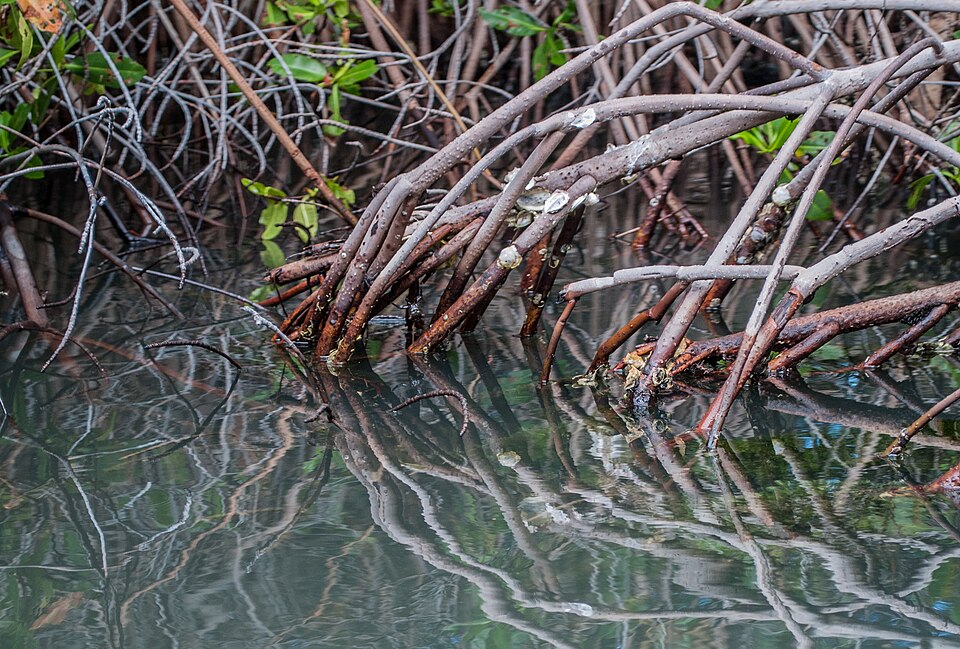
Water has more than one ecological role
Water can be a surrounding habitat, a resource taken up by plants and a way materials move between places. Wetlands include areas covered by water permanently or for part of the year. They may contain still or flowing water, and fresh, brackish or salty conditions.
Availability concerns timing as well as amount. A shallow pool present for a short interval offers different conditions from water that remains throughout a season. Different organisms use those conditions differently; more water is not automatically better for every habitat or species.
Worked example: balance an invented account
Two paper ponds each begin an interval with twenty model water units. Both receive eight units of rain and lose seven through an outlet. Pond A loses five through evaporation: 20 plus 8 minus 7 minus 5 leaves sixteen. Pond B loses nine through evaporation: 20 plus 8 minus 7 minus 9 leaves twelve.
The four-unit difference comes from the different evaporation entries in this stated model. These are invented bookkeeping units, not field measurements or watering advice. The calculation does not establish why evaporation differed, which organisms live there or whether either pond has suitable water quality.
A boundary keeps the explanation coherent
A water budget needs a chosen area and time interval. Water entering a pond is an input to that account, even though it may have left another part of the wider landscape. A missing route such as seepage can make a simple budget disagree with a real observation.
The water cycle includes stores and transfers rather than one identical circular journey for every drop. An ecological question may focus on a plant’s access to moisture, while a catchment question tracks movement across a larger area. The scale should match what you want to explain.
Keep habitat claims separate from arithmetic
Wetlands support varied plant and animal communities, but a remaining total of sixteen does not measure biodiversity. Habitat structure, water chemistry, timing and connections would require further evidence. A consistent model is useful because its assumptions can be inspected, not because it includes every real process.
You can revise the paper account by adding a clearly labelled invented input or loss. Keep the original values visible so another reader can follow the change. No water handling, testing, feeding or visit to a pond is needed to complete this enquiry.
Only if you feel like trying
Explain a paper water account
- Write the starting amount, rain, outlet and evaporation entries for both fictional ponds. Calculate the final totals.
- Change one entry by two units and recalculate. State which transfer changed and preserve the original account for comparison.
- List one habitat question the totals cannot answer and one additional variable a fuller model would need.
Optional fictional arithmetic and drawing. No visiting water, collecting samples, water-quality experiment or interaction with animals is required.
Look at the sources.
These references offer further reading on the ideas here. Check who published them, what they support and what you would ask next.
- Australian Government Department of Climate Change, Energy, the Environment and WaterAbout wetlands
- National Oceanic and Atmospheric AdministrationThe water cycle
Research checked 1 November 2026. External pages have their own content and privacy practices.
Where could this connect?
These are editorial links between subjects. You choose which, if any, to follow.
Ecology
Ecology includes the availability and movement of water as part of the conditions and connections that shape habitats.
Follow this connection
Models & Explanations
A water account explains selected relationships under explicit assumptions, rather than reproducing the whole ecosystem.
Follow this connectionWater Cycles & Catchments
A wider catchment connects water stores and transfers across a landscape.
Follow this connection