
Art · Explore
Three views of an invented object
What does each viewpoint reveal or leave hidden?
Compare three straight-on views of an invented block and distinguish a hidden face from a missing feature.
15–25 minutes, or two views for a first try. More time is optional.
Start here
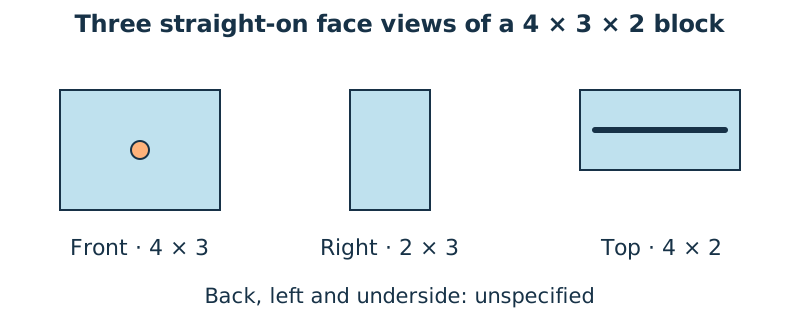
Use an invented block 4 units wide, 3 high and 2 deep. It has one dot on its front face and one stripe on its top face.
Use your idea or the example below. Talk, write, draw, point or listen first. You can stop after one step.
Try it your way.
Name the viewpoints
Treat front, right and top as separate straight-on views. Front shows width and height; right shows depth and height; top shows width and depth.
Draw the three faces
Sketch front 4 by 3 with a dot, right 2 by 3 blank, and top 4 by 2 with a stripe. These are labelled face views, so you do not need a perspective drawing.
Track the information
List where the dot and stripe appear. Not seeing the front dot in the right view does not prove that the block has no dot.
Leave unseen faces open
Write a question about the back, left or underside. The supplied model gives no design for them, so do not silently add an answer.
One possible version
Constructed object: front, right and top
The block is invented; its dimensions and face markings are supplied facts of the model.
- Front: 4 wide × 3 high, with a dot.
- Right: 2 deep × 3 high, with no marking supplied.
- Top: 4 wide × 2 deep, with a stripe; the other three faces remain unspecified.
A view selects information. These schematic views do not establish the appearance of an unshown face or reproduce the perspective of a photograph.
Something to keep?
When a feature disappeared from a view, did I mistake hidden for absent?
You can keep a question, a sketch or a change of mind. A finished product is optional.
This opens an editable starter in your project tools. It asks before replacing open work. Choosing it does not save or share your work automatically.