
Chemistry · Explore
Three particle pictures
How can symbols explain states of matter while showing a model's limits?
Use equal-count dot pictures to discuss arrangement and motion in three simple states-of-matter models.
10–20 minutes, or one model comparison for a first try. More time is optional.
Start here
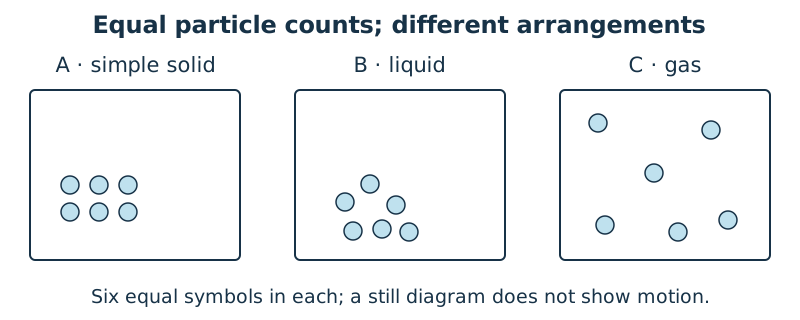
Each supplied box contains six identical particle symbols. Solid A keeps them close in a regular cluster; liquid B close but irregular; gas C spread through the box.
Use your idea or the example below. Talk, write, draw, point or listen first. You can stop after one step.
Try it your way.
Count before interpreting
Check that all three pictures contain six dots of the same size. The dots stand for particles; changing the drawing’s arrangement does not create extra particles.
Describe the arrangement
Compare regular and irregular close arrangements with widely separated positions. Describe what the dots show, rather than treating the empty paper as a different substance.
Add the motion the picture omits
In this simple description, solid particles vibrate around positions, liquid particles move past neighbours, and gas particles move around through the available space. A still drawing does not show that motion directly.
Label a model limit
Write ‘symbols, not a magnified photograph’. These pictures select arrangement and motion ideas, leaving detailed particle shape, forces and scale out.
One possible version
Original model: six symbols in every state
The three schematic pictures are constructed examples of a simple solid, liquid and gas description; no substance is handled.
- A: six close symbols in a regular arrangement; vibration is described, not shown as stillness.
- B: six close symbols arranged irregularly; neighbours can change.
- C: six symbols separated across a larger occupied region; the particles themselves have not grown.
Not all solids have a regular structure. Dot spacing is schematic and does not by itself supply measured density, temperature or speed.
Something to keep?
Did I mistake a still symbol for a particle that never moves?
You can keep a question, a sketch or a change of mind. A finished product is optional.
This opens an editable starter in your project tools. It asks before replacing open work. Choosing it does not save or share your work automatically.