
Film & Animation · Make
Plan a soundscape without recording
What would a sound cue add that a picture leaves open?
Write two sound plans for the same quiet fictional scene, with no recording.
10–20 minutes, or one small comparison for a first try. More time is optional.
Start here
Sketch a paper disc beside an empty tray and write the time marks 0, 2 and 4 seconds.
Use your idea or the example below. Talk, write, draw, point or listen first. You can stop after one step.
Try it your way.
Fix the picture
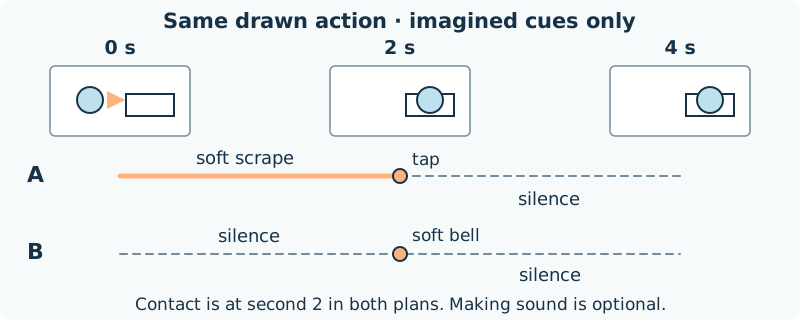
Imagine the disc sliding into the tray at second 2, then resting until second 4. The picture is the same for both sound plans.
Plan cue A
Write: soft scrape from 0 to 2; a quiet tap at 2; silence from 2 to 4. Label when each cue begins and ends.
Plan cue B
Try silence from 0 to 2, a soft bell at 2, then silence to 4. These are imagined cues; you need not make the sounds.
Explain your choice
Describe what a cue could suggest and what the image already shows. Keep possible effects open rather than claiming every viewer hears the same story.
One possible version
Original model: a disc meets a tray
The timings and cues are invented. No sound, recording or audience response has been collected.
- Picture: the disc enters the tray at second 2 in both versions.
- A uses a scrape during the movement and a tap at contact; B uses only an imagined bell at contact.
- The changed cue may make the event read differently, while the visible movement remains fixed.
A written sound plan cannot establish the loudness or effect of a finished soundtrack. Silence is a valid choice.
Something to keep?
Which meaning came from the picture, and which came from my sound choice?
You can keep a question, a sketch or a change of mind. A finished product is optional.
This opens an editable starter in your project tools. It asks before replacing open work. Choosing it does not save or share your work automatically.