
Games · Make
Design a cooperative paper puzzle
Which rule makes two fictional roles useful without requiring competition?
Build a shared-goal puzzle in which two fictional rule cards contribute different information.
10–20 minutes, or one small comparison for a first try. More time is optional.
Start here
Draw three tokens: circle, square and triangle, with three empty slots in a row.
Use your idea or the example below. Talk, write, draw, point or listen first. You can stop after one step.
Try it your way.
Set a shared goal
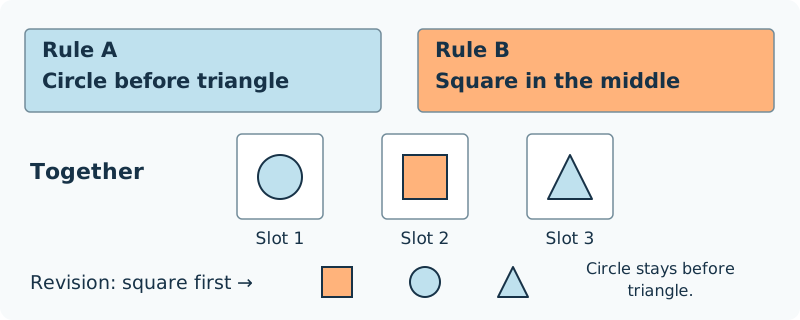
The aim is one arrangement satisfying both rules. Role A’s card says circle before triangle; Role B’s card says square in the middle.
Combine the clues
The square takes slot 2. The circle must be before the triangle, so place the circle in slot 1 and triangle in slot 3.
Choose how to play
You can read both role cards yourself, take turns with a mentor, or simply discuss the solution. No hidden information or partner is required.
Revise one rule
Change the second card to square first. Keep circle before triangle. Find the new order and explain which placement changed.
One possible version
Original model: two rules, one arrangement
These fictional roles organise a paper puzzle. No claims about social-skill improvement or participant responses are made.
- Rule A: circle before triangle. Rule B: square in the middle.
- Both together give circle, square, triangle. With square fixed in the middle, only that order has circle before triangle.
- Changing only B to square first gives square, circle, triangle.
A one-solution token puzzle does not establish how all cooperative games work. Information can be shared openly if that suits the learner.
Something to keep?
Which part of the solution depends on each rule?
You can keep a question, a sketch or a change of mind. A finished product is optional.
This opens an editable starter in your project tools. It asks before replacing open work. Choosing it does not save or share your work automatically.