
Languages · Investigate
Find a rule in invented words
What pattern can a small set of made-up words support?
Find a pattern in a tiny fictional label system and state how far the evidence goes.
10–20 minutes, or one small comparison for a first try. More time is optional.
Start here
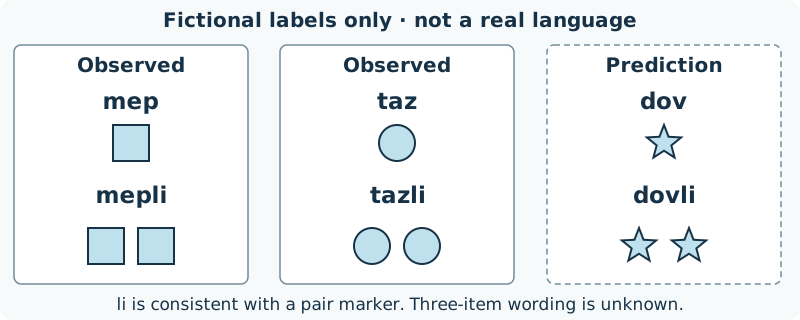
Read the supplied made-up pairs: mep labels one box; mepli labels two boxes. taz labels one circle; tazli labels two circles.
Use your idea or the example below. Talk, write, draw, point or listen first. You can stop after one step.
Try it your way.
Compare pairs
Underline the ending li in the two-item labels. These are invented puzzle labels, not words presented as a real language.
Propose a narrow rule
Try the hypothesis: adding li marks a pair of the named item in this toy system. Do not assume it means any number greater than one.
Make a prediction
A new card says dov labels one star. Predict dovli for two stars and mark it as a prediction, not another observed card.
Choose a test
A two-star label would check that prediction. A three-star card would help distinguish pair from a wider plural rule; its label is not supplied.
One possible version
Original model: a made-up pair marker
All labels and meanings in this small dataset were invented for the puzzle.
- mep → one box; mepli → two boxes. taz → one circle; tazli → two circles.
- The shared ending li is consistent with a pair marker in both observed examples.
- Given dov for one star, dovli is a prediction for two stars. The label for three stars remains unknown.
A small set can support a useful hypothesis without proving every future case. No claim is made about an actual language or culture.
Something to keep?
Which examples did I observe, and which result did I predict?
You can keep a question, a sketch or a change of mind. A finished product is optional.
This opens an editable starter in your project tools. It asks before replacing open work. Choosing it does not save or share your work automatically.