
Mathematics · Make
Show one fraction two ways
What must stay the same for two fraction pictures to be equivalent?
Shade equivalent fractions on equal-length strips and explain the difference between an equal proportion and an equal physical amount.
15–25 minutes, or one strip comparison for a first try. More time is optional.
Start here
Draw two equally long strips and label each whole as 12 cm. Divide strip A into four equal parts and strip B into eight equal parts.
Use your idea or the example below. Talk, write, draw, point or listen first. You can stop after one step.
Try it your way.
Choose one whole
Keep the whole lengths identical for this direct length comparison. The parts inside each strip must be equal to one another; quarters and eighths do not have the same part length.
Shade the same proportion
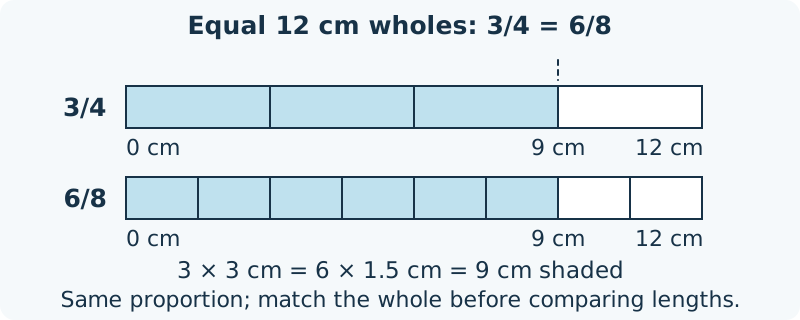
Shade three parts of A and six parts of B. A quarter of 12 cm is 3 cm, so three quarters cover 9 cm. An eighth is 1.5 cm, so six eighths also cover 9 cm.
Explain the equivalence
Write 3/4 = 6/8. Multiplying both numerator and denominator by 2 gives the same proportion. The numerator counts shaded parts; the denominator counts equal parts in one whole.
Check what the picture proves
Compare the shaded endpoints, or use the labels to explain their match. If a new whole were only 8 cm long, three quarters would cover 6 cm: still the fraction 3/4, but a different length.
One possible version
Original strip model: 3/4 and 6/8
The supplied strips are a constructed model. Both represent a whole length of 12 cm; they are not measurements from a real object.
- A: 12 ÷ 4 = 3 cm per quarter; 3 × 3 = 9 cm shaded.
- B: 12 ÷ 8 = 1.5 cm per eighth; 6 × 1.5 = 9 cm shaded.
- Both shade 9/12 of the same whole, which is 3/4 = 6/8.
Equivalent fractions name the same proportion even when used with different-sized wholes. Equal shaded lengths are evidence only when the whole lengths are comparable; unequal parts would make these particular fraction labels unreliable.
Something to keep?
Have I kept the proportion separate from the size of the whole?
You can keep a question, a sketch or a change of mind. A finished product is optional.
This opens an editable starter in your project tools. It asks before replacing open work. Choosing it does not save or share your work automatically.